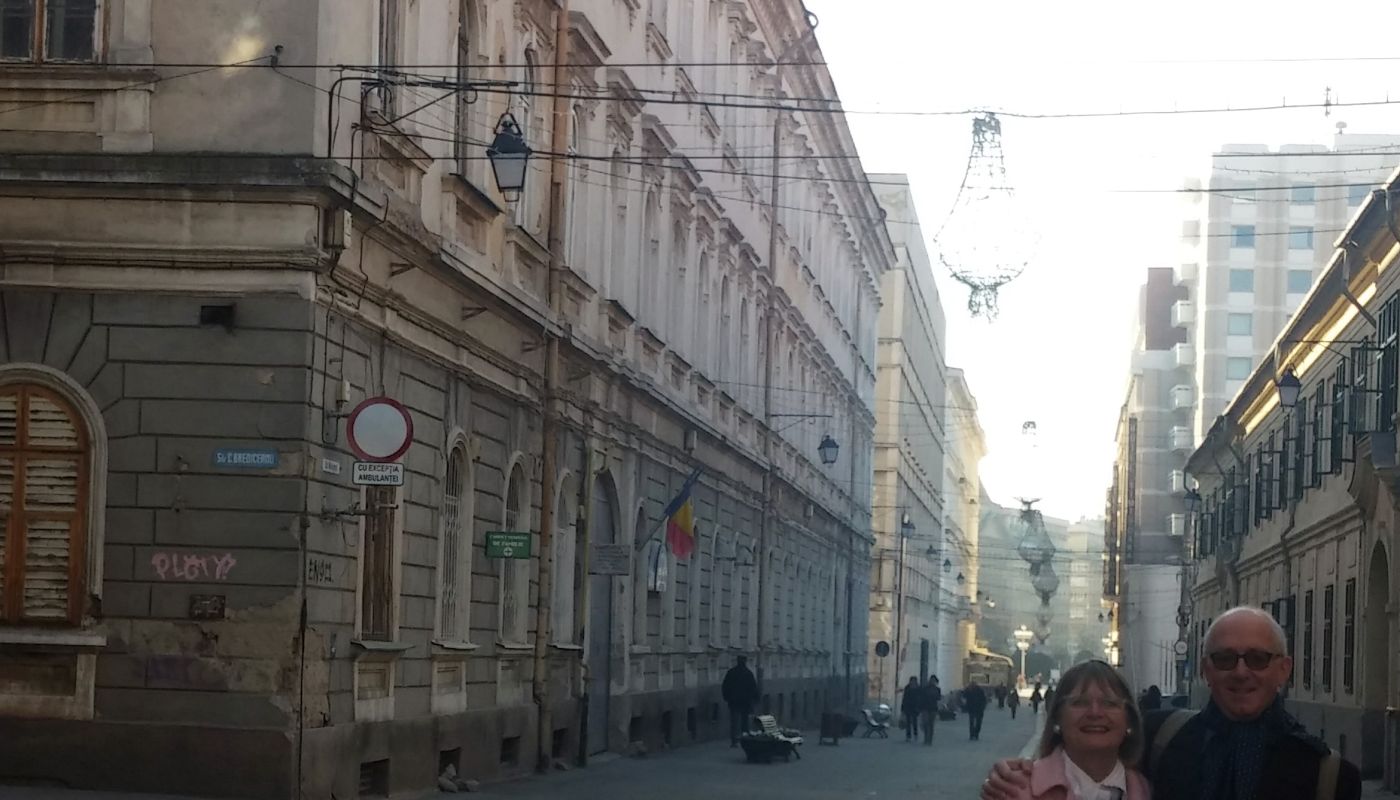
There were numerous reasons for accepting an invitation to speak at the first wine and food event to be held in Timișoara in the heart of western Romania (for details of the wines see Romania – land of hope).
Most importantly, the event was being held and, as we were to witness, most professionally managed by a group of mentally and physically disadvantaged young people, for far too long a neglected minority in the former Communist countries. (In the end, the various events raised over €8,000 for a new minibus).
Secondly, I had never been to this part of Europe before although my initial reading of Olivia Manning’s Balkan Trilogy many years ago left a very deep and strong impression on me.
And above all, there was a particular quest – to discover whether I could and would taste aubergines cooked as well as those I remember my mother cooking, based, as she was always the first to admit, on a recipe handed down from her Romanian mother, who had settled in Manchester in the early 20th century.
Inherently, the recipe is extremely simple. Take three aubergines of the same size and prick them all over. Set the oven to high and roast them until the aubergines are shrivelled, about 45 minutes. Allow them to cool; slice down the middle; scoop the innards into a blender and whizz them with one clove of crushed garlic, sea salt and olive oil until it reaches a gloopy consistency. Pour into a serving dish; top with a spot more olive oil; cover and put into the fridge for a few hours.
This recipe appears slightly differently in many forms across the Balkans and the Middle East but the three facts I have come to appreciate most about it over the decades I have been making it are these. Firstly, that it does not need any extraneous ingredients, such as yoghurt: the simpler, the better. Secondly, it always tastes best when it is made in advance, refrigerated and then brought back to room temperature. And, finally, that it is incredibly versatile. This recipe goes equally well with fish, red meat, chicken or even as part of a vegetarian ensemble. For me, making this dish has the added bonus of reminding me of my mother and grandmother.
I was to be reunited with this dish, albeit in a slightly paler form, after we had been picked up at the airport from our connecting flight via Munich, by the very tall and equally unassuming Zoltan Szoverdfi, who had created and masterminded the weekend.
After a 20-minute drive through the dark streets of the city, we arrived at around 10.15 pm at the sweetly named Hotel Vanilla, where a table was laid out to gladden the heart of any weary traveller.
The table was set for 10 and laden with dishes inspired by the local recipes that I had intimated I would like to eat on my first visit to Romania. There was zacuscã, a seemingly innocent combination of tomatoes, aubergine, peppers and onions, but one that takes 3-4 hours when made correctly. Next to that was my aubergine salad, known here as salatā de vinete, a composition of smoked aubergines and onions but lighter than my version because here the final ingredient is mayonnaise not olive oil – but still it was as good as I had been expecting.
Alongside these were plates of ostensibly less healthy food. Rācituri, pork and turkey meat set in aspic having been boiled for a couple of hours; slāninā, strips of delicious, creamy white, lard; jumāri, pork crackling; and pastā de jumeri, a crackling paste made with boiled eggs, mustard, salt and pepper and served on grilled bread; as well as plates of white, local cheeses: Telemea, a hard, salty cheese, and Caš, a fresh, unsalted and extremely appetising cheese.
I loved all of these dishes, full of flavour and extremely appetising but I enjoyed them while under two very different delusions. The first was why, I kept wondering, were most of the men round the table speaking with such a strong Portuguese accent while enthusing over the Portuguese wines they were pouring?
The answer to this question, I learnt, goes to the heart of the region round Timișoara, which has for many years been a centre of excellence for the training of engineers. This process began in the Communist era, continues today and manifests itself in various different forms: in the scores of small engineering companies located around the airport; as the inducement for numerous engineering companies from outside Romania to set up production in this region, such as the Italian company that originally set up its factory to produce espresso machines but has subsequently opened its own winery; and the fact that so many from here have emigrated to take up engineering posts abroad. Hence, the unmistakable Portuguese accent that these wine-loving Timișoarans have adopted during their 25 years working as engineers in Oporto but now, because of their love of food and wine, were back in their home town for this weekend.
The second delusion I was under was that all this food on display, enough for a small army, constituted the whole meal. I was dong very nicely and I would have happily snuck off to bed had we been staying at this hotel when all the plates were cleared and out came another wave of food. Šunca de casa, a ham cured with salt and herbs for a month or two and then smoked and an indispensible part of every Christmas table in Romania, was served alongside a slightly sweeter and simply boiled version. These came with several large plates of colourful organic vegetables: tomatoes, peppers, cucumber and green onions. Then a large plate of sarmale, a very traditional mixture of pork, rice and eggs with home-made pickled cabbage and delicious sour cream and finally, a dish of ciolan, large pork legs, cooked in the oven with white wine, garlic and herbs for 3-4 hours. Desserts were crèmes, vanilla custard and a crumbly pastry; clatite pufoase, fluffy crêpes with orange and lemon zest; and excellent chocolate truffles.
It was now close to midnight and the combination of all this food and a glass of Martha’s Reserve Tawny Port was having an obvious downward effect on our collective eyelids. This was spotted sensitively by our host, who, rather than wishing to consign us to the whims of a local taxi driver, asked his Romanian friend to get his car and take us to the Hotel Timișoara, where we were staying and the wine event was taking place (and is, incidentally, next to the opera house where Nicolae Ceaușescu made one of his final public appearances).
This short journey was to highlight the extremes that exist here, as in so many other countries, because the car that was waiting for us was an extremely new, plush Maserati coupé, whose interior smelt of extremely expensive leather. This was a car that would have turned heads even in London’s Bond Street.
This journey was to prove as memorable as our last in Romania, when, after tasting at the brand-new high-tech Italian-financed Petro Vaselo winery we drove through a village populated by ethnically Serbian Muslims whose surroundings did not seem to have changed for 60 years. Ducks and chickens wandered by the side of the dirt road and the elderly women walking along, dressed in black, waved back at us. To complete the picture, as we drove back on the main road to the airport, a dark, swarthy man was driving a horse and open cart.
This sense of extremes applies also to the Romanian wine world. One of the red wines that Jancis most enjoyed was a Cuvée Charlotte from SERVE (www.serve.ro), a wine I will leave her to describe with much more finesse. However, while I was waiting on the Sunday morning in the hotel lobby for her to return from a tasting (and she has never yet in 33 years returned on time from such an event), I met Dan Savulescu, the director of this winery.
Savulescu and his wife have been in the Romanian wine business for many a year and have consequently seen huge changes. At the major tasting Jancis moderated the day before, the fact that Romania had spent many years providing cheap Merlot, harvested at 16 tons per hectare that could be sold in Germany for €2 euros a bottle emerged as a fascinating fact and a historical obstacle to this country’s finally achieving a reputation for the increasingly high quality of its wines.
Savulescu smiled when I passed on our compliments about Cuvée Charlotte but then explained how his former winemaking career had been somewhat different. Then, with the emphasis on quantity rather than quality, his role had been to produce vast quantities of inexpensive wine that was then shipped in bulk to a port on the Black Sea. There it awaited a large vessel chartered by the Swedish wine monopoly which loaded this wine and then made its way round to Bulgaria, loaded up again and then traversed the Black Sea for its final consignment of inexpensive Turkish wine. After that, it was full steam ahead to the north.
Savulescu was now a far more satisfied winemaker and his explanation of why Cuvée Charlotte has its name was also interesting. Apparently, the winery belongs to a wealthy individual with two wineries, one in Romania, the other in Bulgaria, and two daughters, each of whom is now fortunate enough to have a cuvée named after them.
While the connections between the current state of winemaking in Romania and that of even its recent past are not obvious, despite their deep roots in the national psyche, the country’s menus still contain two obvious and unusual links with the past, however much the cooking, the quality of the ingredients and the friendliness of the service has improved over the past 20 years. These became apparent as soon as we looked at the menu in the Belvedere restaurant on the first floor of our hotel alongside Ghenadie Bobeica from Alira winery (related to Bessa Valley in Bulgaria and, more distantly, to Ch Canon La Gaffelière in St-Émilion).
The first is that Romanian menus have to be the longest in the world. There are vast amounts of dishes in each category, soups, salads, first courses, meat and fish courses and desserts. And here there were even 10 dishes on that week’s list of specials!
This seems to be an aspect of the restaurant experience Romanians are unprepared to do without, whatever they may experience elsewhere and however strong the appeal of ‘the shorter is the fresher is the better’ maxim. The only way that this will change, according to Radu Ianas, an engineer turned restaurateur and proprietor of Merlot, the most exciting restaurant in town, is with time. Although he did explain a sleight of hand he uses at his hugely popular Casa Bunicii restaurants to bring this about.
Casa Bunicii means ‘Grandmother’s house’ and this first venture of Ianas into the restaurant world proved very successful as he took his grandmother’s recipes and made them available to the Romanian public. The menu is large in format and contains a huge number of dishes. But, he explained to me, each time he sits down with his chefs to rewrite the menus, they adjust the layout to hide the fact that one dish at a time is being surreptitiously removed. Clever, these Romanian restaurateurs!
Perhaps they have to be extra astute because of the other constraint they operate under, one imposed by the government in this case. As well as the sheer voluminous nature of these menus, what also distinguishes them is that a serving weight per portion has to be listed. At the second branch of Casa Bunicii, for example, a dish described as ‘a traditional tray like at Granny’s’ with sausages, bacon, onions, cheese, radishes and scrambled eggs with bacon weighs in at 350 g and costs 17.99 leu (£3.20); Hungarian goulash, all 300 ml of it, is 22.99 leu (£4.06); and the precise quantities of ice cream and hot raspberry sauce that constitute a dessert called ‘Hot Love’ are officially prescribed, a fact that could diminish its romantic appeal (yours for just over £2).
But under the professional eye of Sebastian Antal, the enthusiastic F&B manager at the hotel, we had a very good meal overlooking the square with the hugely popular Timișoara Orthodox Church at the far end. I began, from an appetisingly large selection of soups, with a particularly good rendition of ‘beef sour soup’, a clear consommé full of strips of beef and vegetables, the last half of which provided succour to Jancis as she tasted through an impressive range of wines, and then we all chose what proved to be a really authentic rendition of papardelle with a wild rabbit ragu.
A long weekend in Timișoara, alongside a copy of Nick Thorpe’s highly evocative book The Danube, a journey upriver from the Black Sea to the Black Forest (now a Yale University Press paperback), left me keen to return to Romania.