Robin Hutson is a man of so many different parts that I wonder which profession he actually claims.
It is probably hotelier, after his success with the Hotel du Vin group, which he founded with the late Gerard Basset and sold successfully to the Malmaison group in October 2004. Ably supported by his wife Judy, he then went on to open The Pig, a growing group of currently five hotels, based principally in the southern English countryside but crucially never too far from bigger urban conurbations.
It could also be restaurateur as Hutson has brought not just a welcome sense of hospitality into all his hotels via their restaurants but also managed to price everything appropriately.
There are two other possibilities. He could be listed as a ‘blue jeans wearer’, the informal uniform in which he is invariably photographed, together of course with an open-necked shirt and a broad smile. Or, judging by the lovely bottle of Giaconda Chardonnay 2013 that he kindly left in our room, with a note saying that this was a bottle from his private cellar that he had been turned on to by Gerard, he could just as easily be described as a wine lover.
What links all these professions, and is responsible for Hutson’s success, has to be his nose, his awareness of the changing demands and appetites of his customers and his, and his wife’s, ability to satisfy these.
Hutson was a school dropout with three O levels but soon found his metier working as the concierge of the Berkeley Hotel in London’s Knightsbridge. There he learnt how to please demanding customers even if the formal dress code he had to wear – tails and a stiff white collar – was more uncomfortable than anything he or his staff have to wear today.
Hutson subsequently moved to Chewton Glen, the country house hotel then owned by Martin and Brigitta Skan, outside Southampton in Hampshire, where he learnt one important lesson and made one great friend.
The lesson he learnt was that what is inside every hotel, and its restaurant, must match what is on the outside. And in those days and until the end of the 20th century that meant smart food, white tablecloths and all that this combination entailed. And it was at Chewton Glen that Hutson met Basset, the full details of which I will leave for Basset’s excellent book Tasting Victory – the life and wines of the world’s favourite sommelier that will be published posthumously by Unbound later this year.
It was at Chewton Glen that Hutson’s nose first started twitching. He had already noticed that there was money outside London and that it increasingly belonged to a generation younger than those accustomed to spending it at Chewton Glen. And with wine seen as an increasingly attractive inducement, the number of Hotels du Vin grew quickly.
But once sold, and presumably with his non-competition clause out of the way, Hutson was soon back in the hotel business opening the first of The Pig hotels just outside Brockenhurst, the largest village in the New Forest, in 2011. When a Pig opens outside Canterbury in May, there will be six Pigs. Hutson has secured the financial backing of Jim Ratcliffe, the UK’s wealthiest man.
Over the years Hutson has also acquired another prerequisite for a successful hotelier, the ability to spot buildings that will become, or can be quite easily converted into, comfortable hotels. The website for The Pig at Brockenhurst reads, ‘Our hotel may not be perfect, but it is interesting, comfy and homely.’
To these attractions, the Hutsons have brought their experienced eye. After we had been shown round our room by the eager receptionist, Jancis was heard to pronounce, ‘they must have had a lot of fun putting this room together’. It was the unusual juxtaposition of the Victorian sampler; the SMEG fridge; the very comfortable bed; the enormous shower; the high chair; the half dozen fresh eggs; and the French windows that led out on to quite a large garden – not to mention the bottle of Giaconda. The overall effect was to make anyone feel extremely relaxed.
As did the main hotel, to which we repaired for dinner. The hall was filled with old pictures and paintings with a row of wellington boots lined up under the stairs, with a welcoming reception at the far end and a bar and lounges on either side. The dining room, all wooden tables and chairs, is in what looks, or is made to look, like a former glasshouse. The place was almost full at 7.30 pm with the diners, all considerably younger than us, seemingly having a very good time.
My eye was immediately taken by two small details. The first was the clever ribbon around everyone’s linen napkin, a small strip of paper cut from that morning’s breakfast menu. The second was the equally simple expedient used for dividing the tables of four into the tables for two that are always in such demand over the weekend: a small trough of plants which sensitively and decoratively cut our large table into a more manageable and comfortable size.
It was then time to focus on three much larger issues, the single pieces of paper that listed the red and white wines and that night’s menu. Each is enormous or, in the words of our friendly sommelier, ‘too bloody long’. And to our ageing eyes the small print that is required to list the approximately 50 wines on each side of the paper is too small. Not helped by the fact that there is little in the way of descriptions. But from the bottom of the New World white wine section we chose a bottle of Jeffrey Grosset’s delicious 2014 Polish Hill Riesling (£88).
James Golding is The Pig’s ‘chef director’ and the man whose team is charged with the delivery of a vast range of dishes. Under the overall heading of a 25 mile menu, the radius from which all of the dishes listed on the menu are sourced, with the exception of the beef that comes from Ireland, there are several categories: Piggy bits; garden bits; fishy bits; then starters or bigger; garden, greenhouse and polytunnel; forest and Solent; and finally, nine different versions of gardens and sides. That constitutes 42 different dishes and many more diverse ingredients.
All this, on a night when the kitchen managed to serve just over 130 customers (there are 30 bedrooms so over half were non-residents) probably explained the lack of finesse in the cooking. My leek and potato soup was fine; the comforting short rib with garlic mash was not terribly exciting; while the pastry on my custard tart was a little tired, and the Yorkshire rhubarb served alongside was on the tart side.
But we were almost certainly the only customers who noticed. Everybody else was having too good a time.
Why the name The Pig? I asked Robin Hutson…
Here is his response.
'Well, it’s not a one-line answer!
'As you know, I have spent a long time in provincial hotels and primarily I wanted to relax the guest experience a bit. When I first saw the house that is now The Pig in 2011, I was not interested in it until I saw the kitchen garden. It then had just a few weeds growing in it but I started thinking about bringing the home-grown elements to the fore and in doing so giving the hotel its USP and the clues to its style.
'At that time many country house hotels sounded too grand and rather off putting ... ‘something manor, lawn or castle’, many of them went bust between 1990 and 2005 because metropolitan punters were starting to look for a different experience, they were enjoying high quality casual dining in London. Yet they were scared to drive up the drive of the traditional country house properties, as they imagined the experience would be expensive, formal, snooty…
'So the name of The Pig is supposed to represent a more approachable hostelry with agricultural, home-grown attributes. If it sounds like a pub, then great – and we keep pigs at all the hotels. People aren’t scared to go into pubs.
'It is also all about the kitchen garden and local suppliers, as the back of the menu proposes, that dictate the daily-changing menu.
'We take the kitchen gardening very seriously. Our oldest son Ollie runs that side of the business. He has a team of 20-odd kitchen gardeners spread over the different sites and we have our own polytunnel nursery where all the seedlings are produced too.
'It isn't perfect! But it's comfy, interesting and homely.'
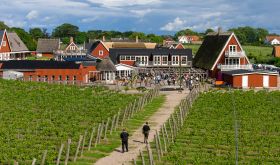
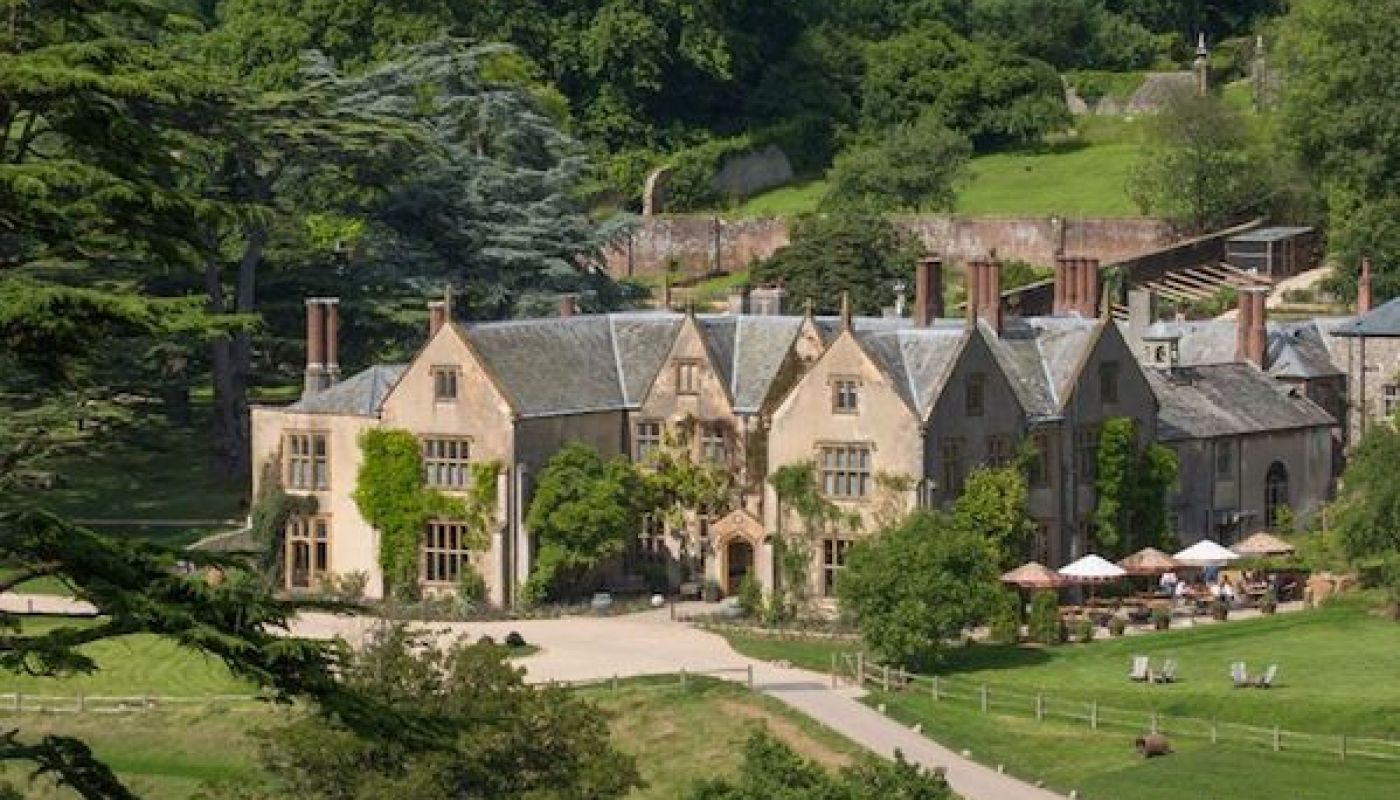
The Pig hotels and restaurants are in Brockenhurst in the New Forest; Southampton in Hampshire; near Bath in Somerset; Studland in Dorset: Combe in Devon (pictured) and Canterbury in Kent.