It is maybe presumptuous to try to talk about Quebec as a ‘place’, when most of Europe fits into our province. It is vast, mostly uninhabited, and the common fantasy is that we all go from one place to another riding a dog sleigh and wearing a fur coat with a plaid shirt underneath. Even in July.
Détrompez-vous. We manage like everybody else to go through four seasons, if only with a little bit more intensity. I believe it is right to say that experiencing spring after five harsh winter months will make people go euphoric (read insane), as they hit outdoor patios like they intend to move onto them permanently when the weather first cracks over 10 °C.
The exquisitely fed up mood that generally goes from the last slush/snowstorm to the first time you wear sneakers with excitement, only to find out that it is shitting straight from the sky again when you leave work, is at its peak in April. Done with eating the comforting stews you were so excited about in October, done with the winter boots you looked cute in for two weeks before they got destroyed by calcium, exit the goddamn winter vegetables – anyway celeriac and sunchokes [Jerusalem artichokes]. It all tastes the same; it’s mushy, sweet white flesh; and not even your favourite chef (Marc-Alexandre Mercier, Le Réservoir) can make them sexy anymore.
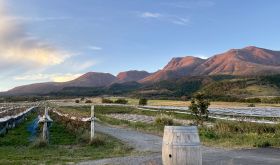
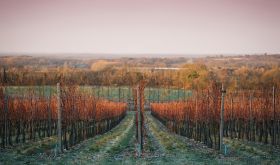
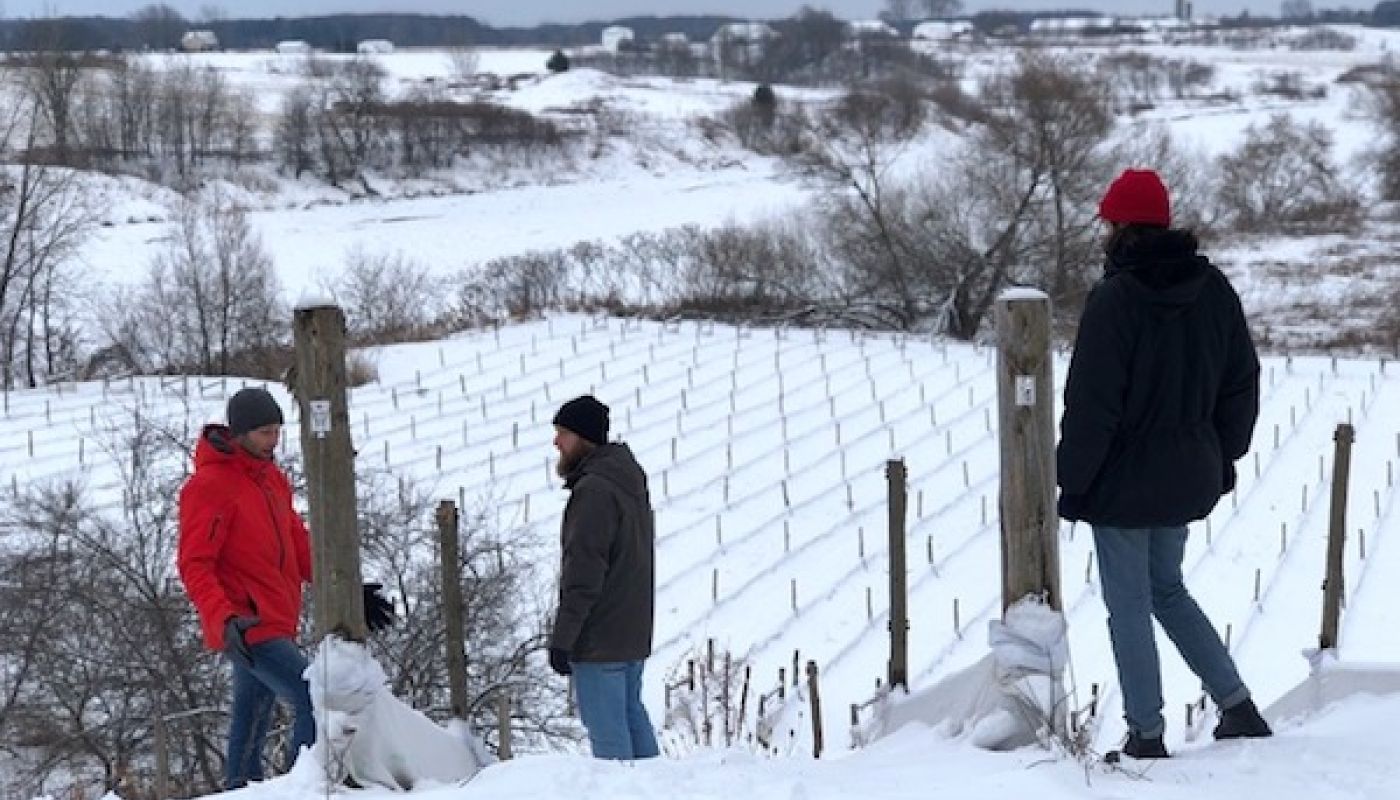
But it is truly a wonder to watch nature burst out of dormancy as spring waltzes in. As Matthieu Beauchemin of Domaine du Nival (its Albarino vineyard is pictured top right in winter) puts it: ‘Every year we think we lost a high percentage of our production to frost, only to find out in the spring that the damage is less than we thought. Everything is lighter in the spring months, most importantly our spirit.’ To ensure quality wine production in a place like Quebec, we had to be creative. Let me explain.
We have a total of about 125 vine growers scattered around the province of Quebec with a vast majority of them concentrated within a one- to two-hour drive radius around the city of Montreal. They’re mainly located above the 48th parallel, making Quebec a marginal climate for vine growing. The marginality lies in the previously described winter months, where the temperature can get as low as -40 °C, which is below what a vine can endure. Simply put, a few solutions are at the disposal of whoever is still brave enough to want to set up a winery anyway.
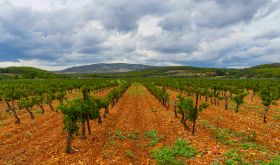
First, make a clear planting decision. Some wineries will dedicate their production to the man-bred hybrid grape varieties that are more weather-resistant and supposedly* more disease resistant as well (*many growers argue this fact). Other vintners have planted only vinifera grapes but most of the wineries I’ll mention have a healthy mix of both, therefore encouraging diversity in production and wine styles and paving the way for economic security as well.
Second, get proper winter gear. Now adopted widely by many winemakers is the famous technique of covering vines for winter under a geotextile tarp. This is done in order to protect them from the frosty wave that may damage the primary buds, which could result in severely lowering the yields and quality of the upcoming harvest. The major challenge of winter protection is that the vines have to be pruned partially or fully before hanging the tarps over the first wire of the trellis system. The last day of harvest is therefore the first day of pruning and the window is short before the first snowfall – especially with the accumulated fatigue from a fast-paced growing season and a few weeks of harvest under the belt. This practice of covering is costly but effective, and has significantly improved the quality of vinifera-based wines as well as encouraged a new generation of growers to join the party: Zaché Hall at an enterprise yet to be named; Hugo Grenon, ditto; Justine Therrien et Julien Niquet of Maison Viticole Joyhill. Some people such as Mike Marhler and Véronique Hupin at Vignoble les Pervenches add straw under the tarps to protect the vines further. Others with only hybrids, such as Carole Desroches and Mario Plante of Négondos, don’t cover at all but proceed with buttage, consisting of banking up the vines with soil to protect them
Now you know: we do have a summer, and thus it is possible to grow quality grapes. We have a shorter growing season, high risk of spring frosts and a late budding date, that’s true. But if you step back from the dramatic frame and look at it from a different standpoint, Quebec has sunshine hours and degree/days comparable to many European regions including Chablis, Bordeaux and the Loire.
I’d like to add my two cents to the sensitive hybrid/vinifera debate, and face a possible public crucifixion: plenty of winemakers have now proven that is possible to make thrilling wines with hybrids. Not only on the East Coast but in various parts of the world. If one makes insipid and banal wines, it is not because of the grape’s deficiency, nor the difficult climate, nor any other excuse. The hand who made the wine is accountable more often than not. As Yvan Quirion of Domaine St-Jacques says, ‘Long gone is the time where you could blame the climate for making terrible wines. Nowadays, if you make bad wine, it is your own fault.’
If you’ve made it this far, I have probably scared you enough to make you want to cancel even the idea of travelling to Quebec – let’s call it reverse tourism guidance – so let me explain why all this effort pays off in the glass. Talking about Quebec wine as a place is not precision talk – yet. It’s a feeling. Last year, the first attempt at classifying and explaining our wine regions was taken here. The first very broad and general IGP (Vin du Québec) appellation was also adopted. We still can’t make reliable conclusions about production, styles, maturity, vigour or expectations. None of the winemakers referred to in this text can be fitted into a box and, as a box hater myself, I reckon this as a force. The power of freedom. The freedom to grow good healthy grapes, make wines that stand out in a crowd, and freedom to sell them to our thirsty market at home that is finally waking up to the deliciousness of the local wine offer.
Fly, drive, or walk to Montreal, and start your journey there. I cannot hand you a bullet point list of wine shops because we don’t have any. Our market is driven by a monopoly (SAQ) whose shops are filled with a lot of bad wine and a little bit of good wine. But with its multiple restaurants and bars carrying exciting wine lists at competitive prices, you’ll feel as though the city of Montreal is having a clearance sale just for you. Look for the new players in the cider game (Polisson, Choinière, Chemin des Sept) who are giving a new name to a beverage long overlooked. Scrape around and see if you can find one of the 200 bottles of Lieux Communs, the new undercover négoce project of four enthusiastic gentlemen. Or scout some older vintages of Le Couchant, Les Pervenches’ bottling of the oldest Chardonnay vines in Quebec. Sit for a four-hour meal at l’Express and buy each one of the cuvées of Pinard & Filles on the list.
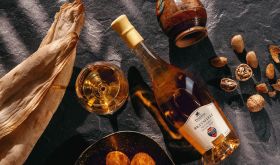
I’m talking to you, the adventurous drinker, the one who will pack a tent and go camping alongside the St-Laurent River all the way down to Kamouraska where you’ll find Samuel Lavoie’s unusual planting at Ferme Le Raku, where Siegerrebe, Rolland, Muscat and Chardonnay are tucked between the river and the mountains, making excellent still and bubbly wines. Go full touristy and make a pit stop in the Eastern Townships to have a conversation with Ève and Marc of Domaine de Bergeville about how hybrids are perfectly suited for their nervy and complex traditional-method sparkling wines. Travel to Domaine du Nival and ask Matthieu about how, from nursing a mere handful of Gamaret vines, he has supplied many producers who are planting the promising Swiss vinifera crossing, yielding a dark-coloured, spicy, elegantly tannic wine to enjoy. Drive up north and pay an educational visit to Géraud Bonnet of Ferme Apicole Desrochers, one of the masterminds of honey wine. And the list goes on.
Plan your trip right, which in my opinion involves most importantly figuring out what you want to drink for apéro. Walk in a place, sit at the bar, talk to us, because our city is filled with knowledgeable, cheery beverage people. Come with an open heart. Expect uplifting, vigorous wines (and cider! and mead!), sketching the cool climate from vine to glass with refreshing electric lines of acidity, angular bodies and an indisputable pleasure factor. And don’t forget to eat to soak it all up – but that’s easy. You’re in Montreal. Eating out is our favourite sport.
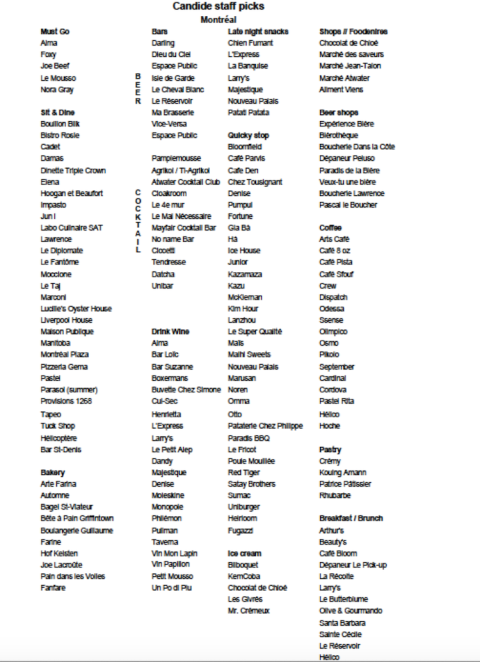
Below is a (slightly blurred) list of places in Montreal recommended by the staff at Restaurant Candide.