
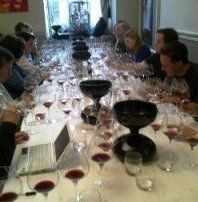
What a lot of fun I had at the end of the week before last. Much of Thursday afternoon was spent tasting 2009 Clos de Vougeots from 57 different producers blind, while Friday morning was devoted to another blind tasting of the same grape, Pinot Noir, aimed at gauging how well German Pinot, or Spätburgunder, stands up to competition from elsewhere (see picture and my full tasting notes in German Pinot Noir does itself a favour).
On balance, I think the average quality of what I tasted on Friday was a little higher than the average quality of the Clos de Vougeots, red burgundies from a famous, walled grand cru vineyard. And since my two favourite wines of the Friday tasting were German, does this mean that German Pinot Noir is better than red burgundy? Much as Wines of Germany, who organised Friday's trial by Pinot, would like it to be so, I would not go quite that far. Clos de Vougeot is a notoriously underperforming grand cru.
What we were tasting on Friday was a carefully hand-picked selection of the finest Pinot Noir that Germany can muster. The London taste-off had been suggested by Hamish Anderson, who buys wine for the Tate galleries' restaurants, when he toured German vineyards earlier this year with wine writer Tim Atkin MW (see this video). Inspired by the quality of the Spätburgunder they were presented with, and the fact that, partly thanks to its warmer climate, Germany now has more Pinot planted than anywhere other than France or California, together with frustration at how rarely German Pinot Noir is seen outside Germany, he suggested a blind comparison in London of top German Pinot with its peers from elsewhere.
The generic body Wines of Germany saw the potential in this exercise and took the choosing of German candidates very seriously. German vintners were invited to submit their wines for a pre-selection process in the Rheingau in September which saw Atkin, Anderson and several high-profile German tasters whittle nearly 400 German Pinots down to 20 for the tasting at Texture restaurant in London. Remarkably, three of the wines in this final 20 were from a single vintner in the southern Baden region, Hanspeter Ziereisen, a red wine specialist who also manages to make a very creditable German Syrah too. Two of them were made by Jean Stodden, one of the most serious stars in the Ahr Valley, another German Spätburgunder hot spot thanks to the heat radiated off its steep slate slopes.
The final German selection was anything other than conventional, with some wines being classified as mere table wines, the lowest of the European low, and even Steffen Schindler of Wines of Germany admitted that he was surprised by some of the names on the final list, which included one wine from the Oberrotweil co-op in Baden – though alas none from new cult producers Enderle & Moll, whom I suggested too late. The Rheinhessen region, not famous for its Spätburgunder, did surprisingly well.
Tim and Hamish were charged with mustering the non-German wines for the tasting, which were assembled, perforce, rather more arbitrarily. They decided that there should be three each from Burgundy, California, Oregon, Australia and New Zealand, and one from each of Switzerland, Austria, Chile, Argentina and South Africa. I think I would have dropped the last two southern hemisphere candidates in favour of two more burgundies since the hugely varied Côte d'Or heartland of Burgundy grows about half as much Pinot again as each of Oregon, Australia and New Zealand – even if only half as much as post-Sideways California.
With regions other than Burgundy, Tim and Hamish invited those they considered to be the leading producers in each to supply the most suitable wine for our taste-off from the 2008 and 2009 vintages, those chosen from Germany. Understandably, the Burgundian top-dog likes of Rousseau and DRC were unlikely to donate their finest (and very, very much more expensive) wines to compete in this foreign bear pit. So, instead, wines from Dujac, Fourrier and Hudelot-Noëllat were acquired from their UK importers, two premiers crus and one village Gevrey – hardly on a qualitative par within their own hierarchy with the other wines in the tasting, though generally on a par in terms of price. Importers counselled 2007 as the most suitable burgundy vintage to taste now, though I for one would have been interested to see how 2009 burgundies would have fared.
In the event, I tried not to get too distracted by trying to work out where each wine came from; we had only 15 minutes to assess each of the five initial flights of eight and a little bit longer for our re-tasting of the top 13 scorers. I did end up liking the burgundies, and most of the Americans, disliking a few of the non-European contenders, but I loved some of the Germans – and described not a few of them as 'burgundian', my highest form of praise when it comes to Pinot Noir. (I can enjoy a vibrantly fruity Pinot Noir on its own terms but have never found one with the subtlety and ageing potential of a great burgundy.)
After the London tasting I was left in no doubt that Germany is now making some truly fine Pinot Noir that can be compared with some of the best middle-ranking red burgundy. Now please may I volunteer for a blind comparison of Germany's finest with Burgundy's finest?
The 2009 Clos de Vougeot tasting was not Burgundy's finest, but a repeat of the one that London fine-wine brokers Fine & Rare Wines had organised in 2010 of 56 Clos de Vougeot 2008s. I think overall the successful 2008s had been a tad more toothsome than the better 2009s. The 2009 vintage in Burgundy was unusually ripe – so ripe that the 2009s on that Thursday tended to taste more like ripe 2009 Pinots than of intricately nuanced Clos de Vougeots. There were few horrors in the line-up and generally the wines were full of sweet fruit but were, contrary to the fears of the UK burgundy importers about showing 2009s at this early stage, surprisingly forward and unambitious. There were very few wines that showed the density and obvious ageing potential of a serious grand cru red burgundy.
When I finally compared my scores with the crib sheet afterwards I was forced to one conclusion: it certainly helps if you're called Gros.
My top seven wines from each of the tastings are listed below, the German wines in the first list are highlighted in bold.
GERMANY V THE REST
1 Rudolf Fürst, Bürgstadter Centgräfenberg Spätburgunder Grosses Gewächs 2009 Franken, Germany
2 Gutzler, Westhofener Morstein Spätburgunder Grosses Gewächs 2008 Rheinhessen, Germany
3 Au Bon Climat, Isabelle Pinot Noir 2008 Santa Maria Valley, California
4 Hudelot Noëllat, Charmes Premier Cru 2007 Chambolle-Musigny, Burgundy
5 Dom Dujac, Premier Cru 2007 Morey-St-Denis, Burgundy
6 Jean Stodden, Alte Reben Spätburgunder 2009 Ahr, Germany
7 Eyrie Pinot Noir 2008 Dundee Hills, Oregon
CLOS DE VOUGEOT 2009s
1 Gros Frère et Soeur
2 Anne Gros
3 François Lamarche
4 Confuron-Cotetidot
5 Guillemard-Clerc
6 Armelle et Bernard Rion
7 Michel Gros













