When I started writing about wine 35 years ago, the people I came across in the British wine trade were generally in awe of a dry white wine made just south of Angers in the Loire valley, Savennières. It was rare, which helped, and it was supposed to demonstrate the Chenin Blanc grape at its best, and be capable of living to a great age. The small delimited area also contained two very special vineyards, La Roche aux Moines and Coulée de Serrant, widely regarded as producing the apogee of this appellation, of which a grand total of just 50 hectares, or 225 acres were planted in total then.
I didn't get it. Too many of the wines seemed to me awfully austere, without much evident fruit, and too often uncomfortably high in sulphur.
The next chapter in the modern history of Savennières was opened – or closed? – by Nicolas Joly, who a couple of years after I first encountered Savennières went from J P Morgan in New York and then London to take over the family holdings in Savennières. The jewel of these famous vineyards, first planted by Cistercian monks in the 12th century, is sole ownership of the Coulée de Serrant (or 'Casting of Tightening' if you happen to read the English version of their website), a magnificent steep slope of Chenin Blanc vines that is clearly destined to be one of the world's great vineyards.
Joly began to read about the biodynamic farming methods advocated by Rudolf Steiner and his followers and by the mid 1980s had converted his entire estate to these lunar-directed methods, chiefly because of his concern about the state of the soil and his plants. He has since been followed along the path of buried cow's horns and dynamised nettle tinctures by hundreds if not thousands of wine producers around the world, many of them extremely eminent, but Joly forfeited some of the respect that should have been his due by what one might tactfully call an inconsistent winemaking record. It seemed as though he was too busy proselytising biodynamics around the world to be aware of what was going on in his cellar – yet his wines were, and are, far more expensive than those of his neighbours. This, alas, did little to enhance the reputation of Savennières.
Fortunately, from around 2006 the wines have been made by Nicolas Joly's daughter Virginie, a trained oenologist who has been turning out some stunning wines from the family estate. But this is not the only recent change to this potentially thrilling appellation.
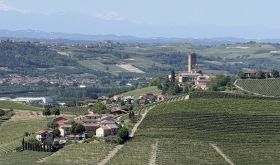
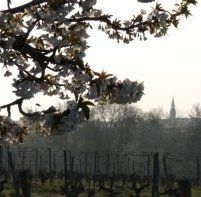
For a start, there has been a dramatic increase in the total area of vineyard. According to my fellow Master of Wine Richard Kelley's excellent site about Loire wines, www.richardkelley.co.uk, there were already more than 140 hectares in production by 2004 and there have been considerable new plantings since then. In 2002 there were just 14 producers, but since then there has been a determined invasion from the Coteaux du Layon on the south bank of the Loire – quite understandable in view of the higher prices commanded by Savennières – so that today there are 36 producers in total, with the majority based outside the appellation itself. (The image above comes from the website of Domaine de la Bergerie, the Coteaux du Layon estate with the restaurant about which Nick writes today in Eating out in the Loire valley, and producer of fine Savennières.)
And the really exciting thing for curious wine drinkers, if not so much for traditionalists perhaps, is that there are now so many styles of Savennières – although all of them show the Chenin minerality and ageability of which this small corner of the Angevine countryside, with surely the bendiest roads in the world, seems uniquely capable. Perhaps inevitably, the oak barrel has invaded the area so that some wines such as Damien Laureau's Roche aux Moines 2008 are very obviously oak aged, yet are extremely delicious and have all the nerve and sinew that characterises a good Savennières.
Oak is by no means the norm for Savennières winemakers however, and other modern variables include whether or not the wines have undergone the second softening malolactic fermentation. Those wines which have tend to be a little friendlier in youth than the ramrod straight ones that are still high in malic acid. As throughout the Loire valley, vineyards are tended with very much more care than they were a few decades ago, so that the grapes are much healthier and very much less sulphur is needed. Sustainable viticulture is the norm with many producers experimenting with organic and biodynamic practices. Yields tend to be lower than they were, so grapes are riper, and wines more alcoholic. Many of those I tasted in the region last month were over 14% alcohol (and Joly's Coulée de Serrant 2008 was 15%) whereas the few examples I tried from even as recently as the 1990s were closer to 12%.
Then there is the question of sweetness. About 95% of Savennières is dry (Sec), or at least under 7g/l residual sugar, but recent warm summers have yielded an increasing number of sweet (Moelleux) wines which are labelled as such. If a Savennières carries no suggestion of sugar level on the label then it will be Sec, but some producers give their dry wines with between 4 and 7 g/l residual sugar the rather charming label description Sec Tendre.
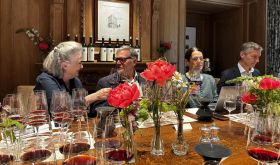
The current head of the growers association, Evelyne de Pontbriand, managed to assemble wines from a dozen of the most prominent producers for me to taste at her family's Domaine du Closel in the pretty village of Savennières. I worked my way through bottles on silver salvers in her handsome panelled dining room while she entertained a party of Korean Americans. Notable omissions from what I tasted included the wines of the dynamic newcomer Eric Morgat, the historic Domaine d'Epiré and the new Domaine F L advised by Bordelais consultant Stéphane Derenoncourt and priced so as to trump even Joly's wines. But my favourite wines from what I did taste are listed here.
Savennières may no longer be the only dry Loire Chenin of note, especially since not only is Jasnières also experiencing a renaissance, but so many producers in the great traditional sweet Chenin Blanc appellations of the Loire such as Montlouis and Vouvray are now making ambitiously styled dry wines too. But they don't have Savennières' schists and other hugely varied soils and terroirs that can result in dry wines with the strictest nerve and the potential to slowly build in bottle to a haunting cocktail of hedgerow and brimfire.
Dry Savennières to savour
Nicolas Joly, Coulée de Serrant 2008
Dom du Closel, Clos du Papillon 2007 and 2005
Damien Laureau, Roche aux Moines 2008
Patrick Baudoin 2008
Dom des Baumard 2006
Dom de la Bergerie, La Croix Picot 2007
Dom du Closel, La Jalousie 2009
See my detailed tasting notes on 36 Savennières and see www.winesearcher.com for stockists. For comments about Savennières on our members' forum, see here.