2018 from €16.90, 3,340 Japanese yen, £20.90
2017 from €17.50, 20.90 Swiss francs, $24.94, 245 Norwegian kroner, 2,142 roubles
South-eastern Austria may not immediately spring to mind when you think of Sauvignon Blanc. You are more likely to think of the upstart but meteoric New Zealand (first plantings in the 1970s) or the old hand the Loire, which is probably the home of the variety and where it has been recorded since at least the late 18th century.
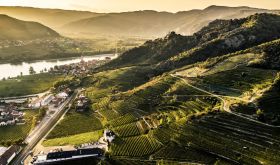
However, Sauvignon was introduced to Austria in the 19th century under the misleading name Muskat-Sylvaner, even though it is not related to either of these varieties. This name was seen on bottles until the mid 1980s. It is now the most important white variety in the Südsteiermark, close to the border with Slovenia, as shown on the World Atlas of Wine map of Austria’s wine regions. About one-fifth of southern Styria’s 2,563 ha (6,333 acres) is planted with Sauvignon Blanc. At the heart of region is the town of Gamlitz, the home of the Sattler family and their winery, hotel and restaurant Sattlerhof.

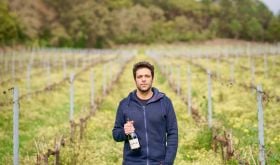
The family has been making wine in Gamlitz, just 10 km (6 miles) from the border, since 1887, but, as Alex Sattler explains, he and his brother Andi are only the third generation of ‘serious winemakers’. They took over the winemaking from their father Willi in 2016. It’s their uncle who runs the hospitality side of things. Hof means ‘farm’ in German, hence Sattlerhof.
‘Our winery used to be a mixed farm with wine until my grandfather took over. He came to the region with a vision, and as a pioneer he was the first to develop the style of dry Sauvignon Blancs that the region is known for today. Back at that time (in the 1960s) the region was more into semi-dry, sugared, easy-drinking wines. He was the first one not to use acidification or chaptalization and would ferment through his wines to be bone-dry. (Early vintages were extreme wines and had 10% alcohol and 10 g/l acidity.)’

They currently have 35 ha (86 acres) of vines, all cultivated organically and biodynamically. From vintage 2021 their wines will be certified biodynamic by respekt-BIODYN, a ‘group of friends’ headquartered in Vienna though its members are working in the German-speaking wine regions of Germany, Austria and Alto Adige in northern Italy. They are also a member of the marketing/distribution group Austrian Wine Estates and the STK, a small but influential private association of 10 wineries set up to classify and promote Styria’s best wines and vineyards, as shown in the key to the map above. (See Shining a light on Austria's vineyard characteristics for the bigger picture on classification.) The Sattlers are nothing if not proactive and collegial.
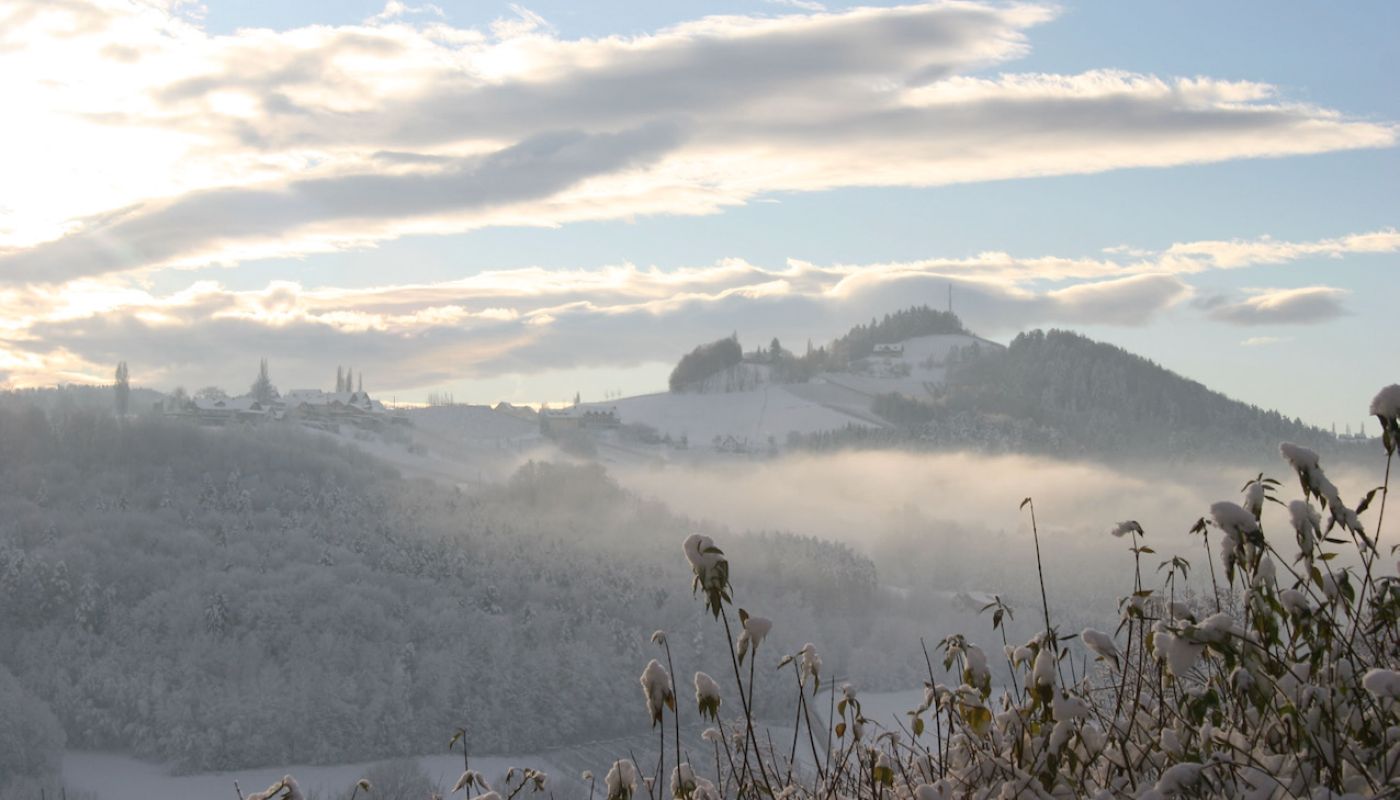
Working within the constraints of organic farming is not easy in a region like southern Styria, the coldest wine region in the country where average annual rainfall is about 1,200 mm (more than 47 in) and where it can be chilly and damp on the steep hillsides that characterise the best vineyards of the region, as this photo shows. The snow seen in the photo at the top of the article visits these vineyards roughly seven years in ten.

It was in the context of a recent webinar to announce respekt-BIODYN’s two newest recruits, Weingut Leiner in the Pfalz and Sattlerhof, that I first tasted the 2018 vintage of this wine. Since the 2017 is still the current vintage on some markets, including the US, Alex Sattler kindly sent me a sample. He’s actually quite pleased that the 2017 is still available not just because he likes the vintage but also because their wines gain greater depth and complexity in the bottle, unlike many Sauvignon Blancs that focus on the fruit.
In Styria, ‘village’ wines are usually put on the market at the start of May after the harvest but the Sattlers believe that their soils – in this instance, limestone and quartz – climate and hilly vineyards are conducive to making wines that are as much about the texture as the fruit flavour, and this style of wine benefits from being bottled later after longer on the lees.
This is why Sattlerhof release their Gamlitz Sauvignon Blanc, the village-level wine, later than they did in the past, in a ‘post-juvenile’ phase. On the Austrian and German markets, where retailers and consumers are impatient for the new vintage, they release two vintages of the village wine at the same time: the very young vintage (around six months on the fine lees), and then a later bottling of the previous vintage, which will have spent 18 months on the fine lees. This is indicated on the back label by the word Spätfullung, ie late bottling, as shown in the image below. The early-release wine will be phased out in due course. Since the early-release wines are not exported, they do not need to put Spätfullung on the labels. If you buy the Gamlitz in the UK or the US, for example, it will be the late-release wine.

Having tasting the fresh but not very expressive early-release 2018 in London early in 2019 (ie with only six months on the lees before bottling) and then the later-bottled version last week, I can wholeheartedly recommend their approach. A 2007 single-vineyard Pfarrweingarten Weissburgunder that had spent seven years on the lees in big barrels was a remarkable testament to potential Styrian longevity.
Even the earlier-bottled wines such as the 2019 currently available in Austria are likely to improve with a bit more time in bottle before you pop the glass closure. They use the elegant and TCA-free glass Vinolok closures but beware, the one on both the 2017 and 2018 vintages was very hard to remove. I had to give up on the usual technique of thumbs and use a teaspoon under the lip.
The Gamlitz Sauvignon is made from organic grapes grown on steep slopes at 350–450 metres (1,150 to 1,475 ft), including some grapes from their top vineyard sites, generally vines under 35 years of age. After 12–16 hours’ maceration, to get as much as they can from the grapes but avoiding obvious tannins, the juice is fermented in stainless-steel tanks without the addition of cultured yeast, and the wine is aged on the lees for up to 18 months. The wines do not go through malolactic conversion so the acidity is refreshingly high, balanced by the richness of the texture as well as by the depth of fruit.
I asked Alex to summarise the last few vintages in Südsteiermark:
‘Fortunately, the last few years were overall great quality years (17/18/19/20). If I was to distinguish between them I’d say:
2017 warm, and densely structured wines, with need of time
2018 sharper more elegant wines, earlier approachable with mid-range ageing potential
2019 sharp style with smoky dense structure, long runner, easily misunderstood in early phase, but in my opinion the best of the four vintages
2020 (psychologically its gonna have a hard time after 2019 vintage); best of the four vintages for Chardonnay though, little more flinty character.’
The 2018 vintage was the child of a challenging year, which was especially wet around flowering, though Sauvignon Blanc coped better than Pinot Blanc and Chardonnay, and the summer had a good mix of rain and sun.
The Sattlerhof Gamlitz Sauvignon has a lovely aroma that is recognisably Sauvignon Blanc but the aromas of herbs and passion fruit are subtle and it’s not simply a varietal wine. There’s something that seems dusty and flinty mixed with stony spice. There’s a slight hint of celery salt and wild grasses. It tastes bone dry, super-crisp and quite linear yet not lean thanks to the texture derived from those yeast lees. It’s an unusual combination of stony minerality and herbal/citrus fruit with an intensely salty and mouth-watering aftertaste. The term ‘salty’ seems a bit overused these days (see the discussion of saline/salty in our Members' forum) but here it is so appropriate.
The 2017 vintage was a good one and less difficult than 2018, slightly warmer, producing riper fruit and particularly good for the cooler sites. Overall, it seems a little more intense than the 2018, if slightly less elegant. The stony/mineral character is just as marked but the influence of the vintage, and the extra year in bottle, seem to have given it greater depth, as well as more green-fruited, herbal characteristics. The texture is creamy in a savoury not sweet way. I’d expect this facet of the wine to become more obvious in the 2018 with another six months in the bottle. Both wines are just 12.5%.
The single-vineyard Kranachberg Sauvignon Blanc 2017 was also excellent, even deeper and longer, and still very youthful.

According to Alex Sattler, the Gamlitz Sauvignon Blanc is the core of their portfolio hence widely available: in the UK, the US, Norway, Denmark, Sweden, Belgium, Finland, Holland, Switzerland, Luxembourg, Germany, Portugal, France, China, Japan, etc. The Sattlerhof website provides full details of their distributors around the world.
In the UK, in addition to the stockists shown on Wine-Searcher, the wine is available from Exel Wines, The Old Bridge Wine Shop, Quality Wines and Valvona & Crolla, all of whom offer nationwide delivery. The US importer is Winebow, who told me that they are currently selling the 2017, with the 2018 on the way.