
The International Organisation of Wine and Vine (OIV) is good at gathering statistics. It recently released a comparison of the major wine-producing countries and the range of different grape varieties grown in each, with some surprising results. Italy, for instance, is a riot of local varietal colour. Its most planted grape variety Sangiovese comprises a mere 8% of the country’s total vineyard area; a total of 80 different varieties make up three-quarters of all vines planted. France’s most common vine is Merlot, but it’s found in only 14% of the French vignoble. See the report here.
But the picture is strikingly different in Spain, the world’s other big wine producer. A full 43% of vines planted in the country with the world’s biggest vineyard area is represented by just two varieties – Tempranillo and Airén – in almost equal amounts. This is extraordinary really. Not least because Garnacha (as the Grenache of the southern Rhône is known in its homeland) and Bobal, dark-skinned grapes that used to dominate Spanish vineyards, nowadays represent just 6% each of the country’s vines.
The light-skinned Airén, much of it used for brandy, was for decades recognised as the world’s most-planted variety, or at least that planted on the biggest area of vineyard. (Area of vineyard is the easiest varietal statistic to measure – you don’t have to count the vines, and the amount of wine produced every year varies enormously.) This is partly because Airén is the characteristic variety of the plains of La Mancha, countryside so dry that vines there have to be planted extremely far apart to take advantage of what little moisture there is in the ground.
It’s not that long ago that Garnacha was Spain’s most-planted red wine variety. Perhaps because of this, Spanish wine producers never seemed to accord it the respect it deserves. Tempranillo, the dominant grape of Rioja and Ribera del Duero, the two classic red wine regions of Spain, was systematically regarded as superior to Garnacha – and indeed is responsible for many a great, long-lived rioja, as I will be describing next week. Tempranillo, as the name, derived from temprano, or early, suggests, ripens considerably earlier than Garnacha, which was doubtless useful before summer temperatures rose, and tends to flower more successfully, so can yield a decent crop. In very general, tactlessly French, terms, Tempranillo produces wines with a similar structure to red Bordeaux while Garnacha is paler, sweeter and hovers over eastern France in an arc from Burgundy to the southern Rhône.
One other attribute of Garnacha is its resistance to the vine trunk diseases that are currently ravaging the world’s vineyards, which means that the average age of Garnacha vines is relatively high. Old vines, if tended carefully, generally produce more interesting and intense wines than young ones, but in smaller quantity. The reduced crop – and historic low esteem – may have been factors in the alacrity with which Spanish vine growers seem to have accepted the subsidies that have been on offer to pull up vines as part of the EU’s attempts to reduce Europe’s surplus wine production. This is presumably part of the explanation for the dramatic reduction in Garnacha plantings.
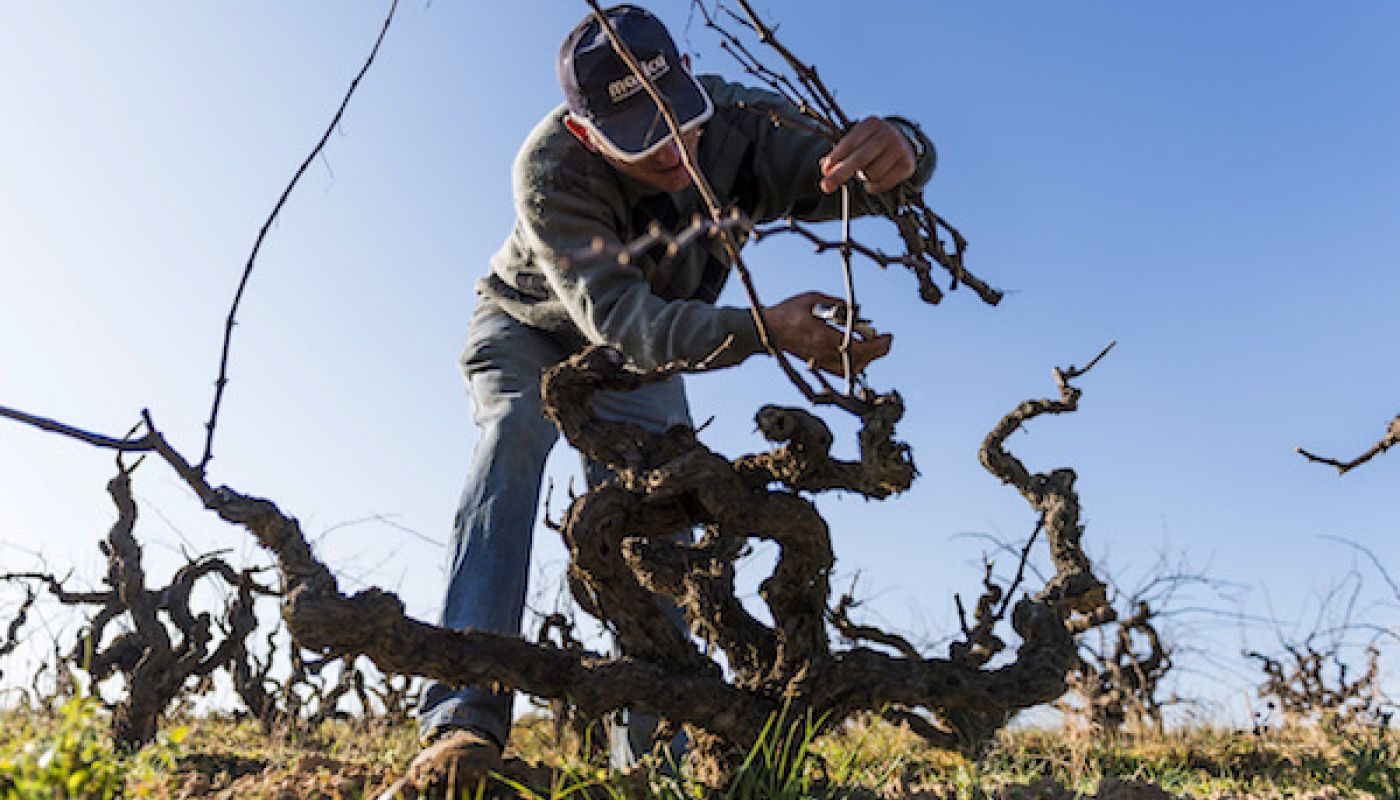
Barossa Valley, California and South Africa all have initiatives in place to value and preserve old vines (see also our Old Vines Register). It would be wonderful if such a thing could be organised in Spain, before more of them disappear. (Our picture of tending an ancient vine in Penedès is from AT Roca's website.)
Garnacha is thought to have originated in Aragon, between Rioja and Catalunya in wine geographical terms. When the variety’s reputation was at its lowest ebb, it was relatively easy to find great-value reds made from old Garnacha vines in such Aragonese denominations as Campo de Borja, Calatayud and Cariñena.
Prices may rise, however, now that there are signs at last of widespread revisionism in how Garnacha is viewed by Spanish winemakers. As part of a new wave of Spanish wines, ambitious, sophisticated Garnachas are proliferating not just in Aragon and next-door Navarra (where Garnacha has long been the key ingredient in dark rosados), but even in Rioja, Spain’s most classical wine region, where Garnacha’s star is rising.
One cult wine region that is hanging its fashionable hat on Garnacha is the Gredos Mountains west of Madrid where old vines, minuscule yields and local slate and schist are resulting in particularly fine, transparent, delicate wines that are almost Burgundian. Leading producers there include Bernabeleva, Comando G, Daniel Goméz Jiménez-Landi (now split from his old family firm of Jiménez-Landi), Marañones and the peripatetic Telmo Rodriguez.

For his Frontonia label, Fernando Mora, pictured above in one of his vineyards, is also fixated on old-vine Garnacha, in this case based in Aragon. ‘We have some of the best Garnacha in the world and yet Gredos is more famous', he told me in Spain recently with some exasperation. But he is used to a fight. Ten years ago as a 25-year-old mechanical engineer, he started experimental winemaking with zero experience but utter determination and, crucially according to him, the backing of his wife. After soaking up knowledge all over the wine world, he eventually became a full-time winemaker and ended up passing the killer Master of Wine exams in record time (and a foreign language) last year. He thinks his relative poverty helped give him the drive to pass first time. ‘I couldn’t afford not to.’
The vineyards he and his partners depend on are north-facing and high elevation (common themes among Spain’s new-wave winemakers who are seeking out the country’s coolest spots for successful grape ripening). And, as elsewhere, winemaking methods exhibit a return to tradition. ‘We’ve established our own winery now for the future, but we’re making wine as in the past', he explained, adding, ‘Some of Spain’s best vines belong to members of co-operatives, so we often have to work with them.’
Both Mora, and Dani Landi when I met with him in London to taste his latest Gredos Garnachas, mentioned Château Rayas, the exceptionally limpid and multi-layered (and expensive) Châteauneuf-du-Pape as their model – which makes me wonder why more producers in this most famous of southern Rhône appellations don’t try to emulate Rayas.
Mora observed that ‘in Spain we’re in a creative moment for wine’ and I would heartily concur as the country’s range of wine styles and interesting wine regions is multiplying rapidly. It takes in much more than revived Garnacha. There are new ways of making wine (come in, amphoras), and a re-evaluation of minor grape varieties, including on the Canary Islands and the Portuguese border, sources of wine practically unknown outside their own region 10 years ago.
Spain has a bright wine future ahead if foreign importers are able to introduce these new wines to the rest of the world.
SOME POTENTIALLY EXCITING INDIGENOUS SPANISH GRAPES
Albillo
Bobal
Cariñena (Carignan)
Garnacha (Grenache)
Godello
Graciano
Juan García
Listán Prieto
Macabeo/Viura (Maccabeu)
Mencía
Merseguera
Monastrell (Mourvèdre)
Prieto Picudo
Sumoll
Xarello
RECOMMENDED EXAMPLES
Alto de Trevejos 2015 Abona (Listán Blanco/Malvasía blend)
Agustí Torrelló, Cantallops d’AT Roca 2016 Penedès (Xarello)
Mustiguillo, Finca Calvestra 2014 Vino de España (Merseguera)
£21.25 Prohibition Wines
Rafael Palacios, As Sortes 2016 Valdeorras (Godello)
About £40 various UK retailers
Daniel Goméz Jiménez-Landi, El Reventón 2015 Vino de la Tierra Castilla y León (Garnacha)
Casa Castillo, El Molar 2016 Jumilla (Garnacha)
£18.20 Bottle Apostle
Compania de Vinos del Atlantico, Sierra de la Demanda 2014 Rioja (75% Garnacha, 20% Tempranillo, 5% Viura)
Artuke, La Condenada 2016 Rioja (80% Tempranillo plus Garnacha, Graciano and Palomino)
About £45 Old Chapel Cellars, The Sampler
Dominio de Atauta, Llanos del Almendro 2012 Ribera del Duero (Tempranillo)
Demencia de Autor 2012 Bierzo (Mencía)
£31.99 The Winery
Torres, Grans Muralles 2011 Conca de Barberà (46% Cariñena, 29% Garnacha, 17% Querol, 5% Monastrell, 3% Garró)
£73.50 Hedonism (2009)
Mas Doix 2014 Priorat (55% Cariñena, 45% Garnacha)
£300 for six bottles Corney & Barrow (2009)
Tasting notes can be found on Purple Pages. See Spain's new wave and/or use our tasting-notes search.













