The cooking of Shanghai should have particular appeal to anyone who enjoys this website.
According to Wikipedia, ‘Shanghai dishes usually look red and shiny, for they are often pickled in wine and their cooking methods include baking, stewing, braising, steaming as well as deep frying. Fish, crab and chicken are “drunken” with spirits and are briskly cooked, steamed or served raw’.
So, having established this elementary connection, let me add a few more. This city, the most populous in China with over 25 million inhabitants, also appears to be a food lovers’ paradise. There are restaurants and small-scale food sellers everywhere and we ate extremely well.
The confluence of so many people drawn to this sprawling city, not just from the surrounding countryside but increasingly from many different countries, has led to an enormous range and variety of restaurants and cooking styles. At M on the Bund I met a German woman who was returning to a small town an hour’s drive north of Cologne because her husband had received a job offer he could not refuse and she was adamant about what she would miss most about Shanghai. ‘Undoubtedly the restaurants', she explained wistfully.
So, having set the tone, I feel that the most useful approach would be to describe briefly four very different restaurants in which we had the pleasure of eating.
The first, and by far the least expensive in a city where food prices are still incredibly low by European standards, came via Google. My search for the best restaurants close to the Bund, the city’s historic waterfront area, revealed the presence of Jia Jia Tang Bao on Huanghe Road. As a great fan of Shanghai’s soup-filled dumplings (described in this report on Din Tai Fung), I hailed a taxi and showed him the address conveniently translated. Ten minutes later we stopped, but so had at least 40 others who were waiting patiently in line outside the restaurant. I went off for an inexpensive haircut (10 yuan, or just over £1) and returned, only to find an even longer queue.
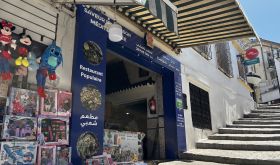
I then turned back on to Nanjing Road, the city’s main shopping street, turned right and wandered along the first turning on the right. I soon came to a restaurant whose windows were replete with hanging ducks and chickens, a familiar sight to someone as fond of inexpensive Chinese food as I am. I walked in, was looked at somewhat suspiciously for a few seconds, and then shown to a seat.
The surroundings were not terribly prepossessing but the smells were good and a large plastic-covered menu was soon in my hands. I flicked through it and saw towards the back that that they offered sautéed river prawns for 52 yuan (£5.50). I ordered them, some mah po tofu and a Tsingtao beer.
The meal was excellent, as was what was on show: an animated conversation between a father and his young son who came in for their lunch after the latter had obviously just finished some extra curriculum activity (he sat with his back pack on throughout the meal). I also enjoyed watching the waitresses empty a huge number of wooden chopsticks that had just been washed on to a large, white towel placed in the centre of the table next to mine, and then dry them before stuffing them back into their paper containers. Numerous strongly built women fulfilled jobs that in the West would normally be reserved for men. In the kitchen behind me the female chef was obviously in charge of the two male chefs. Another woman was in charge of the section at the front of the restaurant which prepared the roast meat and, more importantly, looked after the till. A broad, smiling woman on her motor scooter delivered the take away food that is such an integral aspect of the restaurant business throughout China. It was by now 2.20 pm and big bowls of meat, rice and vegetables were coming out of the kitchen for the staff meal. I said thank you and was rewarded, as I left, with warm smiles.
This meal stood me in great stead that night at dinner at the far more exclusive Imperial Treasure Fine Chinese Cuisine, the flagship restaurant of the Imperial Treasure group based in Singapore, that took place in a private dining room (complete with an enormous Sony TV on the wall) on the third floor of the Yi Feng gallery very close to the Peninsular Hotel. In attendance were the organisers of the China Wine Summit; the judges, including JR, Ian D’Agata and Bernard Burtschy, and Justin Chen, a food and wine enthusiast.
The bottles on the sideboard were equally impressive: a Dog Point 2009 oaked Sauvignon Blanc, a 2011 white burgundy from Domaine Guffens, a Gevrey-Chambertin Cazetiers 2011 from Armand Rousseau, and last but not least, an Aldo Conterno 2001 Barolo. The cold food that was on the table as we arrived was equally good: sweet tofu, salted pork, a whole roast duck that had just been sliced – dishes that preceded some excellent pancakes with the skin of the duck, then some fish, and finally some perfectly steamed egg buns as dessert.
During the course of the conversation, my neighbour Justin mentioned that not all restaurants in Shanghai were as opulent as this one. This gave me the opportunity to show him where I had had lunch and get his approximate translation of the sign outside. This roughly translated is JAI CHU, a phrase that hints at very good cuisine. Something both restaurants certainly delivered.
Riesling played a prominent role in our dinner the following evening, although in this case it was a 2007 from Fritz Haag followed by a Felton Road Pinot Noir 2011 from New Zealand. The location and the restaurant’s owners were equally international. We were in the branch of Lost Heaven in the French Quarter (their other, even bigger outpost is just north of the Bund), a fun, very authentic copy of a restaurant in Yunnan, the province in the south west of China from which LVMH produced the red wine at 200 euros a bottle that so impressed my wife recently.
These Lost Heaven restaurants are owned by Taiwanese, who, as their fellow countrymen have proved with the success of the Din Tai Fung chain of dumpling restaurants, are experts at predicting what the general public will enjoy. The attention to detail is exemplary; most of the serving staff are from Yunnan; and the food, and prices, have already made these two restaurants extremely busy.
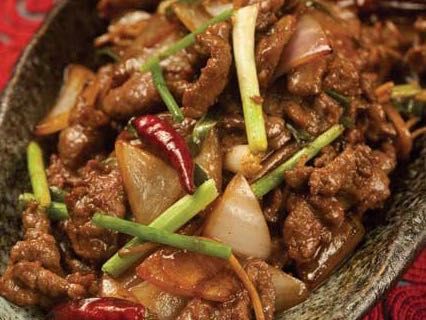
The menu is intriguing, too. The large, thick format contains plenty of photos including one in the middle of the book of a ‘lost valley’ in Yunnan and there are photos too of all the dishes. We enjoyed some excellent rice cakes, an egg salad, Yu-xi soy chicken, Lijang style beef (pictured above), and a Jin Bo style salad as well as some ham pancakes. Each of these rather filling dishes cost less than the 80 yuan (£8.60!) I was charged for the bottle of Voss still water. My total bill came to 556 yuan (£60) for the three of us.
The cost of my final lunch in Shanghai must remain a secret as we were guests at Le Sun Chine, a boutique 16-bedroom hotel with a restaurant in the city’s French Concession which we visited after a morning spent at the extraordinary Propaganda Poster Art Centre close by, where the basement walls are covered in lurid posters from the Mao era onwards.
The juxtaposition was striking as at Le Sun Chine our car had hardly stopped before the door was whisked open and we were shown into an entrance that was not only plush but also a painstakingly restored grand Shanghai family house. We were shown up a broad staircase to a small private dining room, complete with bathroom.
What followed was a string of local delights. Crab soup with mushrooms; a white fish sautéed with new season’s broad beans; sea cucumber in a thick fish soup with boiled shark’s stomach; a seemingly simple, but I am reliably told, highly complex, dish of rice boiled with various vegetables and fried lettuce; and, finally, a hot red bean jelly that was both comforting and invigorating.
This meal provided a fitting finale to Shanghai, a city in which the range of restaurants is, in my opinion, unprecedented.