The temperature is dropping and the nights are getting colder here in London. This makes me remember a saying of my late grandfather’s.
Born in Imperial Russia, he moved to England in 1910 and, for as long as I can remember, he used to repeat one phrase at the dinner table: ‘a meal is not a meal if it doesn’t begin with a soup’.
Soups are relatively easy for any restaurant to prepare. They may be vegetable-based, a fish soup using discarded bones, or even a meat broth, such as the lamb broth I enjoyed recently at the new St John, Marylebone. They must all be relatively inexpensive to produce, and they ought to be the perfect foil for the sourdough bread that so many restaurant chefs now produce and, understandably, charge for.
A bowl of soup is the perfect antidote to wintry weather. Yet few restaurants today seem to offer one. At the top of the restaurant tree, London’s three-star Michelin restaurants, there is hardly a mention of this dish. No kind of soup is on the menu at Le Gavroche nor at the Gordon Ramsay restaurant on Royal Hospital Road. Neither soup nor potage is on offer at Alain Ducasse at the Dorchester in London and the same is true of both female three-star chefs, Clare Smyth at Core and Hélène Darroze at The Connaught. The only three-star chef I can find who does offer a soup is Alain Roux at The Waterside Inn, whose menu not only offers the classic duck consommé with foie gras and tarragon leaves under a puff pastry crust (£54.50) but also a velouté of chervil root, chestnut cream and wild mushrooms for £50.
Looking at all these starry menus, and that of Guy Savoy’s three-star restaurant in the former Paris Mint, one reason quickly became obvious. By comparison with many other first courses, a soup fails to offer the chef and his brigade the opportunity to impress the eyes, and therefore Instagram. By comparison with other first courses, there is little in a bowl of soup to match the presentational opportunities offered by shellfish, pasta or even the salad leaves that can be the mainstay of a dish that can be visually far more exciting.
This point was well made by Isaac McHale, the Scottish-born chef at The Clove Club in London. In response to my general question about soup on menus, he replied, ‘Soup isn’t going anywhere. If it is going somewhere it is going out of fashion – but I think that applies to “potage”, pureed vegetable soups. Being a good Scot I have always loved a “bree”, aka a broth. And we have long served a sardine broth alongside our sardine sashimi, a winter herb broth at different points during the meal, and our wild-duck consommé with 100-year-old madeira. But I love a potage, or a cock-a-leekie or lentil soup with all my heart. We took a Scottish summer holiday in the Cairngorms last year, and Scotch broth was what I chose to make for the night I cooked dinner. But the question of somebody serving one in an à la carte restaurant in London and the guest choosing it over the scallop or tartare or warm salad, is a different one. A soup as a starter in a restaurant doesn’t sell as well as more exciting options, I’m guessing. But at home, where you don’t have a choice of what to eat and you get what you are given – soup comes into its own.’ A Scot after my Russian grandfather’s heart!
Soups, always the first item on a correctly written menu, used to have pride of place. On several old menus at L’Escargot when I owned it there is a chilled tomato and basil soup in summer and a mussel and saffron soup in winter. And a menu from February 1983 offers a creamy chicken soup with truffles priced, outrageously, at £2.50 a bowl.
The soup tradition is followed religiously by Sally Clarke at Clarke’s restaurant, where she responded so enthusiastically to my soup-related question that I felt I could hear her response through the email: ‘Yes, yes! Soups every day – for 38 years on 17 December!! Chilled in the summer of course and fabulous hot ones the rest of the year. Pumpkin or celeriac with chestnuts, chives and a drizzle of our lovely organic oil from Tuscany – usually accompanied by our mile-long (thinnest) breadstick that usually attracts oohs and aahs from the tables and is hand-rolled every morning.’
Which brings me back to the point outlined earlier, that soups no longer feature as prominently on menus today not because customers do not want them any longer but rather because their presentation simply does not allow the chefs to show off. They are usually served in a bowl, the contents of which other customers cannot see, and often with their contents covered, either by a lid to ensure it stays hot or topped with a thoughtful pastry crust. Either way, they make their way through the dining room, hidden from view.
There may well be another factor, as intimated by Stuart Andrew, the thoughtful chef of Portland and Clipstone restaurants, in London. He responded as follows, ‘I like soup very much. It does sell if it is described in an appetising manner, perhaps with accoutrements’. (Philip Howard does this well at Elystan Street, where a cavolo nero, spinach and garlic soup with new season’s olive oil and ricotta croustades currently features.)
‘I find the Western soup canon still nostalgic to older guests but it’s difficult to find younger chefs who understand how to cook them well. I think the end result is not flamboyant enough for their time. You need to contemplate the romance of a soupe au pistou to make it with care. Incidentally I made the above for a staff meal in the summer and none of the staff had heard of it, nor of Elizabeth David.
‘The Eastern soup canon seems more pertinent to contemporary professional kitchens. Dashi, ramen, pho, essentially punchy broths similar in character perhaps to a consommé but not always clear.’
Which led me to question Andrew Wong, the highly intelligent chef at A Wong Michelin-starred Chinese restaurant in Victoria, about the place of soups on his menus and why, at our recent fantastic dinner there, the meal did not end in the traditional Chinese manner with a soup. His response was illuminating.
‘We do not have any soup on our à la carte menu that we serve at lunch. I’m not entirely sure why I have made this executive decision for our menu. However, just thinking out loud, I think it’s because a lot of the soups that we see on traditional Chinese menus such as hot and sour soup, chicken and sweet corn and so on are normally quite thick in texture and finished with egg velvetting, which in turn makes them quite heavy and filling.
‘Broths and lighter soups that I have experienced in Hong Kong are normally made using revered dried seafoods such as abalone, fish maw, dried scallop and sharks’ fin. These soups in particular are not always very popular in London for a variety of reasons, but especially with the attached price tags due to the presence of the dried seafood.’
Soup lovers, do not despair. There are still plenty of options available, although in the UK these tend to be in the major cities, and are to be found in the growing number of ramen restaurants opening here. (There are reportedly more than 24,000 of these across Japan!) A bowl of ramen consisted originally of Chinese noodles in a broth, of which there are many, many variations.
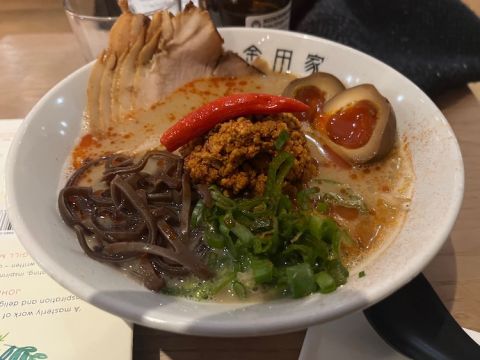
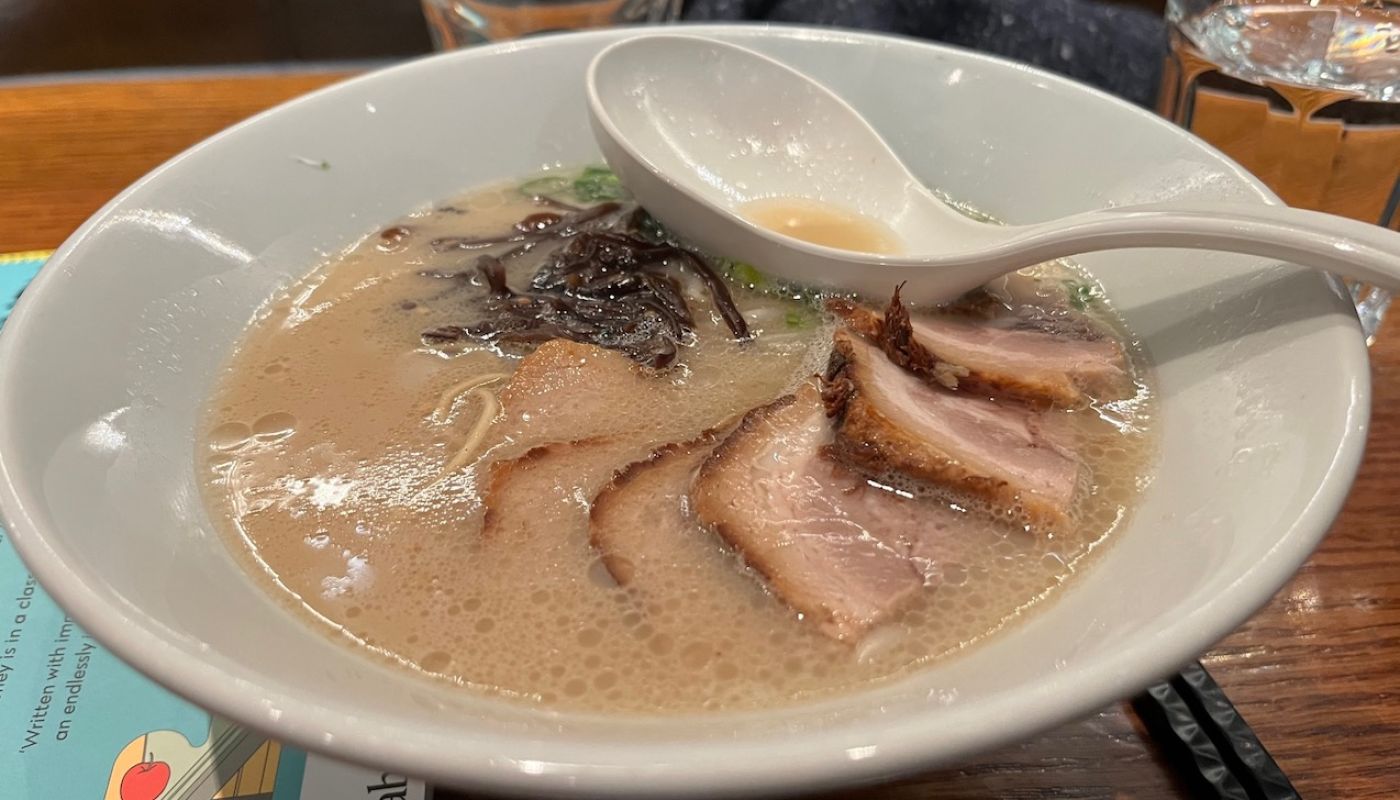
Several London restaurants offer these bowls of noodles in soup. I tried two: the branch of Kanada-Ya in Islington, where I enjoyed the bowl shown immediately above of gekikara ramen topped with a hanjuku egg (soft-boiled) and a bottle of ginger beer (total bill £24.87), and then at the branch of Ippudo in Central St Giles, where I enjoyed the bowl in our main picture of shiromaru chashu and a 90-ml serving of Hakkaisan Yukimuro sake (total bill £25.50). Of the two, my soup was richer at Kanada-Ya whereas the pork at Ippudo was thicker cut and therefore had slightly more flavour.
But both had the desired effect. On leaving each restaurant to walk the 30 minutes back home, I felt warmer and stronger. Despite the cold.
Kanada-Ya 35 Upper Street, Islington, London N1 0PN; tel: +44 (0)20 7288 2787
Ippudo 3 Central Saint Giles Piazza, St Giles High Street, London WC2H 8AG; tel: +44 (0)20 7240 4469