
20 June 2017 The folds of the Val d'Anniviers hunch deep into low mist and cold rain starts to fall. The village of Grimentz looks like a hand-coloured bookplate torn from an old copy of Heidi: time-weathered, dark, larch-wood chalets packed close against the slopes of the mountain as streams of melting snow rush between them and under pretty wooden bridges, and the first roses of spring wind their way up to carved balconies.
Narrow cobbled streets turn into even narrower pathways and steep stone steps. Above us wooden homes shuttered to the rain; below, smaller chalet-like huts that have served as family pantries, cold storage and treasure vaults for close on 300 years, sitting on mushroom-like stilts to keep mice out. We see the odd carved face to ward off thieves and devils. The rain keeps dripping down our necks – no room for umbrellas here.
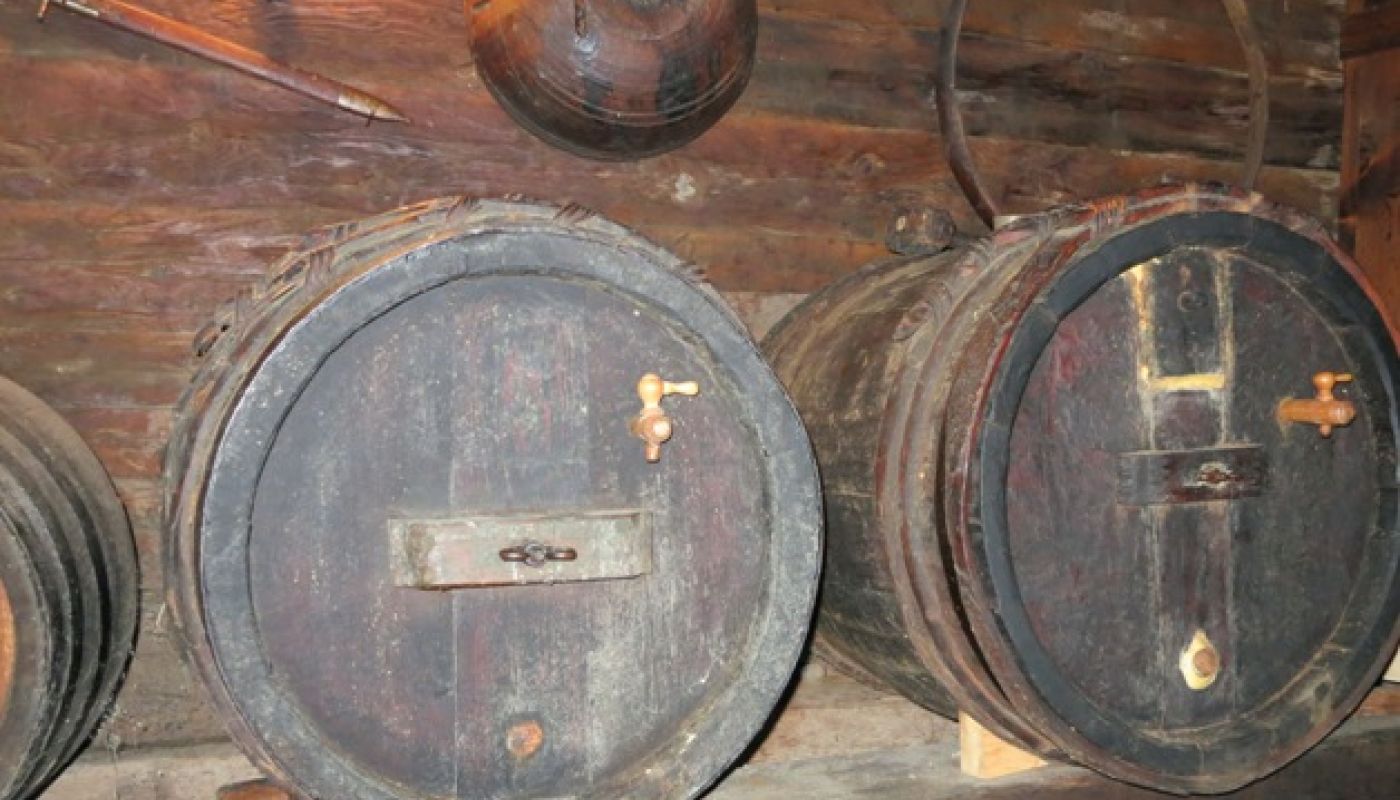
We stop, suddenly, and duck single-file through a thick rough-plank door, maybe shoulder high, hacked into the side of a storage hut. It's dark, and tiny, inside. The floor is scree and gravel and earth. There's a single lantern hanging from the ceiling and four ancient black barrels against one wall. We squeeze in on benches tucked into one corner, behind a small table, seven of us visitors sitting and five Swiss winemakers (two Zuffereys and three Merciers) shuffling in to the remaining space – not much of it. There are 12 of what look like shot glasses on the table. Someone passes them to Maurice and he starts to fill them with a deep amber liquid that glows in the dim light, catching shadows.
I pick one up and smell. Amontillado.
But not Amontillado. Shimmering acidity, salty, roasted nuts, marzipan, candied citrus peel, and then again this thrumming, taut, harp-string of acidity that vibrates on and on long after the wine has been sipped. I go back: marmalade and oranges. Manuka honey.

Maurice Zufferey (pictured here with his wife, Anne-Dominique), snow-white hair, tanned, wiry fit, piercingly blue eyes, starts to talk. There were many people living in the Val d'Anniviers in the Swiss canton of Valais until the Second World War. Until then, for hundreds of years, they'd lived a transhumant, almost nomadic, lifestyle, moving between high-mountain pastures, little mid-mountain villages such as Grimentz, and the lower valley villages and towns, following the alpage grazing for their alpine cows and tending their vineyards basking in warmth on the lower slopes. Come autumn, their tiny cellars would fill with barrels of fermenting wine but in springtime they'd load up mule carts with special long barrels and take their wine up into the mountains. It was a life on the margins. Tough, sparse, unforgiving. It required people with a certain grit, mental as well as physical, and communities clung together to survive.
But they had wine. And the mountain people of Grimentz also had a very special wine. Each family made enough wine for themselves for a year, and then they made a little extra. This went into an old, old larch barrel, black with age, kept to one side, and never emptied. This barrel did not go up on the mule cart into the mountains. It stayed in those dark, cold, little cellars hewn into the Alps. Each year, in about May, the new wine is poured in to top the barrel up. Each year, strictly for special occasions, the tap on the barrel is opened, and tiny glasses are filled – usually only for the family, very occasionally for the visiting bishop.
These uniquely Valais wines are called 'vin des glaciers' (they can also be called vin du glacier or Gletscherwein, meaning rock glacier wine). Not because they are made in glaciers, but because they are made by the people who live among the glaciers. Perhaps also because they are wines that go back to the earliest memories, ancient traditions, because they are rugged wines made of time and place and family and hardship and history.
Traditionally the vin du glacier was made from a variety called Rèze (see A grape treat). One of the oldest varieties in Switzerland, it was badly affected by phylloxera and as people began replanting, it fell out of fashion. Today there's not much more than 2 ha (5 acres) left in the Valais. So as time went by, the villagers of Grimentz began to make their vin des glaciers from a mix of Malvoisie, Ermitage (the Valais name for Marsanne), Petite Arvine, Fendant (the Valais name for Chasselas) and Humagne Blanche, from vines grown on the hills of Sierre, just above the banks of the cold, narrow, fledging Rhône river. Nowadays, to be called a vin du glacier, the wines have to be made from a blend of local white varieties, the vineyards must be in Sierre, and the winemaking must be in Sierre. The spring following the vintage, the new wine must be added to the larch-only barrels inside the cellars of Grimentz at a minimum altitude of 1,200 m (3,940 ft) above sea level. Some people have more than one barrel of vin du glacier – the younger barrels are used to top up the older barrels, solera style. The barrels can never be emptied. They're almost never bottled, though, and – officially anyway – you can't buy them.
The barrels differ in size, from tiny to large, depending on what the family could afford at the time. Some of these barrels are now 100-200 years old and are treasured family heirlooms. Very occasionally, in an exceptional year, a new barrel may be started. These, Zufferey tells us, will begin at about 10% alcohol and as time goes on will lose a little water to evaporation and the wine ends up around 13-14% alcohol. The density of the wood prevents acetification. Most of the time. He stops and you can see he is thinking of some unfortunate barrel: 'but it does happen', he grins. I suspect it hasn't happened to him. Not with that grin.
Back to the wine in front of me. I keep breathing it in. Despite the complexity and layers, it has a clean vitality, as if cut from alpine rock and air.

The wines we are tasting belong to the Marie Jo and Jean-Michel Salamin. This vin du glacier is their family wine, one they never normally share with anyone else. They drink it to mark births, deaths and marriages. It feels almost sacred to be in this dimly lit burrow, holding this glass of liquid that probably has an average age of 60 years.
That first wine we tasted came from a barrel that was 120 years old. Now we taste one from a barrel that is 20 years older, making the solera wine 20 years older too. There is more citrus on the nose, a sort of burnt Seville-orange marmalade smell. It tastes more highly strung, very different. There is mushroom and lemon, and a smudge of furniture polish. It's sharper, more edgy, focused, a higher pitch. Dried rosemary and allspice. Lots of lemon, some satsuma and bitter pith. A suggestion of saffron-spiced pecans. Umami yet deep tang. This seems almost more pure, less mellow, despite its age.
We all sit there, in a kind of reverie, tasting these extraordinary, beautiful wines – not quite sherry, not quite vin jaune, not quite orange. Then it's over and we emerge blinking into bright sunlight. The rain has cleared and the snow-covered peaks tower over us, pink light on the glacier in the distance.













