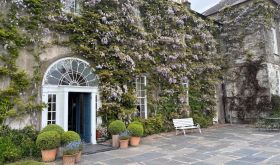
As Lili Jacquet-Pierroulet brought in the copious breakfast she serves to her guests at Le Cret l’Agneau high up in the Jura mountains in south east France, she reported that the temperature outside was minus five degrees Centigrade and that the first snow of the season had just fallen.
I still felt sleepy but across the table Jason Hinds, 37, export director for Neal’s Yard Dairy and the man responsible for shipping 200 tons of the very best British farmhouse cheese every year to Australia, Japan, France, the USA and Canada, was relishing the prospect of another day in the company of cheesemakers.
These would, however, not be the British cheesemakers who have dominated his working life for the past decade but rather those of the Jura who produce the most distinctive and delicious Comté, the best of which Hinds now imports into the UK with orders of up to 36 wheels, or two tons, at a time. And, perhaps even more perversely, the origins of how this has come to pass lie in two food stores Hinds visited in New York and North Carolina 13 years ago.
Hinds had just left university determined to fashion a career out of his major passions, cheese and travel, and consequently applied to Neal’s Yard Dairy. But the company’s exports then were only £100,000 so initially Hinds went behind the counter at their shop in Covent Garden until a trip to the US revealed how he could sell the best British cheese to the rest of the world.
“In those days US retailers would buy our cheese but it would never move off the shelves invariably because it was considered too expensive,” he explained. “Alongside the cheese buyer at Dean & Deluca I realised that it was vital that we educate the retailers, to get them to taste the difference and, consequently, to convert their customers by letting them taste it. Then, when we went on to North Carolina, I immediately appreciated that no-one had any idea of what Neal’s Yard does. I had to establish our own identity and that of the individual cheesemakers.” This didactic approach has led to more than 250 retail customers across the US and annual exports of over £2 million.
This experience also taught Hinds how to export British cheese to France. A fluent French speaker (Hinds went to a French school in Cairo while his father was compiling the first colloquial Arab dictionary), Hinds saw this as a bit of a Holy Grail although as he explained, “there is now a younger generation of French cheesemongers, Pascal Trotté, Fouchereau, Laurent Dubois, and the husband and wife team of Quatrehomme amongst others in Paris, who are much more open and more enthusiastic about British cheeses.” As a result, Hinds visited Paris regularly – Rungis, its main market, is the worldwide logistical hub for the best food products – and it was on a trip in early 2002 that Trotté opened his eyes to Comté.
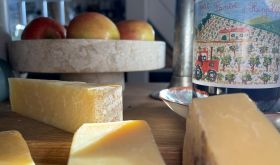
“I was astounded when Trotté explained that to borrow his phrase ‘Comté was the locomotive which drives his sales’. It isn’t well known outside France nor is there a big production – of the country’s annual production of over 200 million tons of cheese there is only 55,000 tons of Comte produced each year – but it is still traditionally made within a very strict set of regulations. And it has a wonderful range of flavours. Fully mature at 24-36 months it is as complex as any Cheddar we sell but younger it is wonderful to cook with either in salads, as a tart or incorporating even more calories on top of a gratin or with chicken.”
Hinds visited the Jura initially in May 2002 with Trotté, who always goes there then because it is the best time for frogs’ legs, and was smitten, so much so that he has now set up his own company, Borough Cheese Company, that has so far sold over 600 wheels of mature Comté to amongst others, Selfridges, Harrods, a growing number of restaurants and direct to the public via their own stall on Borough Market.
Having wiped the snow from the windscreen, we set out on what was to be his twenty-first visit to the region, a visit that was to convert me through the combination of tradition, farsightedness on the part of one particular individual and great attention to detail on the part of many more, into a Comté fan, too.
The tradition is exemplified by the fact that where the cheese is initially made is still referred to as ‘fruitière’, a term that goes back to the 13th century when this milk was considered to be ‘the fruit of the farm that could be converted into cheese worth keeping’. 180 fruitières still exist and at 0800 we donned plastic, hygienic coats, hats and shoes to walk into the cauldron of the highly modern Les Majors where every day two strong men convert 5,000 litres of milk produced only by Montbeliarde cows from 15 farms within a 55 kilometre radius into 25 wheels of cheese by heating it initially to 32 degrees C and then 56 degrees. The cheeses stay in the much cooler cellars for a week before being taken off to mature in one of the region’s six ‘affineurs’ or cheese-maturers.
In the case of Les Majors the cheeses are collected by Fromageries Marcel Petite and it was Petite himself who back in the mid 1960’s changed the style and maturing process of Comté from a cheese that was sold young and still studded with holes like Emmental into one that would greatly benefit from maturing. And at the same time Petite created a fashion for converting forts, built in the 19th century to protect France from the Prussians, into extraordinary cool if rather spooky cheese stores.
But initially and happily, lunch at Les Voyageurs was our next stop. This charming restaurant run by Marie-Jeanne Gremion offers not just an excellent vista across the rugged countryside but also, with its cast iron fire, old armoires and elegant absinthe dispenser (this drink is another of the region’s specialities), a glimpse of how once people used to live here. Her 17 euro menu also takes in the range of Comté starting with a tart of warm cheese then a chicken with a gratin of Comté atop some well cooked potatoes. Then it was off, even higher to the Fort Saint Antoine.
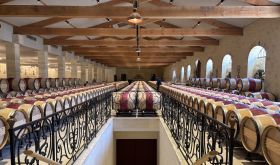
The drive took us through pastures and then woods but when we finally we emerged at the top the fort with turreted walls which I was expecting and from which I hoped to sniff the cool mountain air, was not there. Unfortunately for me, although hugely to the benefit of the 65,000 wheels of Comté within which are stored to a constant temperature of between 8 and 10 degrees Centigrade, the fort is completely earthed over so that the only entrance is via a small arched entrance. But once across the threshold the sight is breathtaking for any cheese lover.
Effectively, the entire interior of the castle has been given over to storing cheese with shelves built from spruce, the only wood on which Comté may be stored running in every direction – and into every nook and cranny including small tunnels and corners. This is quite simply a cheese castle and the king of it is Claude Querry.
Querry is strong and wiry and walks the cheese aisles with considerable speed, almost certainly a natural reaction acquired over the years to keep out the damp of his underground hideaway. But what is exceptional is his flavour memory, his natural recall, assisted by the occasional recourse to the computer of what his particular customers like in their Comté and, even more crucially, how the cheeses, which he tastes from the moment they enter his domain, will develop to meet the flavour profile of his customers’ customers.
Hinds was here to put his marker down on two lots of 36 cheeses which would be shipped in early 2005 so off we set scurrying behind Querry who could recognise when and by which fruitière each cheese had been made by codes on the outside of the wheel. But then pulling out each cheese and tilting it against his hip, he enacted a strange ritual. Firstly, he rubbed the palm of his hand forcefully across the top of the cheese, then turning the cheese iron around he used its wooden handle to bang on the cheese in various places, a process which satisfied Querry that there were no imperfections running through the cheese. Satisfied, he plunged the iron into the cheese, always at an angle so that the hole would heal, and then pulled off a piece for us to taste always sniffing the cheese and rubbing the paste against his fingers to check on its development. If it met with his and Hinds’ approval the iron was used to mark the rind with more hieroglyphics on the rind and we moved on.
Until it was time to leave the 19th century and Comté Castle and head down the hill to Geneva airport.
Le Cret l’Agneau, 25650 Montbenoit, www.lecret-lagneau.com
Restaurant Les Voyageurs 17 rue des Marais, 25160 Vaux-et-Chantegrue, 03.81.69.61.24
Weekend FT