Among the many clouds that have characterised this damp, cool and gloomy British summer there has been at least one professional silver lining: I have come to appreciate and enjoy nimono dishes in Japanese restaurants. And I have even learnt how to cook some of them at home.
Nimono, according to Richard Hosking's indispensible Dictionary of Japanese Food, translates as 'simmered food' and appears at any meal in Japan other than at breakfast.
It is a technique that can be used for cooking meat, fish and particularly vegetables with a wide variety of seasonings – sake, soy sauce, egg yolk, ginger and miso, with mirin rather than sugar used as the sweetener. Because these ingredients are then simmered, usually in a dashi stock made from water and bonito flakes, the resultant flavours are gentle, warm and soothing and packed with savoury umami, which the Japanese consider the fifth basic taste. The only essential cooking utensil is a heavy, straight-sided pan with a lid.
In a subsequent email exchange, Hosking, now retired and living back in London, explained why this style of Japanese cooking is so under-appreciated. 'In Japan, nimono dishes are everyday home cooking whereas sushi and sashimi are luxuries, hence the difference in price and the fact that the latter two styles are far more widely available in Japanese restaurants.'
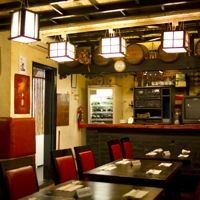
In fact, after my taste buds had been excited by their first acquaintance with nimono at Asakusa restaurant (pictured) in Camden Town, north London, I went on a mission to study Japanese restaurant menus in search of these dishes and reached two conclusions. The first is that nimono dishes tend to be available principally on the dinner menus rather than at lunchtime and secondly that they seem to be more widely available in the less expensive and less glamorous Japanese restaurants.
The two nimono dishes – saba no misoni and buta kakuni (on a Japanese menu, anything ending in -ni is a simmered dish, I learnt from Hosking) – on the menu at Asakusa were in fact so good that they went a long way to leading the rest of my table to think that I knew far more about Japanese food than is the case. But I was more than happy to accept their compliments.
The food and warmth of service at Asakusa are in stark contrast to its location and decor. While the excellent Spanish restaurant El Parador is only a few doors away, much closer is a sauna of dubious distinction, and there is a bus stop directly outside the restaurant's front door. Its interior seems to have been untouched for many a year and comprises a mass of posters, photos and the odd small blackboard covered in Japanese. Walking into Asakusa, as into Aburiya Kinnosuke, the highly atmospheric Japanese restaurant right by New York's Grand Central Station, is extremely comforting and reassuring, rather like slipping on a well-worn pair of shoes.
Except that this meal began with a shock. No sooner had we all been handed our menus than my fellow diners closed them and said, as if with one voice, 'We'll leave the choice to you, Nick, you order for us.' This was understandable given their specialisms were maths, wine and international diplomacy, but it did put me in a difficult position. No mention had been made of price, and bills in Japanese restaurants can quickly mount. Nothing had been mentioned about likes and dislikes, and Japanese chefs do like to turn every edible item of every ingredient to good use (turbot fin muscle sashimi would not be to everyone's taste, I assumed, despite the accompanying ponzu sauce).
And this menu, encased in less-than-attractive plastic covers, is incredibly long, with well over 100 dishes spread over several pages. I floundered but, fortified by some green tea, began to point to a few dishes that I knew that I at least would enjoy: deep-fried soft shell crab; grilled aubergine, a must in any Japanese restaurant, with miso; a plate of sushi; and some vegetable tempura, the most delicate style of Japanese cooking, in my opinion.
Then my eye was caught by the separate heading of 'simmered dishes', a category that contained two of my favourite ingredients, mackerel and pork belly, each priced at under £6. I ordered both, little realising how this would raise my standing around the table as an expert on Japanese food. But the mackerel, simmered in miso, was excellent, the two fillets happily divided into two although there was a bit of jostling as to who would finish off the delicious stock that remained. Dinner for four with a bottle of Beaujolais was £67.
Another excellent exponent of nimono dishes is the even more compact Jin Kichi in Hampstead, London NW3, which has been run by Atsushi Matsumato next to the robata grill, and the smiling Kazumasa Seki, who looks after his customers with such obvious delight, for many a year (an American Express sticker in the window is dated 1988!).
As well as an excellent rendition of the pork-belly dish, the Jin Kichi kitchen shows its dexterity with two simmered vegetable dishes: horen tamago, spinach, shiitake and eggs in fish stock, and atsuage, slices of thick tofu fried and then simmered with lots of diced ginger and spring onion.
My rendition at home of squash simmered in dashi was good if not yet comparable to these more professional renditions. I am but a recent convert to nimono dishes, however.
Asakusa 265 Eversholt Street, London NW1 IBA, tel 020 7388 8533 (dinner only)
Aburiya Kinnosuke 213 East 45th Street, New York, tel 212 867 5454, www.aburiyakinnosuke.com
Jin Kichi 73 Heath Street, London NW3 6UG, tel 020 7794 6158, www.jinkichi.com