6 November 2018 See also Chardonnay clones updated.
30 July 2018 Richard Fennessy in Western Australia has published this paper that provides a timeline for importations of Chardonnay into this Australian state, with considerable detail about California too. As Brian Croser comments, 'This as they say, has become bigger than Ben Hur. What it does demonstrate is that when making 50 year plus investments in vineyards, it is paramount to get the choices of site,variey(ies) and clone(s) right. I am not sure the efforts of the pioneers are ever respected enough and I would love to know the details of Hilgard's varietal plantings in California. He is the eminence grise lurking in the background of all of this. And this is only Chardonnay. What about Cabernet and Pinot?
26 July 2018 We're republishing this free today, hoping you might share any experiences of or observations on various Chardonnay clones, either on our Members' forum or via [email protected]. See also an addendum at the end of this article.
23 July 2018 This account by Brian Croser of Tapanappa in South Australia makes us realise that behind every popular clone of a vine variety may lie a fascinating story.
In 1979 we planted Chardonnay in the first vineyard in the Adelaide Hills, the Tiers Vineyard in the middle of the Piccadilly Valley, the wettest and coolest location in South Australia.
The site was a very deliberate choice to allow Chardonnay to achieve its best expression. Chardonnay, then a rather exotic choice in Australia, was also a very deliberate personal one which led to the site selection. I had been inspired by the wonderful Chardonnay wines we had experienced in California in 1972/73. Little did I realise at the time of planting The Tiers Vineyard that the circle would be completed with my choice of Chardonnay clone.
Although a few notable early California Chardonnays were based on field selections from other vineyards, many of those of the early 1970s owed much of their memorable exotic fruit characters to a particular clone of Chardonnay known as FPS 1 (FPS = Foundation Plant Services at Davis), derived from the 1930s Armstrong Farm vineyard at Davis. Harold Olmo (my viticulture professor in 1972) transplanted this Chardonnay clone from the old Armstrong site to a new location in the Davis vineyard in 1956 and called it FPS 1.
The clone FPS 1 was in the Armstrong Vineyard in 1930 towards the end of Prohibition. It is likely given the circumstances that not much was planted or selected during Prohibition from 1920 to 1933, so FPS 1 is likely to be a pre-Prohibition clone.
The Wente family speculate that this old clone came from their vineyard originally and, according to them, 'Ernest Wente acquired Chardonnay from the Theodore Gier Vineyard in 1908, and planted it in his father’s vineyard at the Wente Estate. That was supplement by an additional importation from the F Richter nursery in Montpellier in 1912. Between 1912 and Prohibition, the Chardonnay vineyards were not expanded significantly. After Repeal in 1933 and with the advent of varietal labelling, the demand for Chardonnay began to increase, and it was this need to expand plantings that led Ernest Wente to begin selecting vines with the best physiology and flavours to be replicated in the new vineyards to supply Wente Chardonnay.
'Over the next 30 years, this selection process created a signature intensity that was recognised by fellow winemakers and UC Davis as an ideal source for additional Chardonnay plantings as the industry expanded. This created two paths forward, those vineyards that were field selected by other wineries, and are essentially "heritage selections", and the single-vine selections by UC Davis that became clones.'
Those who seek a more detailed history of Chardonnay in California should see this 2007 UC Davis paper on the subject. It seems that the original source of the Gier Chardonnay was probably Charles Wetmore, president of the California State Viticultural Commission, who had imported Chardonnay budwood from Meursault in 1882 and distributed it in the then viticulturally thriving Livermore Valley, where Wetmore’s own winery Cresta Blanca, and Wente, were located.
FPS 1 was probably a result of Ernest Wente's efforts. Olmo’s 1956 new planting of FPS 1 was distributed by Davis until 1961 when it was withdrawn from distribution because of its hen and chicken fruiting habit thought to be caused by leafroll virus.
The remarkable accident of history is that Professor Harold Olmo in 1955 had a sabbatical in Western Australia, where he worked with Bill Jamieson of the WA Agriculture Department, identifying new cooler-climate viticultural regions to plant. This was about the time he was renovating the Davis source vineyard and replanting FPS 1.
Significantly he identified the Mount Barker (Great Southern) region as a potential cooler-climate wine region, which was subsequently first planted in 1966. He also inspired John Gladstones to identify the Margaret River wine region, first planted in 1967.
It seems that Bill Jamieson worked with his Davis colleague Professor Olmo to bring into WA the Chardonnay clone known as FPS 1 in 1957 before it was withdrawn from distribution in 1961. This was recognised in WA as the Old Farm (OF) selection of Chardonnay and later became known as the Gin Gin selection, named after the Houghton vineyard site in which it was planted. Consistent with FPS 1, the Gin Gin clone has a propensity to set hen and chicken berries.
Back at Davis in California, Olmo and his colleagues heat-treated FPS 1 and destroyed the original stock, naming the heat-treated selection FPS 2A. FPS 2A retained some of the propensity for hen and chicken and was imported into South Australia in 1968. It was distributed along with other clones at the very beginning of the Australian Chardonnay invasion.
It is this importation of Chardonnay that I chose to plant in The Tiers Vineyard. The choice was not inspired. We planted what we could get from the Yalumba nursery, although I deliberately avoided the Mendoza and I10-V1 clones available at the time.
Consistent with the earlier WA importation, this clone was also known as OF Chardonnay (Old Farm).
Meanwhile back at the ranch, the Davis custodians had decided that FPS 2A was not free of virus and they once again destroyed the planting material in 1969, a year after it had been sent to Australia. The virus status of FPS 2A has never been questioned in Australia, however, and it is still available for planting.
The Wentes promoted the recovery of the clone, which their family had painstakingly selected in the first place and which had been responsible for many of the standout wines of the early California Chardonnay adventure.
In the words of the Wente viticulturist, FPS 2A produces flavours of ‘apple, muscat, pineapple and fruit cocktail’ and ‘makes a very good Chardonnay'.
Using material selected from their vineyard and further heat-treated, FPS 1 aka FPS 2A, has been re-released as FPS 72.
It is this much-travelled and battered clone that contributes to the ‘distinguished site' reputation of The Tiers Vineyard.
The accumulating accidents of history that contribute to Tiers Chardonnay OF begin with Professor Olmo’s sabbatical in WA just as FPS 1 was replanted and redistributed at Davis in 1956, which in turn probably influenced him to send it to Bill Jamieson in WA when he asked for a Chardonnay clone. This original FPS 1 was then destroyed at Davis and replaced with the heat-treated version FPS 2A in 1961, which was sent to South Australia in 1968 just prior to its being destroyed in turn at Davis in 1969.
Having been inspired by those pioneer Californian Chardonnays of the early 1970s, many made from FPS 1, I consider it a virtuous circle that the wonderful clone, OF Chardonnay (FPS 2A) is performing so well in The Tiers Vineyard and its predecessor the Gin Gin clone (FPS 1) is doing the same in Western Australia.
I am not sure that the Davis people understand they can reach back to these Australian imports to see FPS 1 and FPS 2A in their original glory and compare them to FPS 72.
We intend to try to establish the genetic similarity of the Gin Gin clone and OF Chardonnay and will keep you posted.
You never know, we might just send FPS 1 and FPS 2A back to California and they in turn might send them back to Meursault. That would be a lesser coincidence in a long circular chain of coincidences.
27 July addendum It has often been said that Western Australia's Gin Gin clone is the same as the clone known as Mendoza, but Gin Gin came to WA from Davis in1957 and Mendoza arrived at Davis only in 1961. Mendoza came into Australia from Davis alongside FPS 2A in 1968.
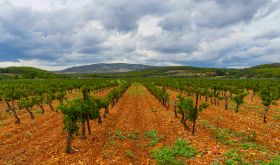
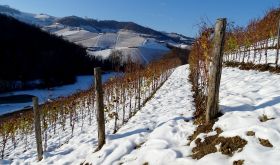
Milton Wordley is responsible for this picture of the Chardonnay vines of Tiers vineyard in autumn and that illustrating Croser crows little.