
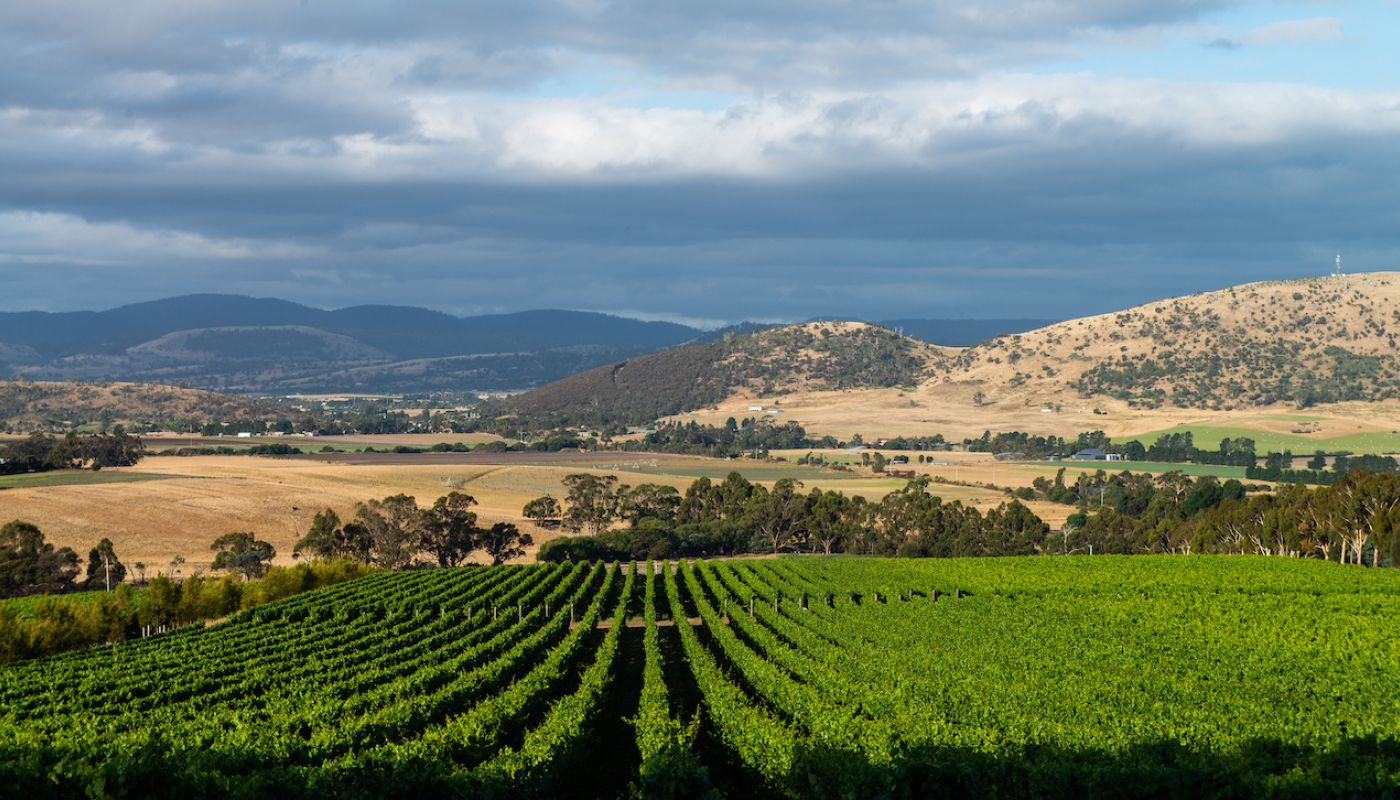
One of the most successful wines to have been launched in the last 10 years is made from grapes that travel 30 hours from vineyard to winery, including an overnight ferry journey. The Tolpuddle vineyard, pictured above by Chris Crerar, is in the south of Tasmania. Since 2011 it has been owned by cousins Martin Shaw and Michael Hill Smith who ship the freshly-picked grapes via Launceston and Melbourne to their Shaw + Smith winery in the hills above Adelaide in South Australia.
Tolpuddle makes almost equal quantities of Chardonnay and Pinot Noir and in its second vintage ever, 2013, the Pinot Noir picked up three trophies, including Best Australian Red, in the 2015 International Wine Challenge. In all, Tolpuddle wines have so far won 17 trophies in Australia and the UK and the 2020 Chardonnay won five awards at last year’s Royal Melbourne Wine Show. There is every likelihood that Tolpuddle would have picked up many a trophy in the rival wine competition to the International Wine Challenge, also held in London, but Tolpuddle co-owner Michael Hill Smith, Australia’s first Master of Wine, is also co-chair of the Decanter World Wine Awards so does not submit his own wines to his fellow judges’ scrutiny.
It seems appropriate however that Tolpuddle wines are judged in the UK as they take their memorable name from the Dorset village famous for its ‘martyrs’, agricultural labourers despatched to Tasmania as convicts for the crime of setting up an agricultural union. Their leader George Loveless served some of his sentence working on a property on or very close to the vineyard.
The 23.7-hectare (58.6-acre) vineyard was originally planted in 1988, on a site selected by the late Dr Tony Jordan for Domaine Chandon, the Australian sparkling-wine outpost of Moët & Chandon. (He had a record of scouting out great sites for vines, having spent four years travelling round China in search of the perfect spots for LVMH to produce sparkling wines – Ningxia – and still red wine – Ao Yun in Yunnan in the south.)
Jordan, wine producer Garry Crittenden of Mornington Peninsula just south of Melbourne and local landowners the Casimaty family planted the original vineyard with the thought that it would provide suitably high-acid fruit for fizz, being virtually the closest bit of Australia to the South Pole. At this stage Jordan was also shipping fruit for Domaine Chandon 3,370 km (2,094 miles) across the Nullarbor desert from the cool, far south-west of Australia in order to keep his sparkling wine refreshing enough. Australian wine producers are much less fettered by geography than their European counterparts (as witness Penfolds’ liberal blending policy).
During the journey, whether to Domaine Chandon or Shaw + Smith, the grapes have to be kept cool and as intact as possible so they don’t start to ferment. This entails refrigerated trucks and picking the fruit in shallow crates so that as few berries as possible are crushed by the weight of those above them. According to Hill Smith, Tolpuddle’s 30-hour journey virtually replicates their common practice of keeping freshly picked grapes in a cool room before fermentation to maximise fresh fruit flavours, even those grown on the Shaw + Smith estate.
Since acquiring the vineyard the cousins have tweaked it considerably, pulling out clones that were specifically designed for sparkling wines and substituting mainly Burgundian ones, improving pruning techniques, building a dam to ward off frost and buying a further six hectares (15 acres) of neighbouring land.
They never meant to buy land in Tasmania but set off on a road trip through the island in 2011 when all of Australia’s top winemakers were desperately looking for cool-climate vineyards and the potential of Tasmania was just beginning to be appreciated – by producers if not yet by consumers. Some of the grapes from Tolpuddle vineyard were bought by Hardy’s for the blend of their flagship Eileen Hardy Chardonnay, for instance, and another big company was paying AU$7,000 a ton, twice the going rate, for the fruit from one of the vineyard’s blocks of Pinot Noir.
On their road trip the cousins asked young local winemaker Peter Dredge to organise a tasting of the best Tasmanian wines and found that ‘all the Pinot Noirs and Chardonnays we loved came from Tolpuddle. So some time later we had an overdraft, no idea who would manage the property, nor where the wine would be made, but Martin, who is not given to spontaneity in any form, was, amazingly, set on it’, is how Hill Smith describes their decision to buy the vineyard.
They can’t have regretted it, and Tolpuddle has done much to raise awareness of Tasmania as a still-wine region. Extraordinarily, the first vines to be planted in any quantity on the island were the late-ripening Cabernet Sauvignon. If global warming really sets in, then presumably this will eventually be substituted for the much earlier-ripening Pinot Noir and Chardonnay that dominate the island’s vineyards today. But for the moment Domaine A, now under new ownership, is the only Tasmanian winery to have shown consistent mastery of Cabernet, the most famous red wine grape of Bordeaux. The buzz now is making answers to super-fashionable, and ever less affordable, red and white burgundy. Wine-minded climatologists like to compare degree days during the grape-growing season. Tolpuddle in the Coal River Valley notches up an average of just 1,180 and the widely accepted minimum of 500 mm (19.7 in) of rain a year while the averages for Dijon in Burgundy are 1,319 and 775 mm (30.5 in) respectively.
Tasmania is now being planted apace with vines but it is still tiny compared with the rest of Australia’s wine regions, representing less than 1% of national production. As Hill Smith observed when presenting Tolpuddle’s first 10 vintages to a roomful of sommeliers at Trivet restaurant in London last month, ‘you will spill more wine in a year than Tasmania produces’.

The wines were truly exciting and, at around £65 or US$70 a bottle retail for the latest vintages, 2020 and the even more approachable 2021, compare favourably with their Burgundian counterparts.
I see that I was swept off my feet when in 2013 I tasted the first vintage, 2012, especially the Pinot Noir. The 2012 Chardonnay now looks not so much refreshing as positively tart; in this first year they had the grapes pressed on the island and shipped juice, not grapes, to the winery in South Australia, exposing it to too much oxygen so there was a problem completing the usual conversion of harsh malic acid to softer lactic acid. But that was the only real disappointment in this line-up of 19 wines, all screwcapped so free of any cork taint or oxidation. Vintage 2019 was the victim of wildfires and subsequent smoke taint, an increasing phenomenon in the wine world alas, so that the 2019 Pinot Noir was sold off in bulk and the 2019 Chardonnay lacks the class of other vintages. But that was hardly the fault of the talented winemaker Adam Wadewitz, who arrived in time to make the second, 2013, vintage.
Hill Smith told us of his finest hour. Tolpuddle is the only Australian wine to have featured in the annual tasting of some of the finest wines in the world organised by the fine-wine-buying club Ficofi in Paris every December. At this glamorous event a few years ago Hill Smith was approached by Aubert de Villaine, the Burgundian figurehead then in charge of the world-famous Domaine de la Romanée-Conti, and told that he, de Villaine, had been advised that he must taste this Tasmanian upstart. I advise anyone with a taste for burgundy to do so too.
Favourite Tolpuddle vintages
Chardonnay: 2013, 2014, 2015, 2016, 2017, 2018, 2020, 2021
Pinot Noir: 2014, 2015, 2016, 2017, 2018, 2020, 2021
Tasting notes in our database and stockists on Wine-Searcher.com.













