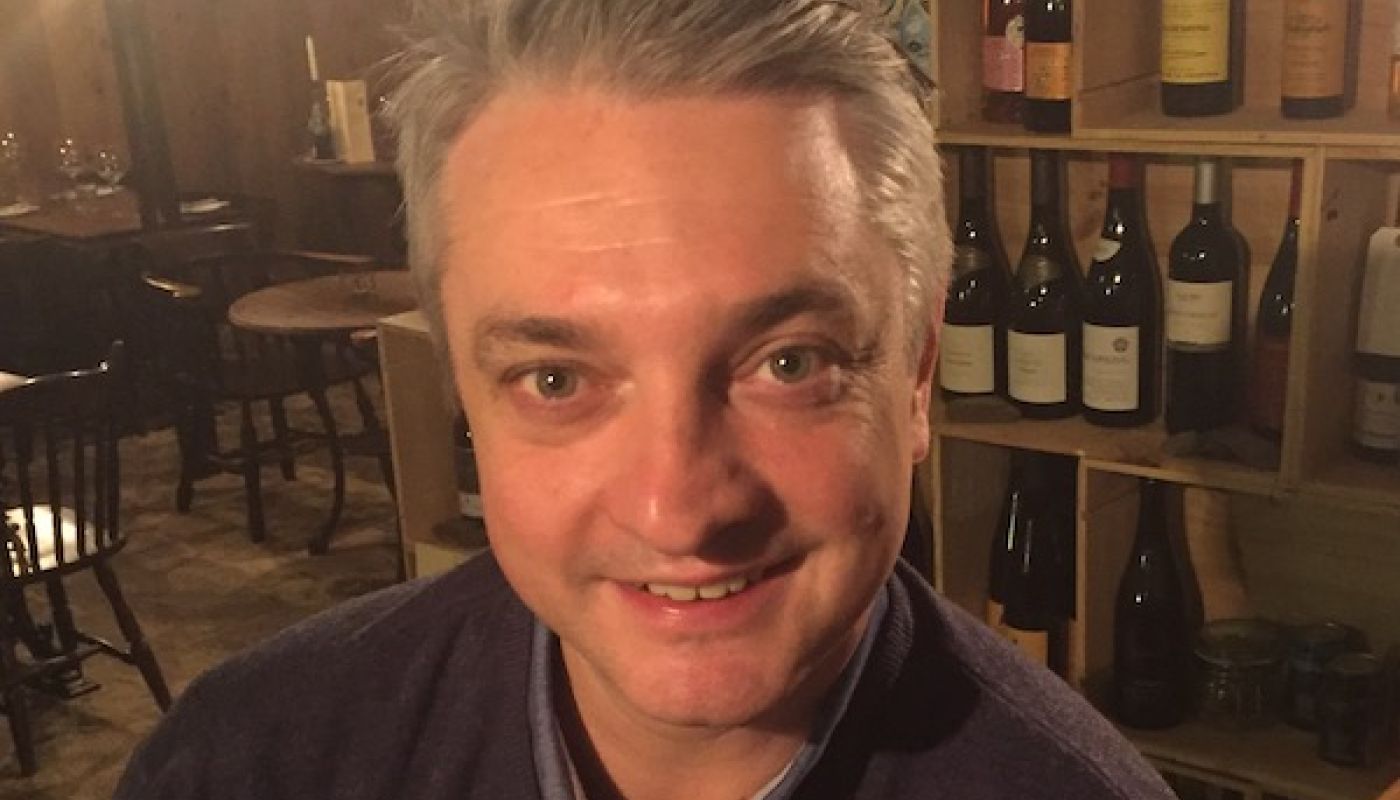
Martin Day, our 25th writing-competition entrant, began his journey into wine in 1996 when, as a 22 year old, he took an assistant manager’s position at a wine bar in Southend-on-Sea. He immediately became enamoured with the world of wine and started to work his way through the WSET exams. Following a stint working with Swig, he took a position with Bibendum Wine, firstly as an account manager, and latterly as a buyer with responsibility for South Africa, USA, Portugal, Austria, Germany, England and Eastern Europe. In 2013, Martin took the opportunity to get back to his roots and purchased the wine bar he first started at, The Pipe of Port. A diploma graduate, he is looking forward to becoming a WSET-approved provider and eventually enrolling on the Master of Wine course.
It’s all in the eyes
You can tell so much from looking into somebody’s eyes. The look of love, a stare of anger or simply ambivalent boredom. As my old boss used to say to me, ‘You only truly know about a wine when you can look into the eyes of the winemaker'. At a recent tasting of Nine Popes, I was surprised and humbled with what was in the eyes of winemaker Charles Melton.
Charlie is one of Australia’s most fervent characters. He’s right up there among the likes of Vanya Cullen, Geoff Merrill, Peter Lehmann and Len Evans as the shapers of the wine trade today (not just Australian wine – the work they put in in the 1980s and 90s set the standard by which New Zealand, South America and more recently South Africa have thrived). They gave wine from Down Under a personality, verve and vigour that enraptured its audience, and backed it up with some of the most mind-blowingly bang for buck wines the planet has ever seen – the Marvel heroes of the southern hemisphere’s vinous world. So good were they at selling their nation’s wines you’d think it was a veritable utopia down there. But that outward-facing charisma can often hide the darker side of the industry.
The young Mr Melton spent his apprenticeship in wine with Peter Lehmann, and a fruitful one it was too. It was Peter who gave the young cellar rat Graham Melton his new moniker of Charlie. Lehmann set up his winery to combat the surplus in grapes that was the scourge of the industry at the time. His model was simple – he would process the grapes but wouldn’t be able to pay the growers until the wine was sold. And sell he did! Without this scheme, many of the wines we know and love from the Barossa today would simply not exist (no exaggeration whatsoever).
It was during this time that Charlie started to notice the incredible quality of not just the Shiraz coming into the winery, but of the old-vine Grenache as well. When the fashion for consumption changed and winegrowers were replanting their vineyards with white varieties, Charlie decided he was having none of it and sought out specific vineyards consisting of older vine Rhône varieties, with Grenache being an outmoded favourite. From these, the wines of Charles Melton were born.
Back to my old boss. He remembers travelling to Australia in the early 1990s on one of the ‘Oz Flights’, a trip to put the movers and shakers of the UK wine industry in front of the blossoming Australian wine industry. One of the main things he recalls from the trip was the charisma and confidence of a certain Charlie Melton. ‘I knew the wines were going to be amazing before I tasted them – it was just there in his eyes.’ That energy is still there, but now there’s something else.
We were in the middle of tasting a back catalogue of Nine Popes and Charlie was explaining how he had to convince many growers not to dig up their Grenache. Charlie was asked if there was a point that convinced him to pursue Grenache despite the naysayers and this is when emotion got the better of him. He recalled a time working for Peter when the ‘great vine pull scheme’ had just started to be implemented. Grape prices were at an all-time low and, despite the best efforts of Peter, growers were still having to dump tonnes of grapes. He remembers a man in his eighties coming to the winery door begging them to take his fruit at any cost. They couldn’t take it. ‘But if I don’t use this fruit, God will never forgive me.’ To understand the gravity of this statement, is to understand the history of Barossa – a community of conservative farmers of Silesian descent who were staunchly Lutheran in their faith and escaping religious persecution in their German homeland. The church was the centre of their villages and the farming of their old vines was an integral part of that life, patrimony and heritage. The state of the industry was ruining their livelihoods and challenging their faith. Charlie was helpless. Through moistened eyes Charlie took a moment for reflection. What I saw in his eyes was the humility of wine that is so often hidden or forgotten. The fact that these aren’t products of luxury or triviality but a lifeline that allows communities and families to survive. And that a change in the whims of consumers thousands of miles away can lead to it all being destroyed.
The pain and anguish of that 80-year-old gentleman convinced Charlie that he would always respect the history of the land in Barossa, and old-vine Grenache would be at the forefront of his winemaking thoughts. And so Nine Popes is, in a way, his homage to the forefathers of this corner of Australia.
The wines were both brilliant and modest at the same time. Vintages going back to the early nineties, all from magnums no less, and all a perfect representation of land, vintage and cépages (though generally Grenache-dominated). They ranged from the elegant graphite-laden prettiness of the 1991 to the broad-shouldered chiselled refinement of the 2006 all the way through to the penetrating intensity of the 2013. This didn’t feel like a tasting of how a wine develops with age, but more a journal of how Mother Nature had formed and nurtured each wine.
My perception of Australia has been so wrong through the years. I’d filed it under fun and flirtatious for far too long, and here it was laid bare before me; honest and reflective, full of heart and soul. Truly humbling.
The Cape’s Supergroup

I enjoy and dread South African tastings in equal measures. [Click here for dozens of our tasting articles on the country's best – and worst – wines.] They’re a bit like going to a Primal Scream gig (or the Sex Pistols, or The Fall, I imagine) – you’re not quite sure what version of the band will turn up. They could be at the top of their game, smashing it to all corners of the venue and taking the punter on a heady journey of euphoric brilliance, or they could be on the verge of a breakdown, arguing with themselves, the audience, the sound man – whoever, but leaving you with a sense of underachievement, despondency and wasted money.
Heading to South African restaurant High Timber a couple of weeks ago, I was sceptical – hopeful, but nervous at the same time – but isn’t that what’s exciting? I mean, you could spend hundreds of pounds going to a slick Coldplay stadium concert and come away mildly satisfied but much lighter in the pocket, or you could queue up outside The Dublin Castle on a rainy Tuesday night and take a chance that you’ll see the best thing you’ll see for months for the price of a glass of Pinot Grigio (and have change for a kebab on the way home).
On this occasion, I needn’t have worried – this was no mediocre Glastonbury 2016 line up (sorry Adele), this was Woodstock née Isle of White 1970, and I felt like I’d got in by jumping the fence rather than paying the extortionate ticket price plus booking fee. The line-up was stellar; Duncan Savage (Savage Wines), Alex Starey (Keermont), Craig Wessels (Restless River), Pieter Walser (BLANKBottle) and live via satellite link, Adi Badenhorst (his wines were there while he was still flying from Cape Town).
What strikes you immediately is the camaraderie that exists amongst these producers – no backstage tantrums or hogging the limelight, they’ve all got each other’s backs. So much so that not one of them was initially pouring their own wines but taking the opportunity to taste and extol the virtues of their fellow producers' offerings. And the smiles! In an industry that so often gets lambasted for being stuffy, here was a group of colleagues not only enjoying their jobs, but the company and wines of others. Their laughter and sense of fun were infectious.
But these are in no way a bunch of chancers thinking they can turn up at a tasting with a bag full of wines and an unwarranted sense of enthusiasm. These are ground-breaking, dynamic wineries setting the trends and benchmarks for others to follow.
Creativity and originality are often the results of struggle and misery (punk and rap in the 1970s, rock and roll in the late 1940s and early 1950s) and the South African wine industry as we know it today is the consequence of post-apartheid chaos. Before 1994 the pseudo-state-owned KWV had controlled the industry, constraining it both productively and politically. The years following saw the shackles released but with little knowledge of the advances in technology, the global market or the comfort blanket of the KWV, the newly independent industry was always going to face huge challenges – just imagine Mozart being dropped in the 21st century and being asked to immediately compose a top 40 hit! So after only 20 years of establishing themselves (a mere blink of the eye in wine-trade terms), it’s uplifting to see that these guys are as enthusiastic as a teenager with a new Xbox.
If this is the direction the wines of South Africa are going, then I’m definitely on board. The wines ranged from the sleek and classical Restless River (the 2013 Chardonnay is the Jaguar E-Type of wines, beautifully curvaceous, pristine and chic) to the leftfield bonkersness of Adi Badenhorst (be sure to check out John Strikes Again, a characterful flor-aged Sauvignon Blanc, fresh and edgy, while the Brak-Kuil Barbarossa is brilliantly spiky, crunchy and juicy at the same time – if Andy Warhol made wine …).
The most consumer-friendly wines come from Keermont Estate in Stellenbosch (next door to De Trafford), where Alex Starey crafts handsome beauties, particularly his Syrah, which is luscious and pretty like a fur coat, all Monroe-esque. Duncan Savage feels like the elder statesman (in experience rather than appearance). He’s the hand on the shoulder of the group, a winemaker who has not only mixed it with some of the most commercially viable projects of the Cape at Cape Point but also acted as the protagonist of Savage Wines. His encyclopaedic knowledge of the source of both the most interesting and refined fruit in South Africa culminates in just three wines – vividly simple. The red blend is totally on point, it’s Ali at the top, or Bowie in his pomp, almost untouchable. Like the Sagrada Familia, fine and complex in structure backed up with real soul and a long future ahead.
And then there’s Peter Wasler, both a marketer’s dream and nightmare at the same time. Rarely makes the same wine twice, no varieties stated on the label and mental artwork that is as aesthetically brilliant as it is confusing. He’s the cheeky, mischievous child of the group having ducked and dived his way through the industry until he had a clear view of what he wanted to produce: ‘an honest wine brand that had no limitations when it came to style, vintage, area or cultivars in order to break down any preconceived expectations'.
Each wine comes with a back story, be it about him being accused of murdering his son or about stumbling upon a 40-year-old Fernão Pires vineyard simply because it was on a shortcut to Cape Town and he was late. Most intriguing were the Orbitofrontal Cortex and the Limbic wines. This pair of whites were blended from the same selection of 21 different barrels, but one was blended using results from Peter’s subconscious (he was hooked up to neuroscience measuring equipment and blended the wine on the results of his brain’s reaction to each sample – this utilises the limbic part of your brain), while the other was blended in the usual, conscious way (using the orbitofrontal cortex of the brain).
The results are two very different wines, yet with a structure and backbone that runs through both (or maybe that’s my subconscious telling me that …). The Limbic is the funkier of the two, it’s got George Clinton up front, bold and brash with an edginess and salinity. Orbitofrontal Cortex is Prince, it’s polished and poised, it knows how good it is and it wants to show you! Very tidy blend of richness, spice and mouth-watering fruit.
There’s so much to admire about this ensemble of South African talent. Not just brilliant wines with personality and diversity but their attitude and vision is there to see. They know South Africa needs a strategy to define itself as a serious wine producer and not just a supplier of bulk, and to do this requires a collective effort. These wines are proof that a nation’s wine industry needn’t be defined by a single variety’s ability to adapt to a certain region but can succeed producing wines of quality AND individuality. And why not be different – certainly didn’t do Apple and Google any harm!