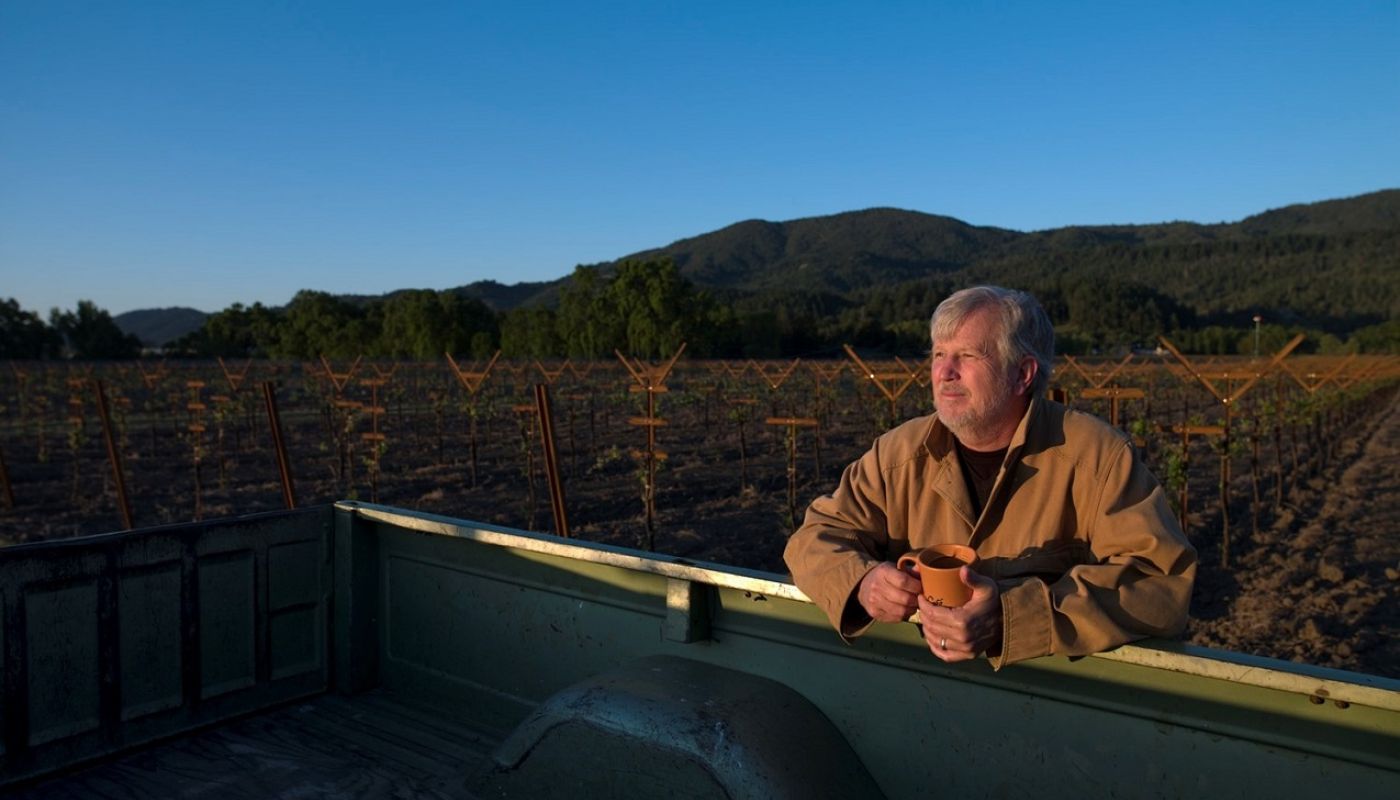
‘As you become more interested in the principle of organics and you know biodynamics and the underlying philosophy of biodynamics … we start[ed] to see all these things [are] interconnected, and so it was fine to grow your grapes organically, but where did your farmworkers live? Did they have a livable wage? And so I think … as an outgrowth of this interest in organics and biodynamics, dry-farming … all of that grew into a greater consciousness that later on became known as … sustainability. And you know we’re focused on that now, you know especially the social equity part of sustainability … particularly during the pandemic. And so it is this deep connection not only the plant to the soil to the living organism of the farm but how we’re all connected to this process. And quite honestly to make wines of balance and restraint and wines that speak to their terroir, they can’t be grown any other way, it is that deep connection that makes the difference.’ – John Williams, Frog’s Leap.
I pulled this quote from a recent feature on Wine.com on the au courant topic of ‘green viticulture.’ To anyone who is familiar with Frog’s Leap and John Williams, this holistic view of the winegrowers’ task will not surprise you. It is embedded, as I will explain momentarily, deep in the soul of the Frog’s Leap Estate in Rutherford, Napa Valley. In fact, some of it is embedded beneath the parking lot.
What is revolutionary about the above quote and the idea implicit within is that the quality of a wine cannot be separated from the entire universe of its gestation. It is not only organic grape-growing or biodynamic treatments or minimalist cellar techniques or the genius of dry-farming – of which John is perhaps the greatest advocate in California – it is the combination of these things and a respect and love for the people working on them that produces great wine. In the end, it’s about connection. Anyone who has had the joyous experience of drinking John’s wines, especially older vintages, can actually taste that ethos in the wine. It would be easy to talk about sustainability and ignore the end product; we can heap praise upon ‘green’ wineries and elide the fact that their certifications aren’t leading them to produce wines of place that are also delicious. These wines are. But I am not a reviewer and this is not a review. This is a revelation.
Frog’s Leap’s sustainable bona fides are myriad: the first Napa winery to farm organically in 1988; received CCOF status the following year; began fully dry-farming in 1989 (saving enough water to fill forty Olympic swimming pools each year); converted to 100% solar power in 2004; first Napa winery to have a LEED Silver certified building with the construction of its new hospitality center in 2005, which is fully heated and cooled by a geothermal system installed … under the parking lot. John and his team manage weeds through cultivating and hoeing. They succeed at dry farming through tillage and acknowledge that they need to find alternatives to diesel tractors. They use bottles with less glass and are contemplating alternatives to bottles if it means an environmental victory. They grow up to seventy other crops in rotation on what is a massive, functioning farm. This is not only good for their soil (environmental sustainability) it’s good for their employees (social sustainability) and for their business (economic sustainability.) John single-handedly spurred an effort in 2003 to restore the Rutherford section of the dying Napa River, and eventually onboarded twenty-three of his neighbors to score a palpable environmental victory.
Frog’s Leap has the impressive resume of a category leader. But those things are completed, achieved through great commitment and toil. Where John’s thinking is leading him next is what’s really exciting. I had the pleasure of speaking with him for this article and he outlined the ‘3 E’s: Economic Viability, Environmental Resilience, and Social Equity,’ as being the pillars of a sustainable agricultural business. I wanted to focus on social equity, which in California, means vineyard workers’ equity. In our discussion of that he was very wise to point out that, ‘quite honestly being socially equitable doesn't work if you're broke,’ and mentioned that as a result of COVID-19, many wineries were going to be cutting back on environmental and social initiatives. John is not afraid to talk about money and the role it plays in shaping sustainable decision making, e.g. ‘equipment choices or recycling, investments in energy infrastructure – all those things tend to be the victims of a tighter economic budget. I hate to say that environmental concerns are only the provenance of those who've got money … that's why people need to focus on the three of the E’s not just one of them.’
Candor is one of John’s best qualities. He is not afraid, as John Adams once said, ‘to avow [his] opinions, and defend them with boldness.’ Particularly on the topic of inequality in agriculture and in Napa more specifically:
It's an uncomfortable thing to talk about but Napa has got kind of a plantation mentality if you know what I mean by that. It's like we're the overseers of our land and we're taking care of these people and patting them on the head that work on the land and, and you know, ‘we pay them good money and they can live down in Vallejo’ … and plantation mentality is rampant in the … industries that need a lot of lower paid labor. So what is the opportunity for people to advance? They all want the same things: they want their kids to go to good schools, they want to have health care and they want enough money to live a great life and they want their kids to do better than them. It's the same for all of us, right, you know and how do we create those opportunities? And so I think it was a growing awareness [for me.] Actually my daughter who is off the charts with this kind of stuff was a strong influence on me with respect to this and you know, you, you don't see racism in yourself, right? And, and I think a lot of people think ‘well look I'm paying good wages to everyone and I'm giving them health care,’ but there's a real possibility that that you're harboring what would be termed now as we understand it a racist sort of idea about separation of the classes and so on and so forth and that's a really uncomfortable thing to understand about yourself and your business and it's a difficult thing to correct and make new opportunities for.
And Frog’s Leap is walking the walk. The business has made all its vineyard crew full-time over the past decade; the starting pay is $17/hr which is above the Napa vineyard crew average of $14, as reported by Dr. Giovanni Peri in 2017; health premiums are paid in full for all workers (though not their dependents) and the team is also trying to get all their vineyard crew onto 401k plans with some level of matching. But as John wisely points out, doing the right thing doesn’t always mean the same thing to the employer as the employee. ‘Are we listening to them about what's important in their lives? ‘I think they need this’ and so you go and get this for them. You know, you need to have those conversations and you need to gain their trust to get real answers to those conversations too because they learned how to speak to the ‘Jefe.’ They know what you want to hear and sometimes that isn't what really needs to be heard.’
We talk more about farm labor contractors and how they are commonly used because winery owners are not ready to have these conversations with their labor force. We talk about the reality of undocumented workers and that though wineries may want to help them on a path to a visa or permanent residence status, due to the current political realities, ‘we would likely put them in more danger by trying to do anything.’
Regarding the 401k programs, he admits to some difficulty in convincing the work force of its potential benefit to them, but also acknowledges that many of the retirement savings programs are written for rich people. ‘They're really not designed for people with lower means.’ And then he surprises himself. ‘There's no other alternative really, you know, we can't start an individual winery pension fund or something like that. Our money would probably be better spent building schools and hospitals down in their communities in Mexico to be honest with you, but that's not a deductible expense. It's not something that we could make a routine part of business. Although it's not a bad idea, is it? I’m going to write that down.’ This is the mind of a revolutionary filtered through the life experience of a businessman farmer … John Adams indeed.
I push him a bit further, pointing out that when I think of extending ‘equity’ to workers, I think of stock options, partial ownership etc. He replies that due to documentation issues and also the legal challenge of being an owner in an alcoholic venture, the better route is profit-sharing, ‘but maybe that's just an excuse.’ At Frog’s Leap ‘we have kind of an informal profit-sharing through the sense that we are very constantly measuring the spread between our lowest compensated employee and our highest compensated employee and there are multiples that are considered sustainable and considered socially equitable and so we are always trying to lower that multiple number of the difference … we seek to be below a ten multiple and we’re actually surpassing that [below ten] right now.’
As we headed further down that road, John revealed that he and his colleagues are in the early stages of considering whether to convert their business to a ‘B-Corporation,’ which is, ‘a beneficial corporation that allows you to … say by a majority vote of 70 percent of the shareholders … they can change their charter to say that the sole criteria of the ‘maximum benefit to the shareholders’ is no longer the only criteria that counts.’ In other words, you can get more radical with social and environmental equity if you’re not afraid your board will sue you if those changes aren’t creating more profitability. Currently he estimates there are only two wineries of this type in California.
Whether or not John Williams turns Frog’s Leap into a B-Corporation, or succeeds with updating his dry-farming techniques, or gets rid of bottles completely, the example of his character makes him a hero of sustainability. His unvarnished honesty about the economic realities and social injustices of his industry, borne out of his commitment to organic dry farming and the pursuit of balance, restraint, and terroir is an amazing example for his peers and for the next generation. And he’s not done yet. In his own words, ‘If you're doing nothing do something; if you're doing a little bit do a little bit more; and if you're doing a lot find new ways to challenge yourself and I can assure you that there are so many ways to challenge ourselves that there's no end to it.
















