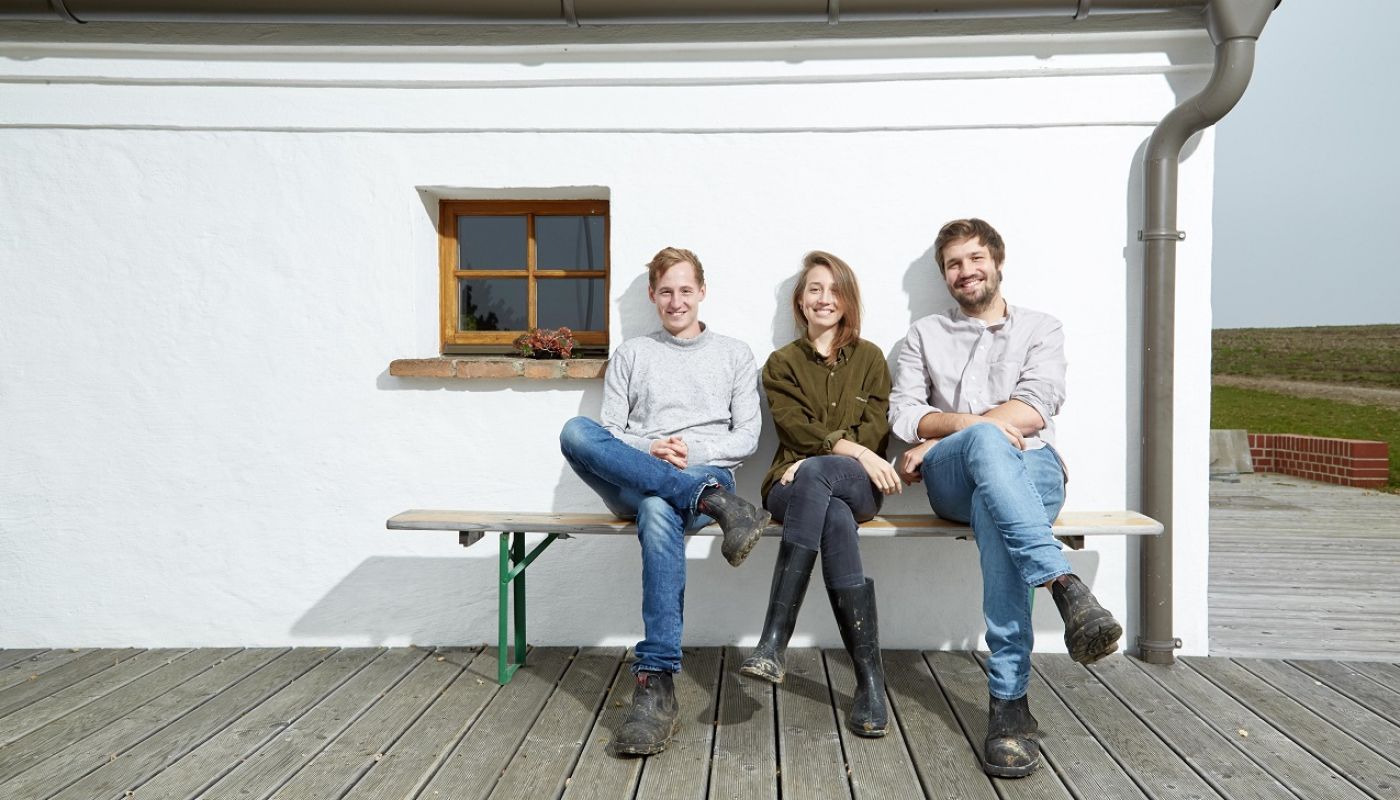
I still remember how surprised I was when I found out that someone can get a scientific degree by writing about the influence of plant species on the wellbeing of the vineyard when grown in the rows between vines. A few years, many wine articles and multiple tastings later this is not surprising to me anymore, but the memory has helped me to choose a low-intervention wine producer to write about. Mathias Schödl, winemaker and co-owner of Weingut Schödl is also the author of the thesis I mentioned above. He runs the winery together with his sister Victoria and brother Leohnard.
Obviously, seeding cover crops between vines is not enough to be a sustainable wine producer. Staying connected to both nature and people is the key. I first met the Schödl family during Weinfrühling (wine spring) – an annual local wine festival that takes place in different wine regions in Austria. Weinviertel – the region where the Schödls have their small winery and vineyards – was the first place I visited on my bicycle & wine trip.
As a guest at Weingut Schödl, located in the tiny town of Loidesthal, you feel that building relationships with people doesn’t end with the festival day. If you show even the tiniest hint of interest, one of the members of the Schödl family will spend long hours talking about wines, vines and much more.
Asked why they started to grow vines in harmony with nature, Mathias answered:
When you are really passionate about wine and farming, then working organically or biodynamically is the way. Keeping the vines healthy without chemicals but with handwork and a diverse ecosystem will result in tasty & healthy fruit which gives you exciting wine, reflecting not only the region but also the people behind it.
These words clearly show the essence of a sustainable approach, where both people and nature are important. Hospitality and a feeling of responsibility for the local community has been passed from one generation of the Schödl family to the next.
What is the story behind the decision to work hand-in-hand with nature?
Mathias told me that his father (Herbert Schödl) used to grow vines in a way which was already close to organic. Herbert Schödl’s children were probably acquainted with oenological knowledge from the outset, because their father also taught oenology at the University of Natural Resources and Applied Life Sciences in Vienna. The younger generation of the Schödl family gained a university education. Thirsting for knowledge and experience, they travelled around the world (New Zealand, South Africa, New York and California). Numerous internships and various jobs provided them with enough experience to make the decision to convert the whole winery to organic. The process of certification started in 2016, and in 2019 Weingut Schödl became fully organic.
Now, they are turning towards biodynamics.
Although the concept of biodynamics is still controversial, studies suggest that biodynamic preparations contain molecules fostering bacterial populations, that in turn stimulate plant growth. In comparison to organic grapevines, biodynamic ones seem to ‘know better’ how to defend themself, as the activity of enzymes correlating to plant resistance is increased [source].
‘Less is more’ for organic and biodynamic vines – decreased soil mineral content influences grape compactness, so that they are more exposed to sun – and consequently less susceptible to rot [source].
For the Schödls, taking care of nature doesn’t end with the requirements of the certifying organisation. According to Mathias, their philosophy is to build a healthy, diverse ecosystem in the vineyards
How is it achieved?
Have I already mentioned cover crops? Beside growing beneficial plants between the rows of grapevines, the Schödls have introduced sheep into their vineyards and use only natural compost. You might wonder how these strategies influence ecosystem.
Cover crops provide a habitat for beneficial insects (e.g. ladybirds and wasps), which prey on grapevine pests. Did you know that one ladybird lives about 2-3 years and during its lifespan devours around 5000 aphids? Therefore, providing a safe environment for these small predators to live (and hibernate) helps to reduce (or eliminate) the use of insecticides.
Plants grown between rows of grapevines also support soil life. Plant matter is degraded by earthworms. The result of this process is humus – a source of nutrients for beneficial microorganisms – plus yeast and bacteria. (If you wish to read a very detailed and fascinating article about the influence on wine of microorganisms living in vineyards take a look here). The role of organisms living in the soil isn’t limited to nutrition. Small tunnels created by earthworms help to hydrate the plants and retain water in the soil.

Even though drought, rather than fungi, is more of a challenge for Austrian wine producers these days, the Schödls don’t irrigate their vineyards. According to Hungarian scientists, about 400-500 litres of water (both rain and tap water) is needed to produce 1 litre of wine. Good management of water resources is crucial when the aim is to reduce negative impact on the environment.
As I have already mentioned, sheep graze in between the Schödls’ Rieslings, Gruner Veltliner and other grapevines. These animals are a natural approach to reducing the amount of weeds and naturally deliver manure to the plants. A study on vineyards from New Zealand shows that putting sheep between grapevines reduces costs considerably. Beside the ecological aspect (reducing the amount of herbicides used in vineyards and eliminating the necessity for mowing), such financial savings are an important part of sustainable winery management.
The Schödls take into account both money and surrounding environment. If spraying is necessary, it is done by using a tunnel spraying system (which recollects the drift-off from the spraying solution).
Labour costs and fuel consumption are reduced by limiting the use of the tractor. In the Schödl’s winery this is achieved by optimising the work in the vineyard (so to combine as many tasks as possible in the vineyards and so limit the distance and time of tractor usage). Hand harvest of grapes is also important.
When it comes to fuel, wine’s carbon footprint is far from neglected:
On a global scale, the wine sector is responsible for around 0.3% of annual global GHG [greenhouse gases] emissions from anthropogenic activities ; this corresponds to about 2% of agriculture sector contribution – an estimated 14% of the total [source].
According to a Californian study, GHGs emitted by (Californian) vineyards account for about 34% of the wineries carbon footprint. Part of this figure is associated with natural processes. Another part is related to practices that the Schödl family have eliminated (or greatly reduced), such as the usage of nitrogen fertilizers or fuel.
Another 'hotspot' for the reduction of carbon footprint is the sustainable use of electricity. Even though considerable amount of energy in Weinviertel is gained from renewable sources, reducing its consumption is still important.
Where the aim is to save energy, traditional solutions have come to the rescue. The cellar where the Schödls’ wine matures is naturally cold, and water used during wine production comes from their own spring. Hand riddling (remuage) of sparkling wine bottles is another strategy that helps to reduce use of electricity.
Many sources emphasise the significance of glass weight on CO2 emission. The results of the analysis of the carbon footprint of European wine production (Verdejo, to be precise) are similar to those from California. Packaging accounts for about 40% of the wine carbon footprint. Glass makes up most of that percentage (76 to 85%).
Since glass seems to be the best material for the maturation and storage of fine wine (due to its long-term stability, low reactivity to acid, as well as consumer preference), bottle lightweighting is the best opportunity to reduce wine producers’ carbon footprint. Having said all that, it is no surprise that the Schödl winery uses lightweight bottles. Assuming that their bottle weighs about 400g (20% less than the average bottle weight), they can save around 100g per bottle of CO2 emission relating to production and transport of an average bottle. Mathias also says that their packaging materials are light and recyclable.
When it comes to bottle closures, the Schödls use both natural cork and screw caps (commonly used in Austria). Although the amount of CO2 emission related to natural cork is 3 times lower than that related to screw caps, their important advantage is lack of risk of cork taint. According to the data a bottle of wine generates an average total of 1,5 kg of CO2 during its life cycle, with a small defect rate of 2% caused by cork taint at the end of the cycle is equivalent to 30 g CO2 per bottle. For me, it is really hard to judge clearly which of these two options is more sustainable.
In the Schödls’ cellars nature is also fully taken into account when it comes to winemaking – endogenous yeasts are used for fermentation and all sparkling wines are zero dosage.
‘Three R principle’ (reduce, reuse and recycle) is a general rule for sustainability in different fields of life (my scientific mind could not ignore the fact that the 3R rule is important even when it comes to scientific research). The Schödl family bring that rule to life to sustainably manage their winery.
For me it is equally important that, while taking care of nature, Schödl balance their relationship with people and science. They respect their roots and the resources gained by their father, skillfully using their knowledge and experience to help nature flourish – both in the vineyards and the winery.
The Schödls show that love towards people and a focus on nature, together with scientific concern, are essential parts of sustainability, not only in winemaking.
















