In Contra Costa, California, surrounded by motorways, Amazon warehouses, motels and new housing developments, you will find the occasional patch of land home to thriving plants. These plants appear skeletal in winter, yet jungle-like in summer. From afar, you’d be forgiven for thinking they were small fruit trees. In fact, they are grapevines.
Grapevines have been planted in the area since the 1840s. At first, the vineyards were planted to native American varieties (Vitis labrusca), as well as some Listán Prieto (known in South America as País and Criolla Chica, and Mission in the United States). In the subsequent years, these plantings were joined by other members of the Vitis vinifera family, such as Zinfandel, Carignan, Mourvèdre, Palomino, Muscat and Alicante Bouschet, all of which are varieties well-adapted to heat and drought.
It was because of my love for old-vine Palomino that I found myself standing in one of these old vineyards in early August 2019. I had just moved to California to do vintage with Abe Schoener in Los Angeles. We were establishing the LA River Wine Company; a winery that focuses on the historic vineyards of the south, namely Cucamonga and Temecula. At the same time, Abe was still making some of his Scholium Project wines from historic vineyards in the north, in Lodi, just a stone’s throw from Contra Costa.
Somewhat serendipitously, I had met Megan Cline the previous year at a trade tasting in Sonoma County, and discovered that one of the Cline white blends contains old-vine Palomino. I plucked up the courage to ask Megan if there was any chance that I could buy some grapes to attempt making my own cuvée. She said yes. Abe, one of the most encouraging and generous people I know, said I could make the wine in LA.
So, before we knew it, Abe and I were in the Palomino section of the Bridgehead Vineyard. The vineyard is celebrated for its Zinfandel, bottled by its owners, the Cline family, and for its Mourvèdre (or ‘Mataro’), previously bottled by Ridge. Not many others are as enamoured by Palomino as I am, so I got lucky.
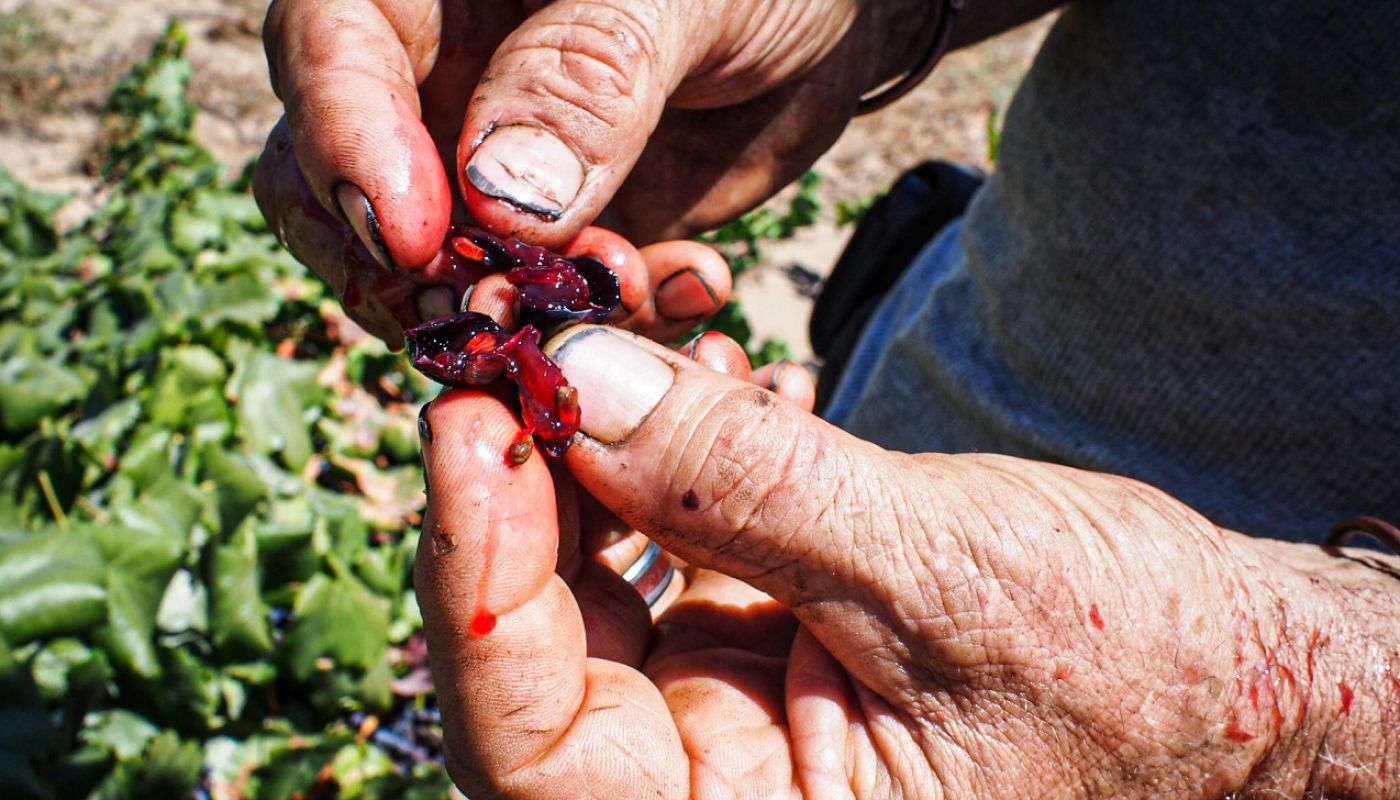
It was while gawking at the statuesque Palomino vines and fiddling with my refractometer that Megan Cline introduced me to Alan Lucchesi, the man who farms the vineyard. Just a few hours later, I would find myself standing in another old vineyard farmed by Alan. This one, however, is planted to the red-fleshed Alicante Bouschet, and it has an unparalleled story.
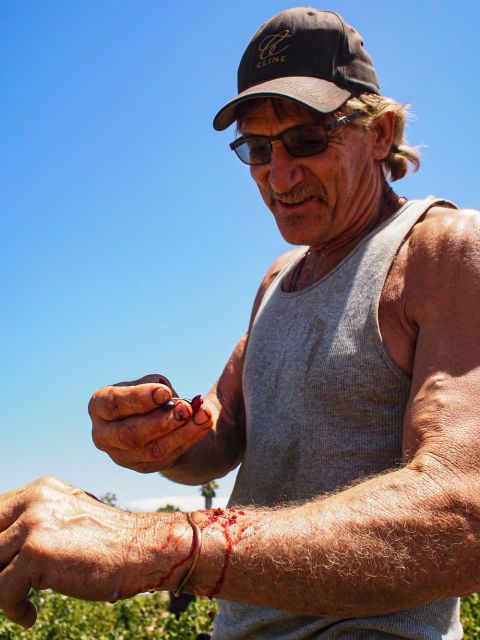
Alan, I discovered, is one of the farmers whose family has been tending vines for decades. In the 1930s, his grandparents emigrated to the United States from Lucca, Tuscany. They bought some land in Oakley, where they planted grapevines, almonds and apricots. At a similar time, the Jacuzzi family (who invented the iconic whirlpool bath) also found their way to California. For the first few decades, these farmers made a bit of wine, but they predominantly shipped their grapes to the East Coast. By the 1980s, there was more interest in locally produced wines. It was in 1982 that Fred Cline, one of the grandchildren of Valeriano Jacuzzi, set up Cline Cellars. Fred would later become known as one of the Rhône Rangers; a group of growers who saw the potential for Rhône varieties in California. At the same time, Alan Lucchesi had begun taking the reins from his parents. Alan reflected,
“I began working for Fred in 1990; I was just helping him to man a few fields around here, and then I also started to sell some grapes to him. At first, it was just Fred, but soon after Bonny Doon and Ridge started coming into the area.”
In addition to planting new vineyards in the 90s, Alan also safeguarded the old vines, and leased other vineyards. Today, he farms 700 acres. This might sound like a lot, but it’s estimated that the vineyard plantings of Oakley have diminished by two thirds over the past 100 years, with half of the region’s vineyards having been ripped up since 1980. On a good day, it takes under an hour to drive from Oakley to San Francisco, so the area is a hotspot for developers. Alan estimates that they’ve lost around 200 acres of vines due to the housing boom in just the past few years. He said,
“Developers come around all the time. The old timers die off, and people get offered big money. If you have two or three kids and someone wants to buy the land… well, this is a democracy—you can do what you want. It’s the owner’s decision, and if they get $300,000 dollars for an acre of land, that’s a lot of money. There’s not enough income from the grapes; it’d take them 30 years to make that. In Italy, I hear that they don’t get rid of many old vines. But here, with developers, it’s often all about greed.”
These corporate companies with their dollar-sign eyes, combined with the fact that the grape market is not doing as well as it was, means that more and more land home to vines is being sold.
I felt a very real, almost visceral pain gazing out at Bridgehead, knowing these vines are the lucky ones, and mourning the ones which weren’t dealt the same hand. Ultimately, it is not up to the vines (or even Mother Nature) to decide whether or not they live; their fate is decided by us. And in a world largely fuelled by consumerism, more often than not the consequences are bleak…
…Unless Alan Lucchesi is involved.

He told me that in 2011, a local family decided they wanted to sell a five-acre plot of land, which was home to around 2,300 100+-year-old Alicante Bouschet vines. Alan had been farming these vines since 1990, and when he was told to not bother pruning the vines that year, he knew something was coming. The news came when the council reached out to him:
“A company was going to buy the land to build some big hydroplant—to make electricity—and when those companies want something, they want something. The city came to me as I lease some of their properties, and they’ve known me all along. It’s good that the council want to try to save vineyards, but sometimes when a developer approaches a private person then the city can’t fight them. There’s no law that says they can’t take the vineyard out, even though you’d think someone would wanna save the vines.”
Luckily, the mayor at the time, Kevin Romick, had a particular love for the old vines; this city council had a conscience. Alan explained,
“When the private company went to the city to get the plans approved, the city said: what are we gonna do with the vines? We need to do something with them. We’re not just gonna bulldoze the vines.”
They got in touch with Alan, asking whether he could transplant the vines:
“The city said they’d found another piece of land which they’d lease to us if we could move the vines over there. If we could move them, we could save them.”
My mouth fell open. Moving an entire vineyard is a task not quite as simple as moving cattle from one field to another. My shock was echoed by Abe, who has worked with dozens of farmers across California over the past 25 years. He was peering at Alan as if he’d casually announced that he’d visited the moon yesterday.
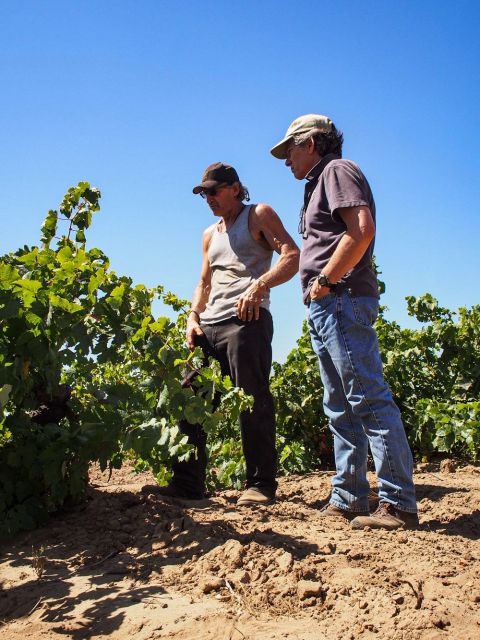
We asked, “moved?”
Alan said,
“Yep! We asked if they could build a well, which they did, because when you transplant a vineyard you need to give the vines water. That saved us $10-15K, and at that point it was a good story — it made the city look good.”
Abe was shaking his head in awe, and muttered to me, “almost everyone in the wine world would tell you that’s impossible.”
I probed, “I’ve never heard of anything like this! Had you transplanted vines before?”
Alan nodded, “I had done it before; that’s how I knew I could do it. A lot of people laughed and said there’s no way that guy’s gonna be able to do that. But I knew I could, as I’d taken a row out here or there, when houses had been built.”
So, in early March 2011, Alan and a group of fellow workers dug up the 2,300 sleeping beauty Alicante Bouschet vines.
“You have to transplant around March—not while they’re growing, or they’ll never make it. You have to do it when they’re still sleeping.”
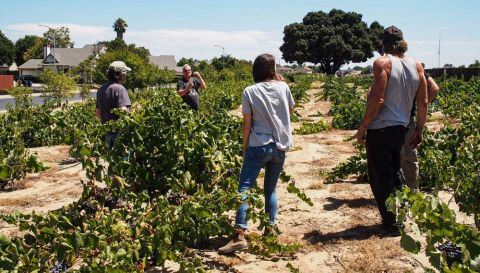
Using backhoes, they took the vines out of their original home, and drove them 1.5 miles down the road to their new home—a narrow five-acre patch of land right next to a new housing development. Incredibly, when it came to replanting the vines, the ten-foot holes were dug by hand.
The vines’ root systems were between 15 and 20 feet long. As it would have been almost impossible to dig 20-foot holes, some roots had to be trimmed a bit shorter; not all that dissimilar to trimming roots when you receive plants from the nursery.
“That’s okay. They still take off. The feeder roots sit higher, and all of the main root balls were still there. It’s the vines themselves that are now 115 years old, after all. We dug by hand because you need to make sure the vines fit right. You can’t just squish them in, because the roots are all different sizes; like spider legs; you need to dig around them and turn the vines around in the hole. And it’s pretty easy to dig sand, it’s not like hard dirt. You dig that hole pretty fast.”
I gulped. I wasn’t sure my attempt at a ten-foot hole in the sand would be dug all that fast.
He added that aside from being watered when planted, they are unirrigated, and organically tended.
“What was the rate of survival?” I wondered.
“I don’t think we lost a single vine.”
Entranced, I asked whether we could visit. Alan’s eyes lit up (“of course!”) and just a short truck drive later, we arrived at the narrow band of land now home to the vines. A long strip in a town environment. It’s the ultimate vinous oxymoron; the modern meets the ancestral.
I asked how it feels to be standing amongst the vines, knowing that if it wasn’t for him, they would no longer be alive. He said,
“The vines are like my kids. I know a lot of them by heart. Some have a certain look — one might look like a table and another might look like a leg.” He beckoned to one particularly gnarly vine with branches resembling limbs. “Even if I knock a branch when I’m on the tractor, it feels like I’ve lost my arm. It’s really hard for me, it’s one of those things where…” he trailed off for a second, “it’s just important. Even in winter, people say they look dead. But they’re just like animals that go into hibernation. They’re dormant; they’re just sleeping. They’ll come back. And these old vines, they’re hard to kill. They’ll live forever if they’re given the chance, even in the housing developments. Sometimes you’ll see a vine poking out of the corner somewhere.”
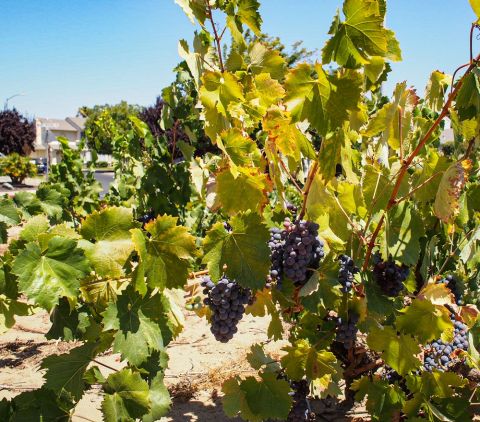
Ironically, the power plant never did come to fruition, replaced instead by an Amazon warehouse. The main threat for the future, however, is the demand for the sand in which the grapevines are rooted, fuelled by the construction industry.
But for now, the 115-year-old Alicante Bouschet vines are safe. Their fruit makes its way into the Cline Ancient Vines Zinfandel cuvée every year, and Alan Lucchesi will continue to defend and tend them for decades to come. Although vines don’t speak in the same way we do, I have a feeling that they’re just as fond of Alan as he is of them.
All the photos were taken and provided to us by Christina Rasmussen.