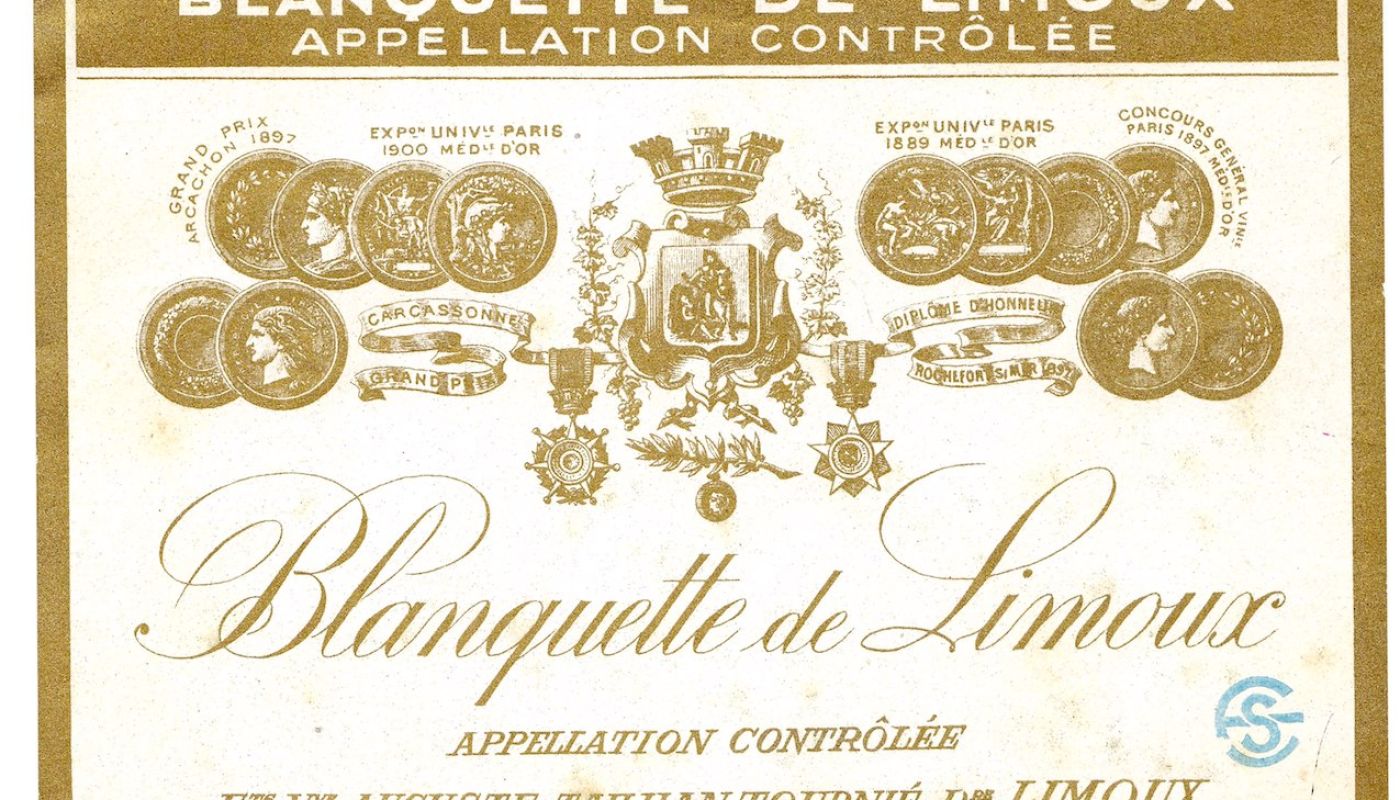
There may be more to Mauzac than meets the glass
We came to Limoux, just south of Carcassonne, in the shade of the French Pyrenees, 20 years ago, because we love a good Chardonnay. Of the region’s three white varieties, it was the magisterial, oak-vinified, crystal-chandeliered Chardonnay with a capital C that beckoned us. At that time, we didn’t know that Chenin blanc would take on as if it were to the terroir born, and we thought of Mauzac as a rather rustic grape used for the local fizz, Blanquette de Limoux. That is to say, when we thought of Mauzac at all.
Who’s ever heard of Mauzac anyway?
I had better declare my interest as well as explain it: we are Château Rives-Blanques, producers of still and sparkling Limoux wines made from Chardonnay, Chenin blanc, and the often-overlooked, eccentric and beguiling Mauzac.
So can we please talk about Mauzac for a minute?
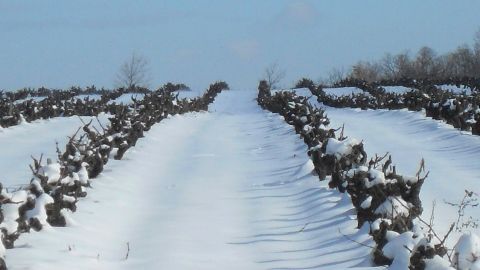
We first saw our Mauzac vines in the light of a memorably cold January day against a bright blue winter’s sky: a field of gnarled, solitary, somber old vines, standing patiently with their backs resolutely turned against a bitter wind whistling down from the Pyrenees. The data for Mauzac’s passport in the Vitis International Variety Catalogue was not particularly encouraging:
Full pedigree: NO
Taste: NONE
The insult lies in the capital letters.
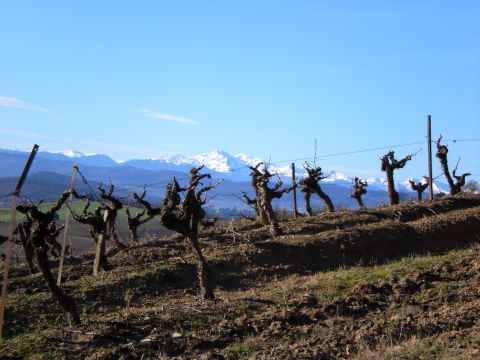
If these vines could talk, they’d have the comfortable Midi accent of the old village square. And like much of the gossip you hear there, the story of Mauzac is a mix of history and hearsay, embellished with chunks of legend drawn from the collective memory.
What we know for sure is that that Mauzac has been around at least since the beginning of the 16th century, because a certain Antequamareta had the good sense to write it down in his Livre de Raison in 1525, and it’s in the archives of the Tarn for all to see.
We can also be confident that it was used to make sparkling wine around this time, thanks to archival records in Carcassonne, which have been carbon dated 1544[i] . Just sprinkle in some regional pride, alongside the knowledge that it was the Benedictine monks in Limoux who were the first in the world to discover how to make their wine sparkle, and before you know it, Dom Perignon is galloping back to Champagne with the recipe tucked in his cassock over a century later.
By the end of our first spring, the old vines inhabiting a field called Le Jardin, right next to our house, had already edged their way into our hearts. This is the time when brave green leaves, with their characteristic duvet of prostrate white hairs (hence the name Blanquette), break out of the dead wood and extend a broad, flat-palmed, fat-fingered countryman’s hand.
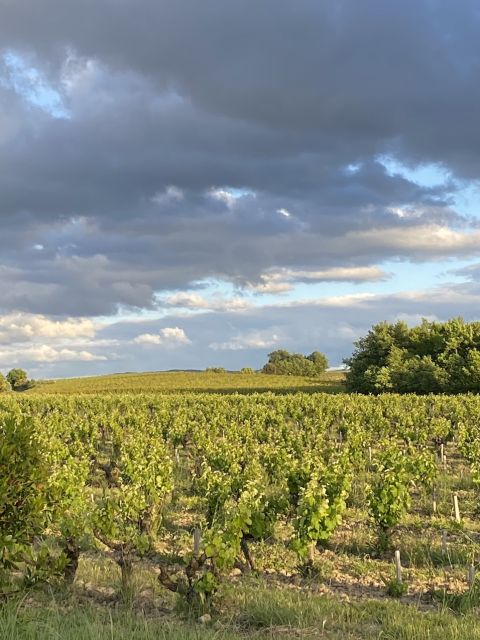
We shook that hand, and that was the beginning of a long conversation.
Le Jardin began to explain itself to us: the woodland that surrounds it, and hedges of juniper, gorse, broom, honeysuckle, and miscellaneous greenery that makes up the garrigue. The biodiversity within it – wild roquette, thyme, sweet pea, clover, rosemary (and some weeds, to be honest) growing among the vines, the hares and mice scurrying from vine to vine, the wild boar and deer feeding off them, wild orchids surfacing on the verges, and the sirl bunting singing overhead.
Add to that a soil of ancient geological molasse dating back around 50 million years ago or so, when the Pyrenees rose with a great shudder from the earth. Mica, quartz, and feldspar lie all over the place, along with bits of Roman relics here and there.
No wonder we began to dream, and set out to make the first non-sparkling 100% Limoux Mauzac made in oak barrels, bravely baptising it Occitania, the name that already defined the region in Troubadour times.

“You’re mad” our colleagues said. “Mauzac is only good for Blanquette.”
And they were right, we were mad, maybe even as mad as the Mauzac Fou de Cépie, the “mad Mauzac” variant named after our village, which delivers no ripe grapes at all. The first year we hardly sold a bottle, let alone found anyone actually prepared to taste it.
(So we drank it all ourselves, which explains why there’s probably more Mauzac in our blood than any any local grower).
We were almost ready to call it quits when a columnist for La Revue du Vin de France called Antoine Gerbelle, visited our cellars, and encouraged us onwards. Two months later, Occitania appeared on the magazine’s front cover: a big, beautiful moment for a still Mauzac from a small vineyard in Limoux. A number of other unusually democratic, open-minded and influential wine writers began endorsing our problem-child wine with the respectability and huge reputation of their names.
We are still grateful to them all, for without them, no matter how delicious or well made it might be, Occitania was doomed to certain death. Indeed, before the encroachment of ‘international varieties’ like Chardonnay and Sauvignon B, there were over 9000 ha of Mauzac in France. Today there are only 1700 ha in total, of which 920 ha are in Limoux. What is more, only seven of the hundreds of genetic strains that existed of the grape are currently in commercial production.
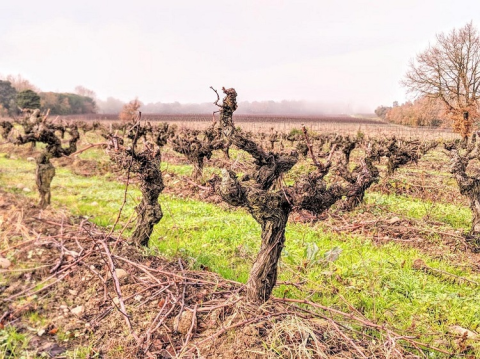
Le Jardin was theoretically planted in 1972, though about a quarter of the vines are easily in their 80’s. Sooner or later, we had to face the sad truth that this single plot was beginning to look a bit long in the tooth, its smile exhausted by dead and dying old vines. Production had dropped dramatically, also because of recent record-breaking extremes of heat, drought or humidity. We started to dream again, and in Lockdown 2020 we received 4000 young vines to fill in le Jardin’s toothless grin.
These were not any old young vines: we had them grafted the year before from 40 of those 200 original, historic clones held in Limoux’s Conservatory under the auspices of the Chamber of Agriculture (100 of each). They were uncertified, uncommercial, and unsubsidised: it was an expensive labour of love from start to finish. The soil was impenetrable, the weather was unhelpful, the work was backbreaking and relentless … in short, the epitome of a hard graft. It would have been easier and cheaper to simply grub the field and start afresh.
So why do it? Particularly when you have no idea what this infusion of authenticity and old blood will do to your sparkling and still Mauzac wines?
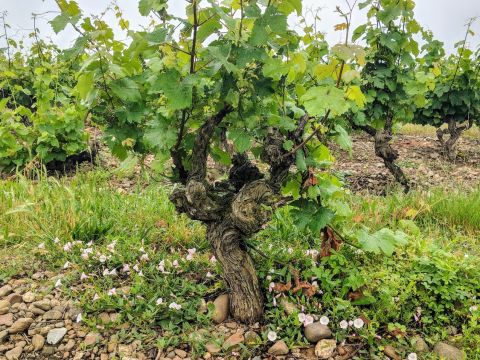
There are a number of reasons. They include the sentimental: the idea of a direct link to the past, the history in a glass, and the preservation of a patrimony. In fact Le Jardin is probably the biggest genetically-diverse parcel of Mauzac in commercial production there is today, and the wine coming from it will probably be as close as you can get to what Livy, Froissart, the good Benedictine monks, Antequamareta, Thomas Jefferson, and anyone else the collective memory clearly remembers, enjoyed.
And they also include the practical: we went for an assortment of high-density, low density, closely compact, and widely spaced fruit-bearing vines because we believe this diversity will help them survive stress and disease, and the new challenges of climate change. Or that’s the idea. We’ll just have to wait and see how our garden grows – and where the vines take us next.
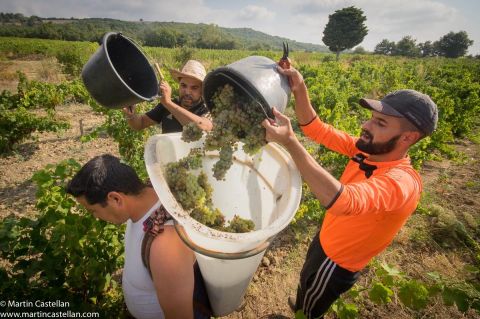
The proof will lie in the bottom of a bottle of Vintage 2025.
Not long to wait in the life of a Mauzac, all things considered.
[i] While It is true that this document doesn’t specifically say that Blanquette was sparkling, or was made of Mauzac even, the names of the grape and the fizz have been used interchangeably for all time (Blanquette is one of the 38 pseudonyms for Mauzac.). Historians say that the Blanquette referred to here must have been sparkling, since it was bottled in glass jars, and was much more expensive than the other wines mentioned. Even the august and powerful INAO (Institut National de l’Origine et de la Qualité ) appears to agree that the first sparkling wine ever recorded was Blanquette de Limoux, and was made of Mauzac – and nobody, but nobody argues with them …. « Ces moines de Saint-Hilaire vont étudier et développer les techniques de culture de la vigne et les techniques de vinification. Ils vont produire un vin mousseux, qu’ils mentionnent dans leurs écrits dès 1531, et qui est ainsi considéré comme le premier vin mousseux élaboré dans le monde. Ils vont développer les cépages les plus adaptés parmi lesquels le mauzac B et vont progressivement maîtriser la technique d’élaboration des vins mousseux » From the INAO’s Cahier des Charges.
The photos were provided by Caryl Panman.
















