Tempranillo is Rioja, isn’t it? Spanish wine lovers know it is also cultivated as Tinta del País in Ribera del Duero, Ull de Llebre in Catalonia and Cencibel in La Mancha. In Portugal, where the variety occurs widely in the Alentejo and the Douro Valley, they call it Aragonez and Tinta Roriz. Although the New World has embraced Tempranillo too, it is a typical Iberian variety. But centenarian Tempranillo in Tuscany… does it really exist? Well, it does. Beconcini’s winery calls itself the custodian of that secret. And it is time to unveil it.
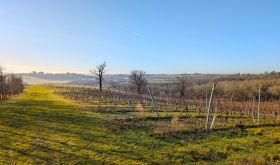
Led by the husband-and-wife team Leonardo Beconcini and Eva Bellagamba, the Beconcini winery is situated just outside the town of San Miniato, in the Arno valley between Pisa and Florence. Leonardo is a fourth generation vintner. Within the so-called mezzadria system his great-grandfather Valentino farmed a piece of land owned by the marquis Di Ridolfi, to whom he paid part of the harvest in kind. From the remainder he raised his family. Valentino grew grains, kept some pigs and – of course – made wine. The actual grape variety he used for that was of no importance. It was simple wine, intended for home consumption or to be sold locally.

After the Second World War, when the mezzadria system was abolished, grandfather Giuseppe was able to buy the land his family had been farming for so long. From the 1950s, Pietro, Leonardo’s father, started to specialise in wine growing. Sangiovese was the main variety. But young Leonardo soon noticed another variety in his father’s vineyards as well. While the leaves of the Sangiovese vines turned yellow in autumn, quite a number of other vines took on a shade of red-brown. Nobody paid attention to them and the grapes simply went into a modest field blend.
But Leonardo was intrigued. Years later, when he gradually started to take over the winery from his father Pietro in the 1990s, he decided to set about solving the mystery. Soon he discovered that the vines in one of the vineyards, Le Nicchie, were ungrafted. Leaves that grow directly from an American rootstock have a different shape than those on the upper part of the vine, whereas leaves growing from the roots of ungrafted vines are identical to the upper ones. But Leondardo still did not know which grape variety gave that lovely red-brown hue to the vineyard in autumn. He called in the support of the University of Milan, which eventually carried out a DNA analysis. What they reported back was a big surprise. The mysterious variety turned out to be Tempranillo! Furthermore, it turned out that the vines had been planted before phylloxera, an aphid deadly to vines, hit the region. Although Leonardo knew the vines had been there for many decades, he was surprised to hear they were at least 140 years old. Le Nicchie’s soil consists of chalky clay in which, unlike sand, phylloxera can thrive.

Little is known about how Tempranillo ended up in Tuscany. “There are two theories, but there is no hard proof,” Eva and Leonardo tell me on the phone. “The Via Francigena, a pilgrimage route, runs right through our vineyards. Continuing to Liguria and Provence, it connects Rome to the famous network of routes that lead to Santiago de Compostella in north-western Spain. Italian pilgrims may have taken some Tempranillo vines back home with them. Or, on their way to Rome, Spanish travellers might have dropped some grapes along the roadside where the pips took root and grew.
“The other theory,” Eva continues, “is that the influential priest and agronomist Giovan Battista Landeschi from San Miniato had a hand in the matter. Being an episcopal see and boasting a customs office, San Miniato was a much more important town than it is now. From there, Landeschi could have actively promoted the proliferation of the variety.”
Fascinating as these theories may be, the situation is actually more complicated. Tempranillo doesn’t only grow in Beconcini’s vineyard. It also occurs in other parts of Tuscany as well as in Basilicata in Southern Italy (source: Wine Grapes, J. Robinson e.a.). In both areas vintners sometimes erroneously refer to it as Malvasia Nera. Tempranillo’s origins in Italy remain unclear. The fact that the Via Francigena continued from Rome to the port cities of Bari and Brindisi in Apulia, from where crusaders sailed to the Holy Land, indicates that Tempranillo might have arrived in Southern Italy as early as the late eleventh century. The Via Francigena originally crossed the Apennines north of Basilicata. However, these pilgrim routes were seldom just a single track. Rather, they were a network of paths that, in this case, led to various final destinations.
Because Tuscany’s hallmark Chianti wine can contain a small amount of Malvasia Nera, the variety is not uncommon in the Tuscan vineyards. Beconcini grows it too. He is therefore an expert on the differences between Malvasia Nera and Tempranillo. Based on his observations, he was soon convinced there was more, possibly old, Tempranillo in Tuscany. This led him and Eva, together with the Istituto Sperimentale di Viticultura in Arezzo to push the authorities to put Tempranillo on the list of permitted varieties for the Toscana IGT. This eventually happened in 2004. They would love to see their fellow vintners taking their ‘Malvasia Nera’ for what it really is, i.e. Tempranillo. Their dream is for Tuscan Tempranillo to get its own DOC one day. But most vintners are conservative, and stick to their habit of calling it Malvasia Nera. To their surprise Tempranillo was also added to the list of permitted additional varieties for the Chianti and Chianti Classico DOCG’s. However, for their own Chianti’s they prefer to use the traditional varieties, which don’t include Tempranillo.
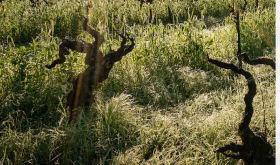
Back to San Miniato, where Eva and Leonardo have made preserving the Le Nicchie vineyard their life’s work. They call the old vines “our monuments”. The low yield vineyard, with its twisted and contorted vines of various shapes and forms, requires meticulous care. When Leonardo inherited the vineyard in the mid-1990s he decided to leave the double-cordon spur-trained system intact, shunning any invasive operations. He only prunes the young wood, leaving the old wood untouched so as to prevent wounds that could invite diseases. Meanwhile they transitioned to biological farming.

Having such a unique old vineyard is more than a means to make singular wines. For Eva and Leonardo, the vineyard is a piece of Tuscan cultural heritage. Creating a great wine is subordinate to keeping the historical vineyard alive. “Nonetheless,” Eva says, “the reason the vines are still cultivated is the quality of the grapes. Besides esthetic beauty, it is important for us to apply the highest oenological standards to these special grapes.”
Eva and Leonardo also planted a new Tempranillo vineyard using scions from the best vines in the Le Nicchie vineyard. From a total of 4.4 hectares – 3.5 new, 0.9 old vines – they now produce three different wines. For their rosé, the Fresco di Nero, Leonardo experiments with different maceration times. With three days on the skins, the 2018 vintage is almost a light red wine. The 2019 that I tasted was a lovely, classic salmon pink rosé with wafts of fresh, air-dried laundry on the nose and strawberry, rosehip and a light savoury touch on the palate.
The iXe – Italian phonetic for the character X, the great unknown that Tempranillo is in Tuscany – is a supple red wine with intense floral aromas and flavours of dark cherries with additional layers of freshly cut herbs, a tad of tar, chocolate, and autumn leaves: a serious wine, but easy to enjoy.
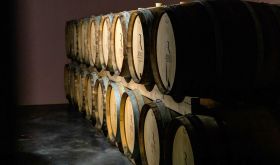
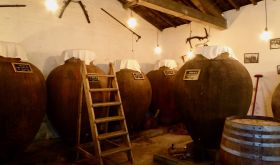
The figurehead obviously is the Vigna le Nicchie, the wine bearing the same name as the vineyard. The grapes for this rich and intense wine are dried in small crates for four weeks, thus reducing their weight by 30 percent. They are then lightly crushed, and fermented with ambient yeasts. Because the “noble skins”, as Leonardo calls them, are somewhat toughened by the drying process, they require prolonged maceration, typically six weeks, to extract tannins and anthocyanins. “To maximise the amount of skins, there is no green harvesting,” Leonardo explains. After two years of maturation in French oak barrels, 50 percent new, and an additional two years in the bottle, the wines are released to the market. At 15.5 percent ABV, the 2013 vintage that I tasted was distinctively full-bodied and powerful. Grippy, but finegrained tannines and invigorating acidity provide the frame for layers of dark plum, cherry and dried fruit and hints of black pepper, bay leaf, leather, tobacco and chalky minerality. The wine is dense and concentrated, and can easily age for another five to ten years.
Le Nicchie’s vinification process resembles that of an Amarone, although Leonardo disputes that. “For an Amarone, the drying process lasts significantly longer resulting in strong wines with some residual sugar. Vigna le Nicchie is dry. An Amarone is about concentration of the grape juice; for Le Nicchie it is about optimising the ratio juice to skins.”
The next step envisaged by Eva and Leonardo is to make an inventory of all the old Tempranillo vines in Tuscany. Now that the secret of centenarian Tuscan Tempranillo has been unveiled, it hopefully makes historical sense for other vintners to call their Malvasia Nera what it really is, join Eva and Leonardo in building an old Tuscan Tempranillo network and strive for the creation of a Tuscan DOC dedicated to the Iberian variety. In an effort to learn more about how Tempranillo arrived in Italy, Eva and Leonardo also hope to organise a conference on the achievements of agronomist Landeschi.
Le Nicchie, in Tuscan dialect, means ‘the fossils’. The name refers to the marine fossils that give the soil their high lime content. But in Italian it also means ‘the quiet places’ or ‘the small valleys’ and, applied to economics, ‘the niches’ or ‘the niche products’. And indeed, the vineyard is a peaceful haven that shelters some magnificent old vines. The wines are most certainly niche products, but they are much more than mere curiosities. They are expressions of a long history, works of love and, above all, they are delicious.
The photos are provided by Bart de Vries.