Caro Feely is a writer, wine and yoga teacher, and organic farmer. This is a story of regeneration of a farm that Caro Feely co-owns, and an appellation, and region, that she is part of. Find Caro Feely, writer, at www.carofeely.com , on Instagram at www.instagram.com/carofeely twitter at twitter.com/CaroFeely and chateau Feely at www.ChateauFeely.com and www.instagram.com/chateaufeely.
Regeneration – changing our thinking
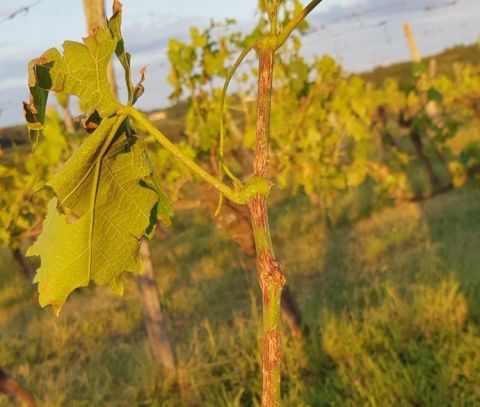
The day after I started writing this article we were hit by a hailstorm. Golf ball size hailstones pounded down, slashing through leaves and scything canes, flowers, and tiny grapes off the vines. The thundering of the stones on the roof was like a battle overhead. We watched, powerless, as our vines were thrashed. As the sun rose, we walked the vineyard to assess the damage. The ground was white with hail. The vines were badly hurt. I could hear them crying. I felt traumatised like they were.
We were in a fog that day, like a day of mourning. Within a couple of days, the vines swift moves to regenerate offered a role model, they told us to pick ourselves up. By the fourth day their wounds had closed, and healing was well underway. Ten days later, new stems and leaves were forming. They wouldn’t bring back the lost harvest, but they would help to ripen what was left, and repair and form potential canes for next year.
I feel the weight of climate change heavy on me. I wonder how we will live in the chaos of it, more storms like this one, more late frosts. I remind myself that our vines are resilient and with regenerative farming, they are more resistant to climate extremes1. Not only that, through our farm we share the story of regenerative agriculture, of organic farming, and how they can help mitigate and adapt to the climate change we see first-hand. Living in a city, the climate crisis generated by our greenhouse gas emissions and the 6th mass extinction2 that is underway, can seem far away, but they are already here, already creating terrible, sometimes fatal, effects. For a summary and recommended reading see my blog post https://chateaufeely.com/7-tips-for-eco-resolutions-in-2020/. Regenerative farming and thinking are tools we can use to meet it.
Feely farm
My husband Sean and I have been organic wine farmers in the Dordogne for seventeen years. When we bought the farm in 2005 it was in liquidation and chemically farmed. The soil was gray and hard, like cement. Any plants that grew through the hard soil under and between the vines, were unwanted weeds like, chiendent, ‘Elymus repens’ in Latin, common English name ‘couch grass’; liseron, ‘Convolvulus arvensis’, common name field ‘bindweed’; chardon marie, ‘Silybum marianum’, common name ‘milk thistle’, and ronce, ‘Rubus fruticosus’, common name ‘blackberry’. I love the last one, picking its berries from our hedgerows in the cool morning is one of summer’s great joys.
Our inherited farm adviser wanted us to herbicide the vineyard with glyphosate to kill the green growth and a pre-emergent herbicide to kill germinating seeds. We were set on organic farming and rejected his advice. We found that by not using herbicide, ‘good’ weeds like nitrogen fixing clover, a natural green manure, and other beneficial plants, appeared. We also seeded some of these beneficial cover crops and they have gone on to reseed themselves.
In the early days we ploughed every second row but seven years ago we stopped ploughing. The permanent plant cover stops erosion, offers natural insulation, and biodiversity. We keep plant growth in check with infrequent mowing between the rows and a mechanical hoe or strimmer under the vine rows, or hand weeding young vines. Today we have flourishing vines, including three blocks of pre-clone old vines that are in great health, natural mats of clover, and significant biodiversity.
What is regenerative thinking?
Regenerative is transforming our thinking from extractive, how much volume of wine and financial value can we generate; to how many benefits can we create, for nature, for us, for the wider community. It is thinking circular rather than linear.
English economist, Kate Raworth, created a new way of economic thinking she calls ‘Doughnut Economics’, initially outlined for an Oxfam paper she wrote in 2012. It assesses the resources of our planet compared to our consumption. Her model shows we must stop thinking about GDP growth as the key economic indicator of success and think wider of the overall health of the eco-system.
When human needs are met are met within the ecological capacity of the earth we are in the happy place, the ‘safe and just space for humanity’ within a ‘regenerative and distributive economy’. Outside the doughnut, if we overshoot the carrying capacity of ecological systems, we create ‘climate change, ocean acidification, chemical pollution, nitrogen and phosphorus loading, freshwater withdrawals, land conversion, biodiversity loss, air pollution and ozone layer depletion’. We could apply the idea to an individual farm.
A farm can generate benefits beyond its core product and associated revenue. Farms can offer a place to discover nature, they can connect all the people in their sphere, the people working the farm, clients, and the farm’s local community to the earth via their approach and outreach. For example, Domaine Montirius in the Southern Rhone takes a moment every morning to check in as a team and be thankful for the day. A simple gesture that offers respect to the team and a moment of gratitude to the earth. Our guests feel a connection to the earth when we walk along the hedgerows, and I introduce trees, bushes, and vines by name. Respect is built by us knowing them; and by getting close.
A farm can create also create overshoots, for example, systemic pesticides create chemical pollution. See my article on pesticides and the taste of pesticides. Chemical fertiliser creates the negative overshoots like nitrogen and phosphorus loading, climate change (https://chateaufeely.com/chemical-fertiliser-disaster-for-environment-and-major-contributor-to-climate-crisis/) and resultant ocean acidification.
Success that includes environmental wellbeing
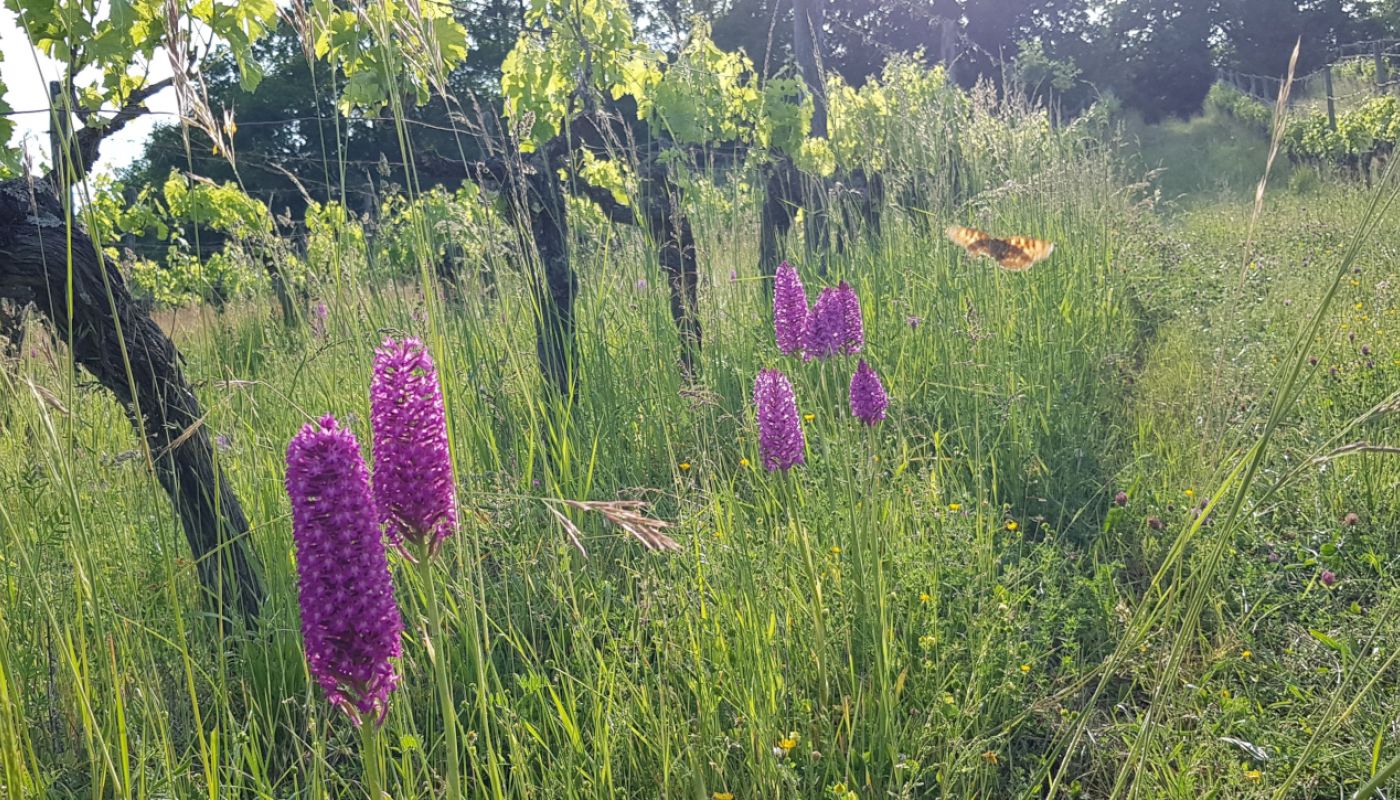
At Feely farm we decreased production, allowed more space for biodiversity, and transformed a vineyard in liquidation into a sustainable business. Wild orchids appeared after three years of organic farming, an indicator that the soil was cleared of the systemic fungicides that had been used before we arrived. At first there were a few. This year, we counted over five hundred total across four different species. Orchids are dependent on mycorrhizae, fungi that develop on the root systems of plants, like an extension of their root network. Mycorrhizae3 are part of the secret to being able to farm successfully without chemical fertiliser and in a regenerative way.
Nurture human nature and nature
In his vineyard work, Sean touches everyone one of our vines several times per year, and I, a couple of times. Sean is in deep communion with them. He felt the hail even harder than I did, like he was living the pain with them. As humans we need collaboration and reciprocity with our farms, our vines, and our community. When I walk our vines, I feel a love flowing from the earth and the vines to me and vice versa.
It goes beyond the vines to our wider farm community. There are two perfect shady spots where I stop to talk about biodiversity on the tours we offer and where I teach ‘yoga in the vines’ classes. The oak trees there seem to know me. When I touch their leaves, it feels different to how it feels with other oaks. We have formed a relationship from them seeing me so often, hearing my voice, feeling me gently touching their leaves. In her magnificent must-read book, ‘Braiding Sweetgrass’, Robin Wall Kimmerer (https://www.robinwallkimmerer.com/) shares the indigenous wisdom to see this earth, rocks, water, insects, plants, trees, as beings, to be respected.
In Saussignac we are part of a winegrower community that is more than 50% organic, where research is being undertaken, for example, on cover crops at Chateau Le Payral, on new methods and disease resistant varieties, at Chateau Grinou. Within the wider Bergerac appellation there are others developing permaculture, agroforestry, and biodiversity, like we are, for example at Lestignac and Combrillac. Covid and tough economic conditions, particularly for winegrowers in less-known appellations like ours, have meant less group gatherings than before, less time for sharing, less community links. There is a growing sense of urgency to work together as we face the challenges of climate crisis.
At a recent event where we were both speaking on biodiversity, a colleague said we need to ‘hold out a hand rather than point a finger’ to help people on the regenerative path. The Bergerac Duras interprofessional wine organisation (IVBD) is doing that with events on agroforestry, biodiversity, climate change and support of projects moving environmental issues forward. Bergerac is one of the most environmentally aware regional appellations in France with 28% of the vineyards certified organic. In addition, the Dordogne basin was classed as Biosphere Reserve by UNESCO in 2012.
Biodiversity, Agroforestry, and Hedgerows
That biosphere reserve status is important, it helps protect the biodiversity here. At the end of our first full year of organic farming back in 2006, our advisor from the local Chamber of Agriculture did a count of beneficial insects in the vineyards. She found three times what she had found on other vineyards that had been organic for longer. We didn’t understand why at the time, but after doing a biodiversity course last winter, I understand. The wealth of hedgerows, forests, and groves, on our diverse terrain, were the secret.
Biodiversity means biological diversity in an environment, as indicated by numbers of different species of plants, insects, and animals. Sometimes people are confused about the terms 'biologique' which means organic in French (a term that can only be used for certified organic products), biodynamic (a way of farming that is 'organic +' see our online organic and biodynamic trail for more details (https://chateaufeely.com/visits/organic-and-biodynamic-trail/) and biodiversity. Unlike the other two terms, biodiversity is not a certification, but it is a valuable component of a healthy farm, a key element of regenerative agriculture, and something that can be encouraged on conventional, organic, and biodynamic farms, and in your garden.
We are only beginning to understand the importance of biodiversity, at a time when we are losing biodiversity as an accelerating pace. The Intergovernmental Science-Policy Platform on Biodiversity and Ecosystem Services (IPBES) 2019 Global Assessment Report on Biodiversity and Ecosystem Services estimated that 1 in 4 species was at risk of extinction due to pollution, loss of habitat, and climate change. Ecosystems are like a house of cards, if one goes, it impacts many others and accelerates more loss and potential collapse of the entire system.
A variety of plants (plant biodiversity) growing in the vineyard brings a variety of insects including the beneficial ones. We have 28% of our farm as wild areas including hedgerows, groves, forests, and prairies. We also encourage wild plants to grow between our vine rows, and ivy and trees within the rows, creating plant biodiversity that brings insect, bird, and mammal biodiversity.
Through insect biodiversity we have large populations of good insects like ladybirds, Typhlodromus, and common green lacewings, that keep those we don’t want, like aphids and spider mites, under control. This means we avoid insecticides. This concept goes beyond low level plants and grasses to include trees in the vineyard and hedgerows around the edges of the vineyard.
In 2014 when we changed to hand picking all our grapes, Sean began encouraging ivy to grow every 20 metres or so, ideally on a post, to feed pollinators. Ivy is one of the few local plants that flower in late autumn, offering much needed pollen as we descend into the darkest days of the year.
For years we wondered why we didn’t have a problem with grape worm. It turns out that bats are our ally. Bats can eat their body weight of the European grapevine moth in a night. They solve the grape worm issue for us. But bats will only fly about 30 metres into a monoculture with no relief. To go further they need navigation points, what our ivy and trees in the vineyard provide. What Sean started for bees is great for bats too.
Hedgerows, forests, and layers in the vineyard, like the ivy and trees we are training along the trellising, offer bats, other mammals, birds, and insects, habitats, or places to live. Ivy is a mega biodiversity booster. An oak tree with ivy hosts double the number of species that the same oak tree without ivy would host.
Compost and animals
Regenerative thinking is also about cycling nutrients back into the vineyard. We use our grape waste for compost along with scythed hay from fields that are resting, vegetable waste and animal waste from our chickens. Stepping away from chemical fertiliser is critical to farm regeneration and to combatting climate change (https://chateaufeely.com/chemical-fertiliser-disaster-for-environment-and-major-contributor-to-climate-crisis/ ). We also use herbs and plants from our farm for biodynamic teas, including stinging nettle, willow, and horsetail. They grow here and provide a natural pharmacy.
Societal thinking
Outsize cars and private jets are still seen as ‘cool’ despite not being okay for our collective future. For some, vine rows with nothing growing underneath them, look neat. I see a desert, and cancer, if herbicide was used. Our perceptions are still being formed by images that seemed okay in the 20th century but are not okay in the 21st given what we know about climate crisis and biodiversity loss. The tide is turning. We contribute to this change by our actions, by what we support, and by what we share and like on social media.
Conclusion
As I write this conclusion it is exactly two weeks since the hailstorm. The vines are covered in new green growth. Their regeneration gives me goosebumps, it is so swift and miraculous. They offer hope and awe at the earth’s capability to regenerate. To be part of this ongoing earth story, transformation of our thinking and actions is needed. As farmers we have a major role to play in understanding this, sharing the message, and connecting people to nature.
Do you have questions or ideas for Chateau Feely? I would love to hear from you. You can reach me on [email protected]
Notes:
1 For example, keeping the ground covered in plants helps against flooding and erosion, agroforestry helps cope with late frost
2 Recommended reading – The Sixth Extinction by Elisabeth Kolbert
3 Recommended reading – Entangled Life by Merlin Sheldrake
















