Gwendolyn Alley writes She has hooted for spotted owls, completed the Pacific Crest Trail, parented peregrines, pruned pinot noir, picked petit verdot, competed for the US Wine Team, and worked in the Ridge Vineyards tasting room. With undergraduate and graduate degrees in English, Education, Environmental Studies, and Ecopsychology, Gwendolyn teaches college, freelances as a journalist, writes for the Slow Wine Guide, blogs at Wine Predator (http://winepredator.com), and attends as many industry tastings in Los Angeles as possible.
The young foster dog “Lupine” was restless. I’d just finished a 90 minute conversation with Ventura County fifth generation farmer Phil McGrath, a statewide leader in regenerative farming, or as he likes to think of it, successional farming, meaning farming in a way that considers successive generations.
Listening to Farmer Phil entailed ignoring the dog who was ready to play, and, after our conversation, I was ready for an IPA. As we walked in the summer sun a few blocks to Transmission Brewing, I called my friend Valerie Mallory who I’m helping with her Burning Man honorarium art installation, “Secretly Abandoned Spaces.” The theme this year is “Waking Dreams” and we needed to discuss the experimental structures we are creating for people to share their stories and their dreams with each other.
But I had something else on my mind. “Valerie, as an artist, what does regenerative mean to you?”
I expected her to say something along the lines of how art regenerates her as a person, but she surprised me by describing how an art installation, like the ones she’s been making for ten years at Burning Man, takes on a life of its own, becoming independent of her, the artist. Making an artwork is like having a child: she may gestate and birth it but it grows on its own, generates its own life, and evolves with those who interact with it. Farming is a lot like that too, I thought, reflecting on my experiences working in Ventura County vineyards.
Saying goodbye to Val, I climb the stairs to take in the view of the Pacific and the golden hillsides from atop their four story high tower. From my vantage point, I can almost see the Ventura headquarters for Patagonia, just a mile or so away.
According to Patagonia founder Yvon Chouinard speaking at an Earth Day talk I attended pre-pandemic, the most important solution to climate change is regenerative agriculture: it’s healthier for the planet and for people too. And that’s why Patagonia started their Provisions division: he felt he could make greater change through agriculture than through consumer goods like clothing.
The way we’re eating, Chouinard pointed out, we’re not getting the nutrients we need, even if the food is organic. With regenerative organic ag, we grow foods with more nutrients and we build topsoil– the all important 6” upon which all life depends. Regenerative agriculture holds on to those top 6″ and preserves it while also capturing carbon by not tilling, and by holding it in the ground where it belongs. This supports soils by increasing organic matter, and that organic matter, dead or alive, is made of carbon. That organic matter then becomes sequestered in the soil. Scientists measuring carbon going from the air into the ground in regenerative protocols extrapolate that if this type of farming went to scale, we could put back the carbon we’re releasing, reported Chouinard, and fight climate change.
How can any product, even an agricultural product, do less harm but do more good? People say we can’t but Chouinard said we can with regenerative agriculture. Regenerative farming also uses less water; the ground is back alive again and full of what holds the water. “We’re going to run out of water before we run out of anything on this planet,” said Chouinard, however, “When you do the right thing you end up making more money.”
Recently, Patagonia’s Provisions launched a line of wines, joining other wineries around the world that have embraced regenerative viticultural agriculture like vineyards I have visited in person and via ZOOM including La Maliosa in Italy, Vincent Charlot in France, and Troon Vineyards in Oregon.
Regenerative agricultural vineyards look a little wild, weedy even. But in that mess is LIFE — rich, complex, life, a web that brings the minerals along with the moisture up from the ground into the vines and the grapes. This is what makes wines from regenerative agriculture special — not just avoiding pesticides or growing organically but that they are regenerating the soil, creating a weblike network of life, and in that process, making better wine — wine that gets higher scores according to UCLA research.
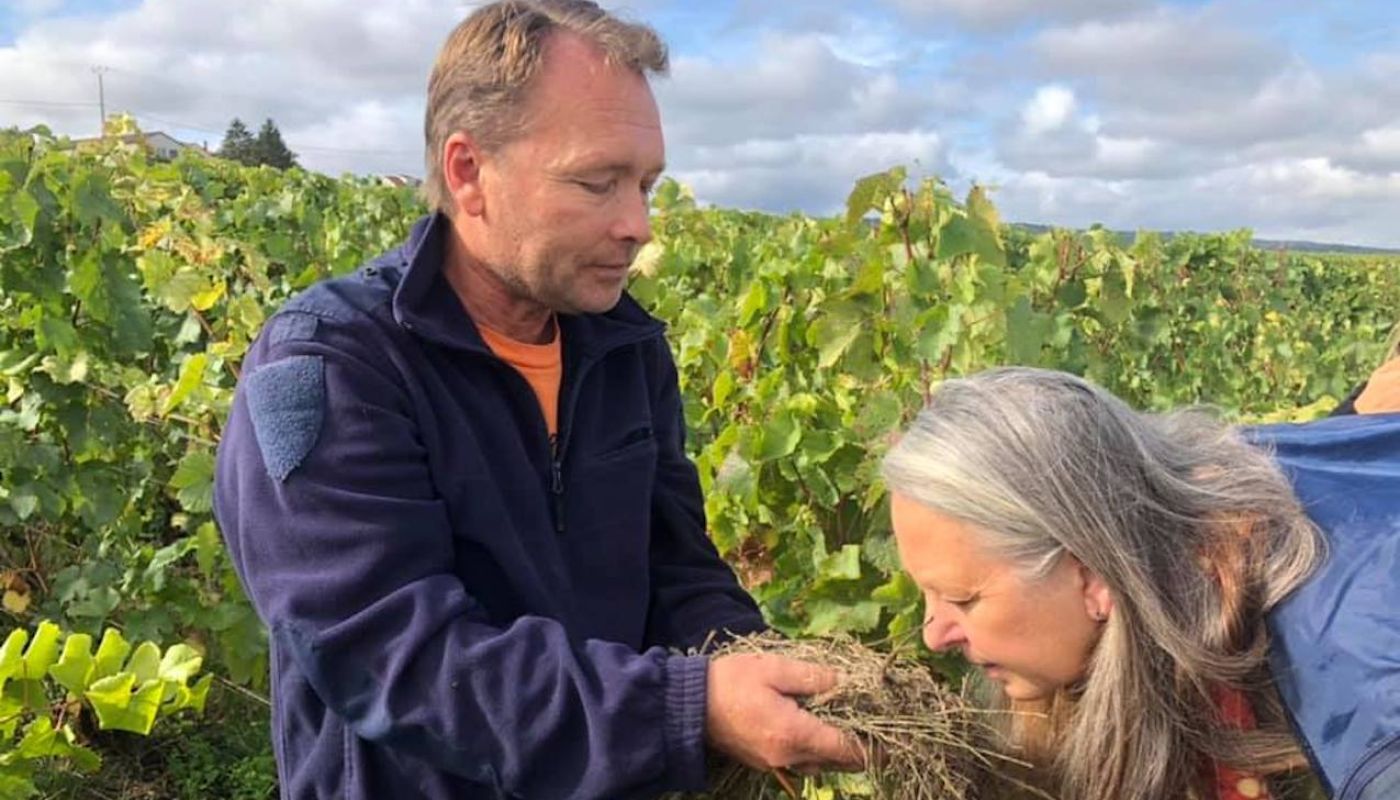
During a visit to Mardeuil, France, winemaker Vincent Charlot held his most precious asset: healthy soil. To make the best champagne, Charlot told me he must “understand the mind of the soil.”

Fifteen years of organic and biodynamic practices direct Charlot in how to listen and learn from the soil in his vineyards. While his grandfather grew grapes and made wine, his father sold the grapes to the cooperative. Charlot took over the vines in 2001 but convinced his father to experiment with viticultural practices back in 1994. They began the transition to organic when he saw “life return to the vineyard” and a “difference in purity in his wine experiments” as Caroline Henry reported in her book Terroir Champagne.
“When you work biodynamically,” said Charlot, “you work closely with the sun and moon. But that’s really just the beginning in biodynamics. When you believe about the sun and the moon, the rest is more simple.”
Because of intensive pesticide use in the vineyards, Champagne may have the most polluted water in France — and the world. Charlot uses natural, organic remedies to build strength in the vines via the chalky soil. “When you have soil like this, the roots are deep,” said Charlot. “Just like a person — more balanced, less sick.”
You can taste the chalk when you taste the soil — which you can do because it is not dead and full of pesticides. “When you smell the soil with products, you can smell the difference,” said Charlot. And when you taste the chalk, you can taste that the wine is born from the sea and the marine life that once lived there.
“You must have a lot of vegetation,” said Charlot. “If you retain the soil, the mushroom will be there.” By mushroom, Charlot means the mycorrhizal fungi that produces a web of communication between the various plants and attaches the soil to the roots making the soil light and fluffy.
Mycorrhizae form symbiotic relationships with the vines and other plants in the vineyard; they colonize the root system of a host plant, providing increased water and nutrient absorption capabilities. In turn, the plant offers carbohydrates formed from photosynthesis.
Like Charlot, Lorenzo Corino said he trusts the moon: “The moon is very important. When a new moon, the vines grow faster. The moon is something we know well and follow."
Corino, who died in late 2021, developed with Antonella Manulli the patented Metodo Corino– a vegan regenerative farming method of wine grape cultivation and production.

"Soil is an organism and you have to try not to disturb too much. Tilling is disturbing. It is much better to work with herbs or to mulch the soil. Of course it takes longer and the yield is a bit lower."
Instead of using animal products like manure, La Maliosa's Antonella Manuli grows hay to use as mulch in her vineyards. “Hay mulching has many functions,” Manuli said, making the land “favorable to life in the soil,” shading the earth, and stopping erosion.
Since Tuscany's Maremma is “subject to long periods of drought… you can have a lot of damage done to the soil life,” she explained. Using hay for mulch “keeps the moisture for a long time when it rains.” With drought and rainless periods lasting 4-5 months, she can keep moisture in the soil which is important because “we don’t irrigate artificially.”
Manulli considers her carbon footprint as well: “When you have grass covering, you have absorption of carbon. What we are doing when we use the hay mulch we are trying to replicate what is happening on forest soil.” The soil that you have in the woods, in a forest, is the best for wine grapes she thinks.
In addition to using no water from outside the farm and keeping soil covered with mulch, Metodo Corino avoids mechanization, uses electric rechargeable equipment, grows vine varieties adapted to terroir, and maintains woods in the farm to support biodiversity so that grapes grown under the system exist in a complete ecosystem. This is one of the oldest places in the world for wine grape cultivation, going back 4,000 years; to keep it going will require continued care for the soil.
While on this summer evening I can see out to the Channel Islands from my perch at the brewery, last summer I experienced a gauzy orange haze from forest fires which disrupted the views in the Rogue River Valley in Southern Oregon. I was there to check out the first regenerative organic certificate for an Oregon winery– Troon–and one of only a few in the world.

Located at 1400’ above sea level where a gap in the coastal range allows cool Pacific air to seep, the Kubli Bench provides Troon’s vineyards with significant diurnal shift for ripeness and acidity, with soils on an ancient well-draining river bed with layers of cobbles. In 1972, Dick Troon planted some of the first vines in the Applegate Valley. New owners Denise and Bryan White allowed General Manager Craig Camp Troon to transform the aging vineyards from the typical to the exceptional by achieving biodynamic certification then a regenerative organic certificate.. This conversion to biodynamics reinvigorated soils and vines with the less healthy ones replanted and replaced with Grenache, Syrah, Mourvedre, Malbec, Vermentino, Tannat, Marsanne, Roussanne. The Troon farm now has dogs, sheep, mounds of compost, a worm farm, and more, seeking to grow and provide all of the plants and inputs they need.
As Lupine and I trot down the stairs from our viewpoint, I think about Martin Luther King Jr’s advice, "You don't have to see the whole staircase... you just have to see the next step and take it." Walking home in the twilight, I muse about how lupine, a legume, helps to heal the soil, and how he, Lupine, as a foster dog from a high-kill shelter, is also an example of regeneration. Surrounded by stories of regeneration and opportunities to participate in regeneration near and far – we just have to look up and see the next steps.
All images are the author's own.
















