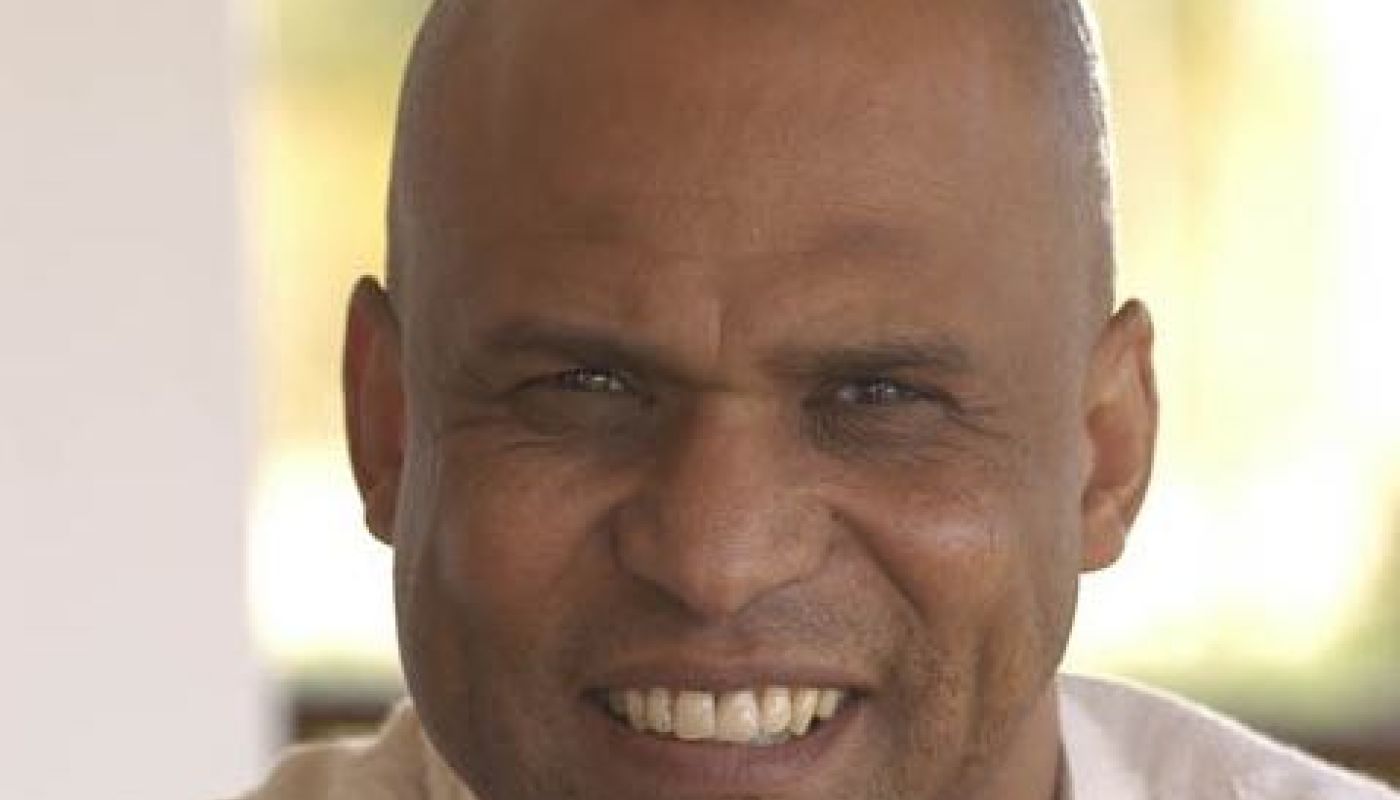
Vernon Henn (pictured below), who runs Thandi Wines in South Africa, was once a freedom fighter. He grins as he recalls how in 1985 he was the high-school ringleader. His eyes light up as he tells how he used to throw bricks and petrol bombs. ‘It was so emotional, you know?’ The man he took over from at Thandi, Rydal Jeftha (right), trumps him, reporting proudly, ‘I was involved in the very first uprising. You’d sit in class and these big guys would come in with guns – you just had to flee. It was a terrible time for our parents. They were all “yes, baas”.’
Rydal, in Ralph Lauren polo shirt, and Vernon, apparently in permanent laugh mode, are entertaining me with tea and biscuits in the boardroom of Koopmanskloof, one of the biggest of the black economic empowerment enterprises in Cape wine. As head of Koopmanskloof, Rydal is in charge of 520 hectares of vineyards, and a slightly tired-looking cellar that produces a very substantial 2.5 million litres of wine a year.
But Koopmanskloof no longer bottles any wine. All their sales are in bulk, ‘so we lose the value-added aspect’, Rydal reports sadly. ‘We used to be strong in the UK. When we sold to Tesco and the Co-op, those were the glory days.’ But companies such as Koopmanskloof have never recovered from the major UK multiple retailers signing up to the Courtauld Convention in 2005, agreeing to ship as much wine as possible in bulk. This saved them a fortune, while allowing them to claim the sustainable high ground. But while the aim was environmentally laudable, the social consequences in South Africa have been considerable.
Rydal may make 2.5 million litres a year but he can’t sell it all. ‘We’re at a critical phase. Even the government admits that’, he says, his broad smile evaporating. ‘It’s a cash-hungry business. Grants were initially available for schemes like ours but no longer. Two to three years ago people were starting to burn down farms because they saw the gap widening between richer and poorer blacks. Now it’s black against black.’ All this is against a background of his being urged by UK importers to somehow make his wine ‘more black’ to give it a point of difference.
Koopmanskloof is made up of four farms in which the 120 workers have shares. The holding company is 51% black-owned. The farms have their own churches, sports facilities, crèches and so on, and the whole thing has been planned with the South African wine industry’s focus on biodiversity in mind, so includes a 67-hectare private nature reserve.
These workers enjoy better living conditions than average and the 120 rand (about £6) they are paid a day, I was assured, is above the 112 minimum wage. In 2007 the workers’ houses were extremely basic but now they’ve added solar panels, ripped out the asbestos, and there is even a provident fund subsidised by the Fairtrade money. But Rydal and Vernon would like to see worker conditions improving a bit faster than they are, even if cars are no longer the rarity they once were on the farms.
Rydal is all too aware of the drug problems in Cape Town just down the road from the winery in Stellenbosch. ‘It can be difficult to incentivise a worker. If I speak to a worker about substance abuse [under the infamous old dop system, Cape vineyard workers would be supplied with and subjugated by free wine], they can now go and buy their own wine. But some of them steal metal pipes. We lost 46 poles in a month recently. The city’s coming closer and that brings drug dependency problems. What we want to do is restore humanity.’
Rydal is particularly proud of a recent workers’ trip to their homeland. ‘It was a very emotional journey, made with money from the kitty, to where they came from. So now they want to work harder so they can afford to go back.’ But his experience of shipping in workers for the harvest from the townships was less happy. ‘Half of them left when they saw what work had to be done for 3.50 rand a bucket of grapes.’
His sales pitch includes being able to promise customers wine from the same blocks of vines each year. He is proud of his team, and of having a succession plan. When his daughter Tamsyn said she wanted to make wine he tried to put her off by showing her a pofadder snake and warning her that this was going to be her companion in the vines. But she has travelled to Napa Valley and Germany and is already assistant winemaker at the highly regarded Hartenberg winery.

Vernon (left) is sceptical about some of the 20-odd black-owned wine companies in South Africa. ‘Some of them are virtual companies, buying a white-produced wine and putting a black label on it. There’s no control over quality for them. But Mhudi is one of the better ones because they have their own land.’ He is speaking from a position of strength. His company Thandi was the very first BEE venture in any form of agriculture – established back in 1995, one year after South Africa’s first democratic elections, by neurosurgeon Paul Cluver on his fruit farm in Elgin on the cool south coast. (There are Thandi apples and pears too.)
I have long found Thandi wines distinctly superior. Its three farms benefit 250 families so it is another of the biggest BEEs. Thandi produced the first Fairtrade wine to win a gold medal in London’s International Wine Challenge, back in 2004. But Fairtrade status comes at a price: each audit costs 50,000 rand and then further investment may be needed to reach the standards required.
Today the BEE brands tend to focus their export efforts on Scandinavia, where monopolies such as those of Sweden and Finland are positively disposed toward helping the cause of the previously disadvantaged, to borrow the standard phrase. Indeed they actively demand Fairtrade or WIETA accreditation.
‘They have a conscience’, says Vernon simply about his Scandinavian customers. ‘A better life for all – that was Mandela’s message, but it hasn’t quite worked out like that.’
I asked them both about the effect of Mandela’s death at the end of last year. They learnt of it while on, of all improbable things, a government trade mission to Vladivostock. Was it successful? I asked. Rydal beamed. ‘If I told you, I’d have to kill you.’
BLACK-OWNED CAPE WINE BRANDS IN THE UK
UK importers are given in brackets. Many of the wines are available from SA Wines Online.
Cape Dreams (Fine Drinks Cooperative)
Dorrance (Top Selection)
Earthbound Wines (Distell)
Land of Hope (available at M&S, imported by Les Caves de Pyrène)
Ses’fikile (Copestick Murray Wine Solutions)
Solms Delta (Dreyfus Ashby)
Stellenrust (Bibendum PLB Group)
Thandi (SA Wines Online)
Women in Wine (Cape London)