
A win against the Trump tariffs
During 19 April’s newscast, I mentioned that the Liberty Justice Center had filed a lawsuit against the Trump administration challenging their authority to issue worldwide tariffs without congressional approval. That suit was filed on behalf of five businesses – one of which is New York-based wine importer VOS Selections. Following that, 12 US states filed a similar lawsuit.
On Wednesday 28 May, the US Court of International Trade ruled that the US Constitution gives Congress exclusive authority to regulate trade with other countries that is not overridden by the emergency powers invoked by Trump, whose use of tariffs is, and I quote, ‘impermissible not because it is unwise or ineffective, but because [federal law] does not allow it.’ The court issued a permanent injunction on the blanket tariff orders and invalidated, effective immediately, all tariff orders issued since January justified under the International Emergency Economic Powers Act (IEEPA). Within minutes the Trump administration issued an appeal and asked the court to pause any enforcement of the ruling while the appeals process played out.
The next day, 29 May, the US Court of Appeals granted the Trump administration’s request to pause enforcement. They will now consider the ruling, and, in all likelihood, this will end up with the US Supreme Court.
I’m now going to skip over Trump’s threats of 50% tariffs on EU goods, which he made last Friday 23 May, because, with the Court of International Trade ruling, I no longer have any idea what we can expect.
New maps for Marlborough
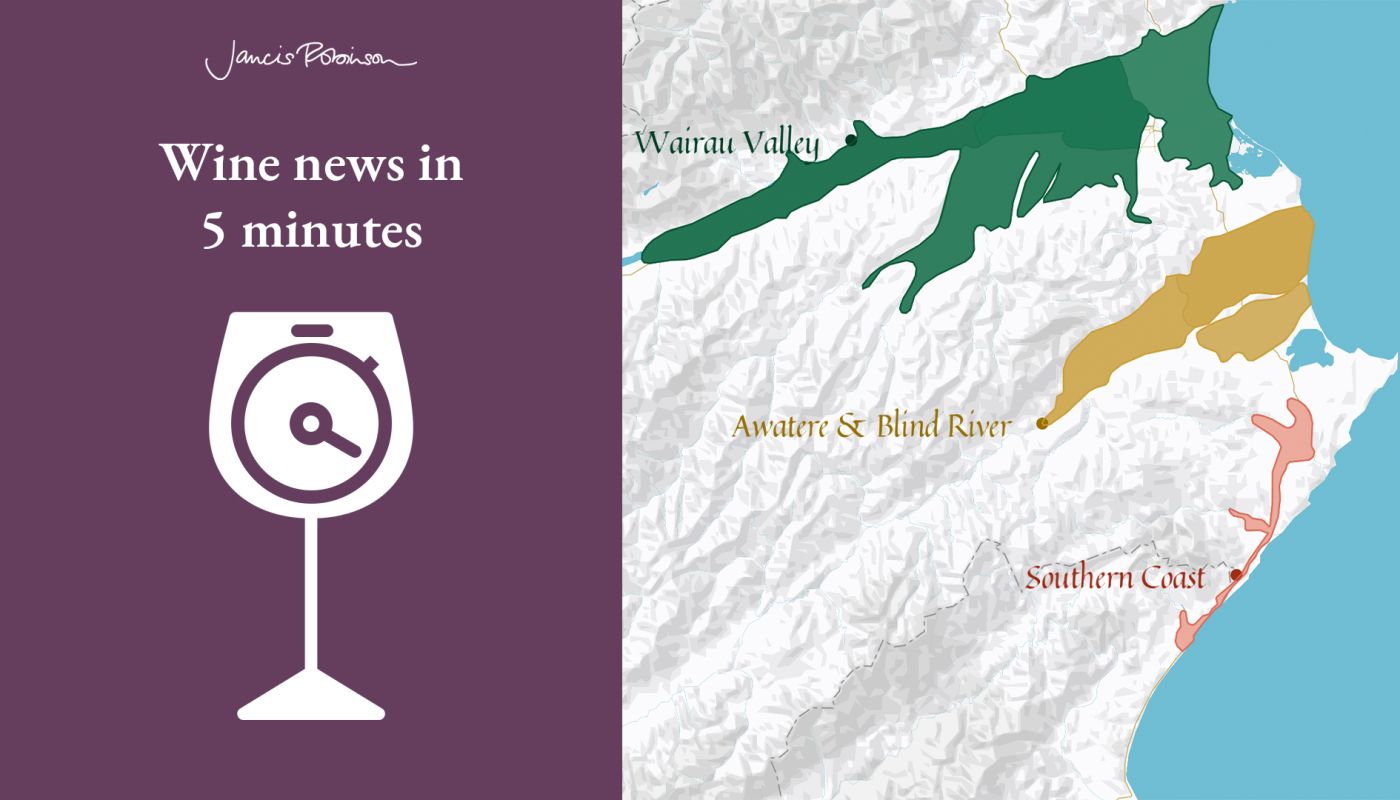
On 29 May Appellation Marlborough Wine (AMW) launched an interactive online map that details the regions of Marlborough. For each region, information on geography, climate, soil, viticulture and wine characteristics is given. As an example, if you click into the Wairau Valley you can then delve deeper to explore the Upper Wairau, the Lower Wairau, the Central Wairau or the Southern Valleys. If you click into the Southern Valleys, the site provides a list of important areas within the subregion, tells you that the most significant soil type is low-fertility clay, that the north–south orientation of the valleys blocks much of the maritime influence of the Pacific Ocean, and many other helpful pieces of information.
If you love Marlborough wine or if you’re a map nerd, I recommend checking it out.
Chile’s 2025 harvest
If you haven’t already read Amanda Barnes MW’s report on Chile’s 2025 harvest, you should go take a look. Yields look to be down around 20% nationwide due to spring frost and strong winds during fruit set. Central Chile saw heat spikes in January and February and rains and cooler temperatures in March, creating a split in harvest dates similar to that Barnes reported on for Argentina’s 2025 vintage. Southern Chile saw heavy rains prior to harvest. The bright spot of the vintage was northern Chile, which had one of its best vintages in memory, with larger-than-average yields.
Lightweight bottles for Langhe and Roero
The Albeisa Consorzio is a non-profit that was founded in 1973 to promote the wines of Italy’s Langhe and Roero regions. All 318 members, which include some of the most famous names in Barolo and Barbaresco, agree to use a standardised bottle that represents the region. The traditional bottle weighs 575 g. In 2007 the Consorzio created an alternative bottle with a weight of 450 g, which allows producers to choose to reduce their carbon emissions by 22% while retaining their Consorzio membership. On 20 May Wine-Searcher reported that the Consorzio has decided to introduce a third alternative weighing 410 g. Producers who use this bottle will see a further 9% reduction in carbon emissions. This is great news! Heavy glass does not indicate better wine and the more producers who commit to reducing glass-bottle weight, the better off the planet will be!
Combating disease with soil fungi and bacteria
Downy mildew is one of the most pervasive diseases affecting grapevines and, left untreated, it impairs photosynthesis, will reduce yield and quality of fruit, and can completely defoliate a vine. It is also possible for the infection to overwinter in the soil and reinfect a vineyard the following year.
A study conducted by Paola Fournier and colleagues at the National Research Institute for Agriculture, Food and Environment (INRAE) in France found that the abundance of certain soil fungi and bacteria in topsoils is directly correlated to a lower incidence of downy mildew. They found that both incidence and severity of downy mildew can be predicted with higher accuracy by looking at soils than by analysing the microbiology present on leaves. Fournier was quoted by Vitisphere as saying, ‘Most of the differentiating fungi we identified in the leaves belong to the category of basidiomycete yeasts, already well known and used as biological control agents that compete for nutrients and space with diseases affecting harvested fruit … In the soil, we also found bacteria already described as antagonists of vine phytopathogens, such as the genera Streptomyces, Bacillus or Pseudomonas.’
Fournier and team’s research is now being used to isolate certain benign fungi and bacteria for use in the development of biological control products – and this is really awesome. However, I’d like to point out that while the research might be new, certain producers have known this for ages. Producers practising biodynamic and organic agriculture often use compost teas and soil preparations for exactly this reason – by growing a population of beneficial microorganisms and inoculating their vineyards with them they are fighting harmful fungi, oomycetes and bacteria.
That’s all for this episode of the wine news. If you enjoy this newscast and would like to see it continue, please subscribe to JancisRobinson.com. And if you have breaking news in your area, please email [email protected].
This is a transcript of our weekly five-minute news broadcast, which you can watch below. You can also listen to it on The Wine News in 5 Podcast. If you enjoy this content and would like to see more like it, please subscribe to our site and our weekly newsletter.