
See more on this topic in Natural wines – 116 tasting notes.
Let no one say that the British have no interest in natural wines, which some see as the next big thing in wine. Timed to coincide with the start of the annual wine trade fair at ExCel in London's Docklands last week was not one but two rival wine fairs for both trade and consumer devoted to natural, organic and biodynamic wines: RAW and The Real Wine Fair.
RAW alone, in this its debut year, claimed more than 3,000 visitors, while The Real Wine Fair, in a much more central location, claimed a total of over 2,000 visitors in its three days. Whatever the final totals, it is clear that this year interest in the natural wine phenomenon is even greater than at the inaugural Natural Wine Fair in Borough Market this time last year when 800 wine enthusiasts bought a ticket to the Sunday event designed specifically for consumers.
The inaugural fair had been a co-production between Doug Wregg of importers Les Caves de Pyrène and Isabelle Legeron, a Master of Wine who styles herself That Crazy French Woman and, with Wregg, is Britain's most fervent proselytiser of natural wine. As is so often the way with zealots espousing the same cause, they fell out. Hence the two wine fairs attended by many of the same people and even, in some cases, with duplicated exhibitors.
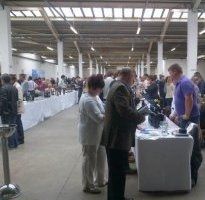
The exhibition space found by Isabelle Legeron for RAW (see above) was by far the superior – once you had navigated the vintage clothes shops and too-cool-to-open cafes of Brick Lane and found the Old Truman Brewery. There on the first floor was one vast, airy whitewashed room with the accessory of choice for wine tasters, a partially glazed roof allowing plenty of natural light. The temperature was right and the single room fostered an appropriate sense of community – until Nicolas Joly of Coulée de Serrant, a biodynamics devotee who gave the second of the talks in the associated events programme, damned the natural wine movement to The Drinks Business as 'nothing more than a drawer in which to put all the winemakers who didn't make enough effort to convert to organics and biodynamics'.
So what exactly is natural wine? This is a tricky one as the individuals in the amorphous natural wine movement tend towards anarchy and deliberate resistance to any regulation. In very vague terms, they are anti additives to wine, even sulphur which is wine's natural disinfectant and which usefully wards off harmful bacteria and secondary fermentation in bottle. The organisers of the two fairs came up with their own rules whereby exhibitors had to at least follow organic or biodynamic viticultural practices (whether certified or not), pick their grapes by hand, and restrict additives (including yeasts) to absolutely minimal amounts of sulphur. Precise sulphur levels for each wine were listed in the RAW catalogue which, like that for The Real Wine Fair, was thicker than the average paperback.
Like RAW, The Real Wine Fair assembled a collection of decidedly superior, new wave food suppliers to satisfy the hunger that wine tasting inevitably generates, making me wonder why on earth this doesn't happen at more wine events, where solid matter tends to be either poor quality or nonexistent. But The Real Wine Fair's setting, in the rather dilapidated basement of Victoria House, Holborn, was much less satisfactory – even though the producers tended to be more established. Lighting was artificial, and the separate smallish rooms recalled the Catacombs of Paris where an earlier French natural wine event had been held, except that in London the wines tended to be too hot rather than too cold.
It is particularly dangerous for natural wines to reach high temperatures – above 20 °C or so – as they are so relatively fragile. In fact one of my beefs about them is the amount of energy that is required to keep them cool enough during storage and transport which contrasts somewhat with their wholemeal, eco-friendly image.
I did not encounter any wines in my limited tastings at these two wine fairs that seemed to have suffered any heat damage but I did find a proportion that were just too 'natural' to appeal to my palate. Less attractive characteristics that seem to me more common in wines sold as natural than in others include a similarity to bone-dry cider made from cooking apples, a lack of persistence whereby the impact of the wine in the mouth seems to fall off a cliff as opposed to lingering appetisingly on the palate and a worryingly high incidence of a smell that reminds me of caged domestic pets – hamsters?
I suspect 2-acetyltetrahydropiridine, 2-ethyltetrahydropiridine and 2-acetylpyrroline are the culprits. An Australian-organised seminar on wine faults a few years ago exposed my nose to a fault known as 'mousiness' caused by these compounds. Tellingly, it is associated with low-sulphur and low-acid wines, is apparently desirable in bread but makes wines horribly tough and robs them of their fruit. Apparently, I was told, as many as 30% of all winemakers are unable to detect this fault. Perhaps there is a correlation between them and some producers of natural wine.
That said, there were some quite stunning wines at these natural wine fairs (see our tasting notes), and there was a complete absence of the sort of anodyne industrial construct that occupies far too great a proportion of space in our supermarket wine departments. And there was a host of exhibitors who have already made an admirable reputation for themselves without the crutch of belonging to the fashionable natural wine movement, some favourites of mine being listed below.
There seem to be strong parallels between the development of natural wine and organic wine. When the market first became aware of organic wines, too many wines were presented as though simply being organic was enough; they didn't necessarily need to taste good. The same seems to be true of some natural wines. In both cases I would much prefer to have my tasting socks knocked off by how delicious a wine is before discovering how it was made.
I sympathise with the theory behind the natural wine movement however. I do think the level of additives in many wines is higher than it need be and am strongly in favour of ingredient labelling, or at least some system of providing us with information on what each wine contains other than grapes (see this thread on the subject in our Members' forum). It is a strange anomaly that food, but not wine, producers are required to fess up in this respect.
SOME NATURAL HEROES
At RAW:
Antadze, Georgia
Antiyal, Chile
Castagna, Australia
Le Clos Perdus, Languedoc
Frank Cornelissen, Sicily
Foradori, Trentino
Francuska Vinarija, Serbia
Dom Josmeyer, Alsace
Ch Maris, Languedoc
Meinklang, Austria and Hungary
Millton, Languedoc
Montirius, Southern Rhône
Seresin, New Zealand
Shobbrook, Australia
⁞Le Soula, Roussillon
Dom des Terres Dorées, Beaujolais
At the Real Wine Fair:
Dominio do Bibei, Spain
COS, Sicily
Mas Coutelou, Languedoc
Felton Road, New Zealand
Dom de l'Horizon, Roussillon
Jimenez Landi, Spain
Luke Lambert, Australia
Dom J-C Lapalu, Beaujolais
Marañones, Spain
De Martino, Chile
Dom Matassa, Roussillon
Occhipinti, Sicily
Dom Peyre-Rose, Languedoc
Dom Patrick Piuze, Chablis
Giuseppe Rinaldi, Piemonte
Dom des Roches Neuves, Loire
Roxanich, Croatia
Dom Frantz Saumon, Loire
Dom Julien Sunier, Beaujolais













