This week I am focusing on a noun that is all too often overlooked in restaurant reviews. It is consistency.
This is an essential prerequisite for any restaurant that wishes to succeed and one that in many cases determines which become our favourite restaurants and why we choose to return. And why we enjoy them. We expect the same warm welcome from, ideally, the same member of an unchanging waiting staff. The same excitement, and familiarity from the menu and the wine list. The same portion size. The same recognition.
How chefs and restaurateurs achieve all this is one of the secrets of their professions but it is something that they are aware of, something they strive for.
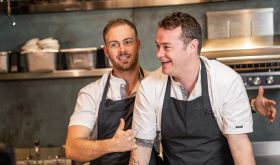
At the end of a lunch recently at our son’s 64 Goodge Street I went up to the open kitchen because I saw the chef, Stuart Andrew, standing on the other side of the pass. ‘We had an excellent meal, Stuart’, I said. ‘Please thank all your team.’ He responded thoughtfully, ‘Thank you and I am glad. We’ve been open for six months now and I think the team is coming together. We’re becoming more consistent.’
It was a response that contained numerous truths. The first is that the initial six months in the life of any restaurant are invariably the most awkward, the most difficult and in many ways the most deceptive. No matter how many meals for family and friends precede the actual opening, it takes a few months for the staff to learn how their new building works. And for the new kitchen to settle down, for the pots and pans to absorb the butter and oil that will add extra flavour to everything that they come into contact with.
These are the principal reasons why I argued 35 years ago with my first editor at the FT that I should not review the most recently opened restaurants but rather that I should only review them six months after their opening. I can still recall his reply: ‘Nick, what are the first three letters of the word news?’ ‘New’, I had to concede. ‘Exactly right’ came his reply. It is still this principle which guides the newspaper reviews we read today.
In my book The Art of the Restaurateur I devote a couple of pages to the importance of ‘looking after your regulars’ who, I argue, come to act as the restaurateur’s spies, passing on information that may not be obvious even to the most assiduous chef and restaurateur. A dish that may not have been quite as good as it should have been; a vintage of a wine served that’s different from the one listed; a too-long wait between asking for the bill and receiving it. It was to receive such nuggets that I used to sit at the window table at my restaurant L’Escargot with our chef Martin Lam as our customers left from the restaurant upstairs.
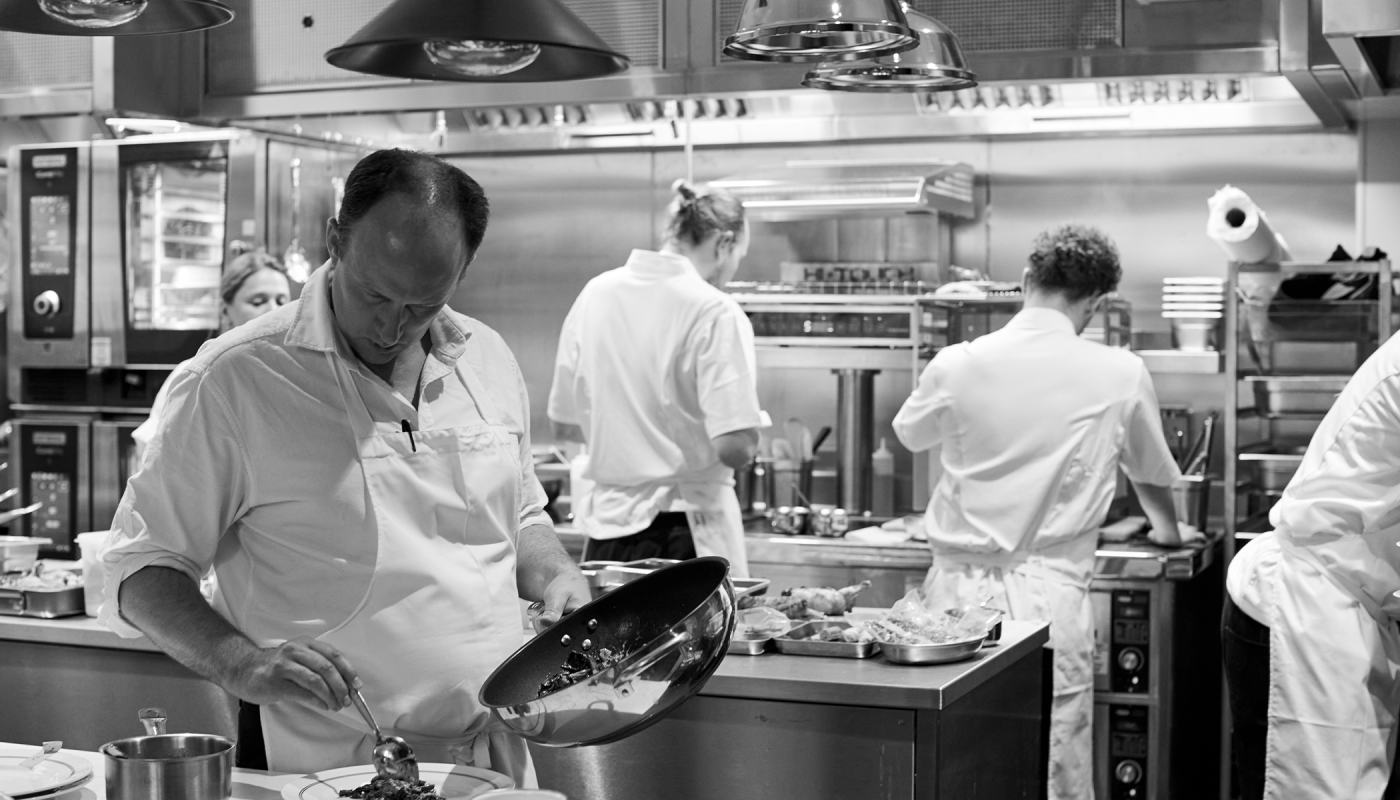
In the era prior to open kitchens, that would have been the first and only time my customers would have seen Lam or in fact any member of the kitchen. Today, it is very different and it has now become far easier to see who is preparing and cooking your meal. Do take advantage of this if you want to. You will be accepting an invitation and you may in fact be passing on something that neither the kitchen nor the restaurateur are aware of.
I thought I would ask several chefs and restaurateurs how they seek the consistency they are looking for. I began with Stuart Andrew, who responded, ‘I think it’s important to be clear-minded as a leader and surround yourself with talented people that buy into your vision and uphold your standards and sensibilities … I’ll taste as much as possible every day to ensure consistency of products etc ... Guests will hopefully come to trust us as a consistent operator, knowing that we’ll do our utmost to meet their needs and expectations.’
From Michel Roux Jnr of Le Gavroche which he recently closed after its 56-year run, came this response: ‘Consistency is probably one of the hardest things to achieve and also the most mentally demanding. Not just every day or service but every plate. Also the service has to always be to the level you set. I’ve found by retaining staff and empowering them with responsibility and respect this goes a long way to ensuring you achieve the standard day after day. Lead by example so that the staff mirror you. It’s basic but it works.’
I asked Sally Clarke, whose restaurant Clarke’s will have thrived for 40 years this December, for her thoughts.
‘Certainly having the luxury of opening just five days per week means that (in theory) we always have the A team on. Ditto fixed holidays (10 days Christmas, 2 weeks summer, 1 week Easter) means that the team can plan flights/trains/family and friends time, ahead. If we were to spread the opening times into eg Mondays and/or Sundays, we would a) need to employ more staff and b) offer weekend shifts on rotation – so not so “attractive” to the team.
‘My first head chef (Liz) stayed 18 years. My present head chef (Michele) has been with us 10 years (his assistant with me for over 15). They work with a team they have hand-picked over the years and are comfortable working together “as a family”. Head pastry chef Dawn has been with me 35 years. Paul, the restaurant manager, has been with me 31; kitchen porter Manuel 30 years.
‘So in essence I am blessed with these people. We work as brothers/sisters, (very occasional) disagreements but fundamentally we are all working towards the same goals: that we are in the hospitality business, we are here to create an all-embracing atmosphere – a welcoming smile hello, comfort, a menu that changes twice daily (still), a constantly changing wine list, and a genuine “hope we see you again soon” sort of goodbye at the door …’
This approach was echoed by John Ragan, president of Union Square Hospitality Group which runs over a dozen restaurants in New York.
‘In my mind, the first thing you can do is provide consistency for your staff – if they know the schedule will be posted three weeks in advance and not a day later, if they understand that family meal is at 3.30 and not 3.40 and if they know that they will always have two hosts on Saturday but just one on Sunday – it makes a challenging job much more do-able. If you provide consistency for the team, you can then ask for consistency from them – arriving on time, knowing your wines by the glass, etc.
‘Once your staff knows the value of consistency, I think you have the first rock in place for “This is how we do things here”. That then opens the door to “how should we make a margarita here?” for example. There are many ways to make a margarita but the second one you order better taste the same way as the first. As you can imagine, it does a lot of good to involve the staff in the “ratifying” of these norms – both to get to the best outcome but also to invest in buy-in. As you well know, the buy-in, or “enrolment”, as we call it, is so very important.
‘Then comes endless communication – in all forms – written, verbal, physical practice and modelling – even so far as role-playing at line-up/pre-meal. We have an internal internet that houses all recipes, SOPs, fact sheets for the wines, etc, etc. This said, you realise very quickly that is just one way to learn, and many people are in the hospitality business because they don’t want to stare at a computer all day long. And, in truth, we don’t want that either! This is why times like pre-meal meetings and in-service training are so important – ideally these times convey the details and nuance that can’t be relayed often through the written word.
‘What I’m excited about going forward is using quick videos as a training and consistency tool. We are working on a platform that should make it easy for (example) a chef to take an iPhone video of the preparation of a salad from ingredients to prep to assembly and plating while describing what to look for, why certain details are important and what the finished product should look like and why – all the while, the cook is watching it come together in real time. I’m often sceptical of some forms of tech in restaurants but I believe something like this will be a fantastic learning tool creating consistency and therefore excellence not just in the kitchens but throughout the restaurants.’

I will leave the final word with Stuart Andrew who ended by encapsulating what drives many into the profession of cooking and looking after us. ‘Fundamentally we don’t take guests for granted and we want them to leave happy.’
Photo at top by Sam Harris, courtesy of 64 Goodge Street.
Every Saturday, Nick writes about restaurants. To stay abreast of his reviews, sign up for our weekly newsletter.