Shimbashi Shimizu and Noyashichi are two of the most exceptional restaurants I have ever had the pleasure of eating and drinking in. And, with these recommendations, I wish you the best of luck in finding either of them.
The former, named after its chef/proprietor Kunihiro Shimizu, is in the Shinbashi quarter of central Tokyo, terminus of Tokyo’s first railway built in 1872. It is, according to one observer, ‘a very safe neighbourhood replete with drunk salarymen’. We spotted none of them but the sheer numbers on the streets can be overwhelming. The act I was most proud of during our stay in fact took place at 8.30 am, at Shinagawa station in Tokyo’s business district, and consisted of guiding JR and our large suitcase through the vast stream of workers heading resolutely to their offices as we worked our way across them towards our bullet train. The crowds were almost as thick on our evening in Shimbashi. But do persist. And do make sure that you are accompanied by someone who speaks fluent Japanese as the chef prefers to be able to communicate with all his customers.
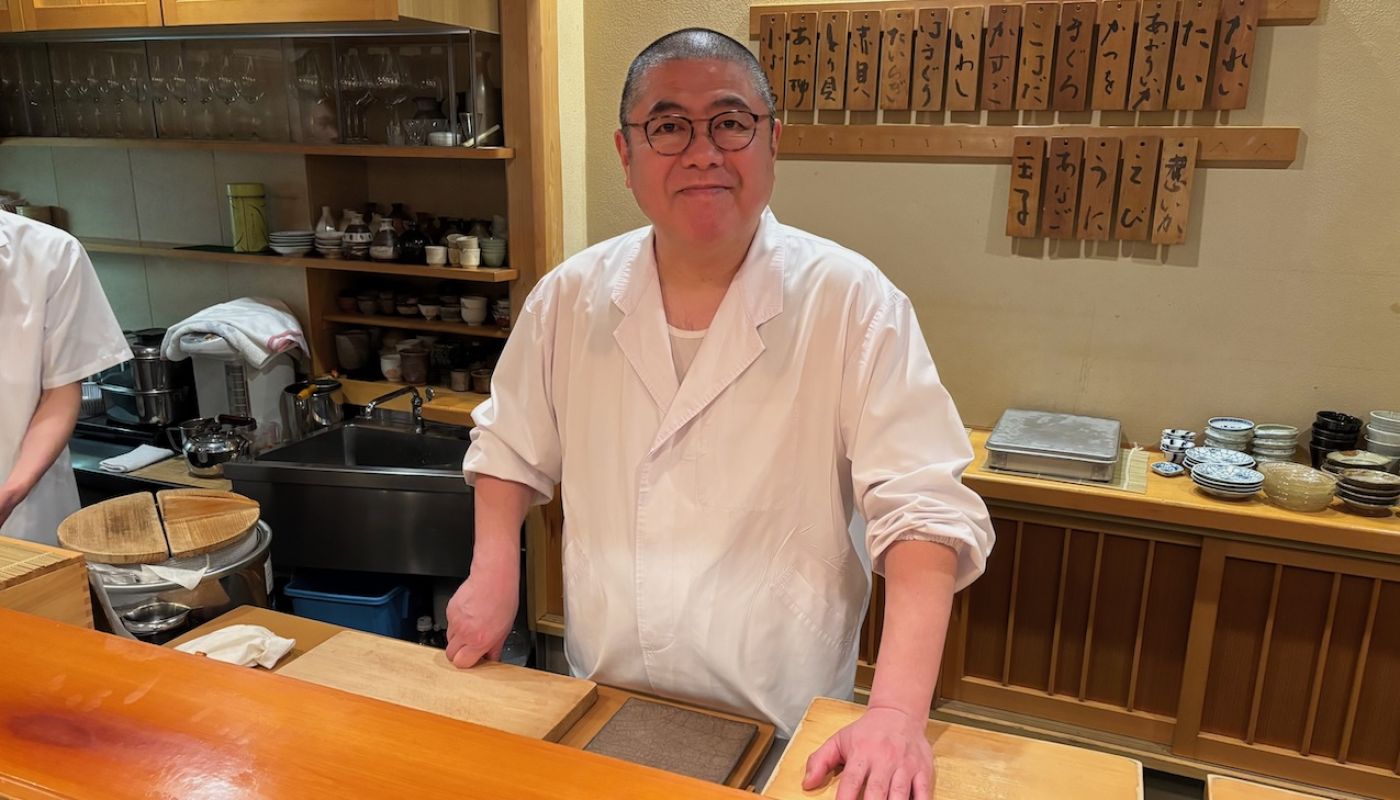
Like the vast majority of Tokyo’s restaurants, Shimbashi Shimizu is down a side street that I would never find again. And for anyone who has ever enjoyed eating at a sushi counter, there will be initially few surprises. We, a party of eight, walked in at 7 pm which turned out to be the second sitting. There in front of us was a spotless wooden counter, highly polished and completely empty. Behind it were four smiling Japanese men, all of whom seemed extremely pleased to see us.
This was the first surprise. The road to sushi mastery is long – Shimizu spent numerous years learning his craft at Tsuruhachi in Tokyo – and as a result when the Japanese chefs finally open their own restaurants, the maestros tend to be severe. Not so here. Shimizu, 56, is obviously in charge but his friendly demeanour spread easily to his principal assistant to our right and the two others to our left. In addition, all of them, it seemed to me, went to the same barber with the same result. All have had the most severe ‘number one’ haircuts.
Before I continue in praise of what we were about to eat and drink, let me get a couple of small gripes out of the way. Firstly, while I always enjoy sitting at a sushi counter – I love watching chefs at work – I do not enjoy being in a party larger than two because of the difficulty of conversation. I find it inconvenient to put my head around the person next to me to engage in conversation or even to clink glasses. (At Noyashichi, we were a party of three and I barely conversed with my friend on the far side of JR who sat in between us.)
My other complaint is about the absence of menus in general. At neither of these restaurants was a menu either present at the outset of the meal nor offered as we left. I don’t believe that I am alone in thinking how important it is knowing either what I am about to eat or to know fully what I have eaten. When, growing somewhat tired, I asked after course 14 how many courses were left, I felt that I had let our side down. But I still managed to enjoy the subsequent four dishes.
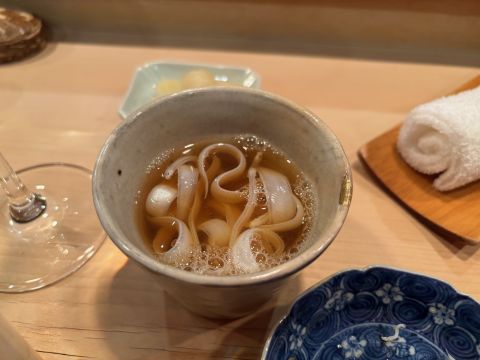
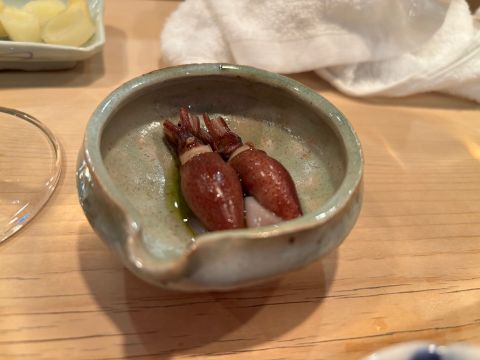
These gripes out of the way, I can report that Shimizu and his team produced an array of fabulous food. This began with a soup in which were floating slivers of young sea eel, soup that was rich and fragrant. This was followed by a series of fish dishes with unusual pairings: flounder with daikon, Japanese radish; scallop with salt that accentuated the bivalves’ sweetness; firefly squid caught, I was informed, in the Japan Sea only at this time of year, and cooked in a rich stock (see below); aoyagi (surf clam) with wasabi (which I saw being prepared): the sweet liver of an angler fish, its flavour again accentuated with wasabi; and, perhaps best of all, and certainly the most unusual, a piece of tairagi, fan shell, served as a sandwich inside a piece of seaweed. All this took an hour, before it was announced to us that the sushi would now begin.
This took the form of six different pieces which Shimizu formed and served to all eight of us, set in front of us directly on to the wooden counter. His hand movements were a combination of the highly personal and the automaton: I believe that, if I had asked him to close his eyes while he was making the sushi, the results would have been exactly the same. It was fun to watch just across the counter as he progressed from snapper to squid then to kinmedai, a dense red fish found only in the waters around Tokyo, followed by two types of tuna including toro, then kohada (young gizzard shad) before he ended with a piece of eel.
The tour de force over, I was ready with a few questions. His favourite fish for sushi is kohada but, he added, he loves the process of creating steaming rice. His favourite season is autumn/winter although this is changing with climate change, and what gives Shimizu the greatest pleasure is to welcome back a returning customer. We will return, I hope – so long as we can find Shimbashi Shimizu again.
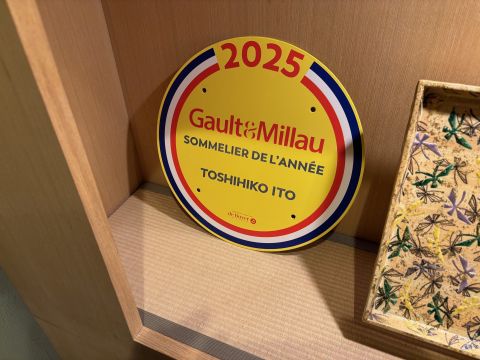
We stopped outside the restaurant Noyashichi only on spotting a young woman outside it bowing to us. She was apparently expecting us. The reason for this was that this restaurant is not only home to a very talented chef – Shinya Yamamoto – but also to an exceptional sommelier, Toshihiko Ito, who had once visited us in London. Once inside we saw the evidence that Ito-san had been recognised as the best sommelier in Japan for 2025 by Gault & Millau.
The restaurant’s layout reflects this joint responsibility. There is a corridor down the middle which leads to the kitchen. On the left are a couple of private rooms, and to the right are two counters, the first with six seats, the second four. The first is opposite a fridge and is Ito’s domain; the second is that of the chef. And just as surprising as this double billing is the cooking instrument part-hidden behind a bamboo curtain off to the left: one large wok as shown in the distance below.
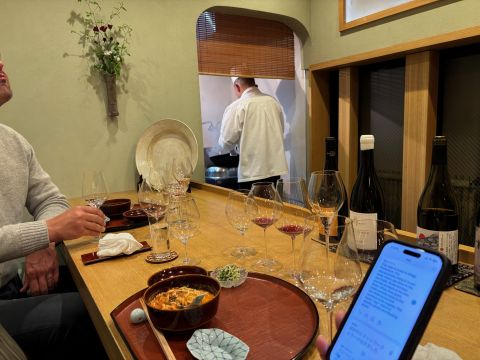
From here, the chef produces a series of dishes that are either Japanese with a Chinese twist or Chinese with a Japanese twist. From the opposite corner Ito-san produces a series of drinks he considers most suitable from a fridge that must be packed to the gunwales with his selections, principally from France, Germany, China and Japan. Meanwhile, the two female waiting staff come and go, one looking quite medical as she is all in white. Ito-san and Chef Yamamoto also look unusually smart, the former in a suit and tie, the chef with a shirt and tie underneath a formal white jacket.
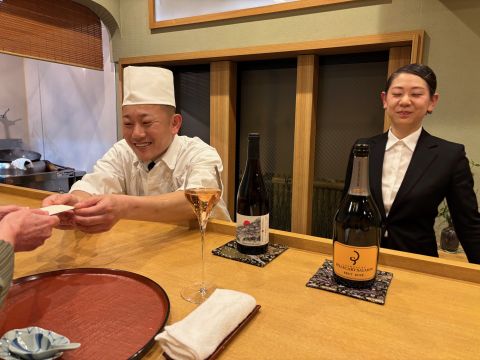
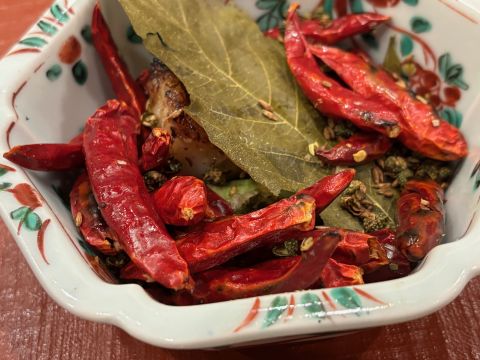
It is an elegant performance with extremely impressive results: a dish of pork and bamboo shoots with pepper bloom that was subtly hot; a spring roll of shrimp and Japanese vegetables with which Ito-san served a glass of Chinese Shaoxing rice wine; a dish of bonito with a spicy Chinese sauce; prawns cooked in Shaoxing wine; kinki, or channel rockfish, pickled first in miso and then served over spicy red peppers, below.
All of these were a prelude to the final dish which showed off the chef’s dexterity with the wok: two pieces of beef sirloin in a much reduced sweet-and-sour sauce finished with vinegar. I have never before been to a restaurant where the chef conversed with us directly by speaking into his phone in Japanese and showing us the English translation on his screen, which process you can see in a corner of the picture two above.
My questions to Yamamoto were simple: how had his particular style of cooking come about and how had he persuaded Ito-san (pictured below) to join him?
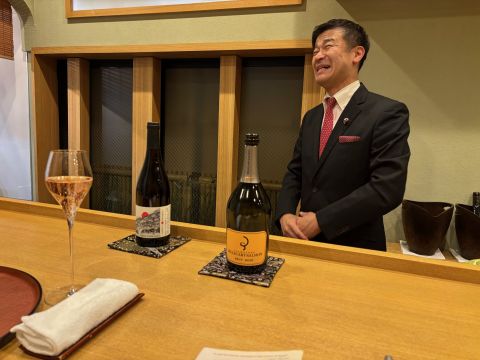
The answers to both were straightforward. ‘From 2005 to 2007 I trained at Hong Ziji, one of the most eminent restaurants in Shanghai, before six years at Akasaka Momonoki, the two-star Michelin Chinese restaurant in Tokyo, where I learnt about the greatness of my country’s cooking but that it has to adapt to survive. In 2015 I opened here with my wife.
‘I knew of Ito-san and his role co-ordinating wine lists in several top restaurants in Japan although I did not know him personally. But I was convinced that with his help we could create an even better restaurant so I summoned up my courage and invited him to join us. He readily agreed, and soon afterwards both Ito-san and the restaurant received recognition from Michelin and Gault Millau.’
Which, on the basis of what we ate and drank, is fully deserved.
Shimbashi Shimizu 2-chōme-15-10 Shinbashi, Minato-ku, Tokyo 105-0004; tel: +81 (0)3 3591 5763
Dinner menu £150 per person
Noyashichi MIT Yotsuya 3-chōme Building, 2-9 Arakicho, Shinjuku-ku, Tokyo 160-0007; tel: +81 (0)3 3226 7055
Dinner menu 30,000 yen (about £160) per person
Every Sunday, Nick writes about restaurants. To stay abreast of his reviews, sign up for our weekly newsletter.