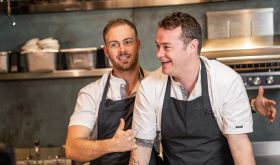
The growing number of Ping Pong dim sum restaurants across central London offer good food, good design and good value. Their creator, Kurt Zdesar, explains how he has achieved this.
Kurt Zdesar decided to leave his highly paid job as GM of Nobu Restaurants in Europe because of an advertisement he saw for a Jaguar car. “The car was on offer for sale in the US at the same price in dollars as it was in pounds in the UK although it was manufactured here and had to be shipped across the Atlantic. I started to think about why it is that you seemingly have to pay more for everything in the UK and particularly for a good meal. So I left my job and decided to set up Ping Pong.”
The first Ping Pong opened just off Regent Street 15 months ago and was trading profitably after only four months. Such is the precision with which Zdesar and his team have now planned the layout of these dim sum restaurants – or little steamed parcels of deliciousness as their slogan declares – that there will be 10 by the end of this year. And, judging by Zdesar’s enthusiasm for Ping Pong during a two hour discussion in which he barely caught his breath, no limit on their eventual number.
I wanted to listen to Zdesar, born in Australia of an Austrian father, who came to the UK when he was 16 and subsequently spent what he refers to as a ‘seminal year’ at McDonalds, because I had heard on the restaurant grapevine that one of the reasons he had been able to achieve his ambition of a good meal in central London for an average price of £15 was because he has so significantly re-jigged one of the industry’s working standards. A hugely crucial factor in what drives the cost of any meal is the ratio of ‘back of house space’ i.e. that taken up by the kitchen, office, reception area, cloakroom and cellar, to ‘the front of house’ where customers sit and which generates revenue. This is usually 55/45 although it can rise to as high as 60/40 in the most expensive restaurants. But at Ping Pong Zdesar had managed to reduce it to 37/63 which meant in practical terms that the first Ping Pong could fit in an extra 50 seats (the most successful retailers, I am told, work on 20/80).
“My time at McDonalds, a cross between a stint in the army and prison, taught me about systems, my time at Nobu about how concepts have to be adaptable to meet local needs,” Zdesar began. “And I had seen the potential of dim sum one night in 1998 when after service I had organised a staff party for 150. We bought £300 worth of dim sum and our chefs steamed it all in 20 minutes which meant that they could join in the party, too. For six years I worked on how I could simplify the whole restaurant process to meet the price points I wanted in London that would be the equivalent of those in the rest of Europe.”
“There are several contributory factors. Firstly, the customer takes their own order by writing down on the long list of dim sum how many of each of the 50-odd dim sum on offer they want and then hands the order to the waiter. Our customers seem to love this more than I had imagined and it means that a waiter here can look after 20-30 customers rather than the average 15. Then we don’t take reservations. This means that we not only save £50,000 a year on salaries as well as the cost of a reservation office. Nor is there a coat check which brings similar savings although there are hooks underneath the tables for bags and we leave the corners unencumbered for our customers to manage. But the biggest saving has been how we have managed to shrink the kitchen.”
“Rather than paying £40 a sq ft, the going rental in central London, to store, prepare and then cook all the ingredients we set up a 5,000 sq ft central production kitchen in North Woolwich, east London, The rent was originally £16 a sq ft but we halved it by putting in a mezzanine floor. Here our Chinese chefs prepare all the dim sum by hand and now 13,000 pieces of dim sum leave there in a refrigerated van at 7.30 am every morning, arrive at our restaurants by 1030 and go straight into the fridge. For our first restaurant we hired 14 chefs but then we only had to hire another eight for the second two so here too we can make savings.”
As a wave of dim sum baskets arrived on our table, most of which I ate cold as I tried to keep up with Zdesar’s outpourings, he continued, “You can see that all the dim sum baskets are colour coded, white for eight minutes steaming, blue for six and black for four minutes. This is to ensure that the food reaches the customer as fresh as possible because otherwise, without this clear differentiation, neither the chef nor the waiter can see which dim sum is in which basket so they keep lifting the lid to see what’s there and every time they do this it lessens the flavour. It also means that when the chefs get the orders they put the white baskets in first, then the blue ones and finally the black ones and set their timers accordingly. I don’t think of this as fast food more as fast service which allows us to serve 7/800 customers most days in a 200 seater restaurant. We served 990 one day,” Zdesar beamed.
“A central production kitchen means that we can control quality and wastage and achieve a food cost of around 19% which is five or six points better than most restaurants aim for. And what I hadn’t appreciated from only working in the West End for so long is that a large unit out of the centre means we can buy well in bulk because there is the storage space and save on costs as our suppliers don’t have to deliver to within London’s congestion charge zone.”
As our meal was being cleared away, Zdesar moved on to two other innovative aspects. “What I have also instigated are table reading signs so that the waiters don’t duplicate each others’ roles. When the chopsticks holder is taken away this means that the order has been taken and when the soy sauce holder has been removed that signals that it’s time for dessert although we only serve organic ice cream as pastry sections don’t really make money and there isn’t much demand for anything else after dim sum. When we discovered that the basement of our Westbourne Grove branch was uncomfortably low for our customers we turned it into a ‘virtual mini-restaurant’ where we conduct all our training so that fully trained staff can move into a new site as soon as the builders are finished and we can be open within two or three days.”
Which brought Zdesar round to complimenting David Marquadt, his Swiss architect and designer, as much for his stylish interior as the manner in which with only a simple re-generating kitchen to install, they can turn around a site in no more than eight weeks, way below the restaurant norm. “Time in the restaurant business really is money,” Zdesar added. “I don’t want to spend more than I have to and I certainly don’t see why our customers should.”
www.pingpongdimsum.com for restaurant listings.