
There is a tendency for everyone to settle close to the railway station in the city that they first arrived at. For example, in 1976 I arrived at Euston rail station from Manchester and have barely moved more than a couple of miles from it in the intervening 43 years.
And so it was to prove with our recent trip to Tokyo. Because we arrived on the Narita Express from the airport, and we were to leave 48 hours later from the same station for Osaka, we decided to push the boat out and stay at the Four Seasons Hotel at Marunouchi, no more than a five-minute walk from the incredibly busy Tokyo station.
This arrangement was to give me the opportunity to learn two things about eating out in this fascinating country.
The first struck me just before 3 pm. Having landed before noon, we had unpacked and decided to head back to the station for lunch as our walk through it had revealed plenty of cafes and restaurants there. We headed to the level below the main concourse and found ourselves beset with myriad choices. We stopped at a corner site with the sign Hanashiya outside. When we went in – obviously non-Japanese – we were politely ushered outside again by the smiling waitresses to examine the front window with its plastic versions of all the dishes on their menu. Having ordered two – and a couple of Kirin beers that, as ever, proved one too many – we were led into a very clean wooden interior with a kitchen at the far end and what can only be described as their floor show at the table next to us.
This was a table of four Japanese men, each over 70, who seemed like a permanent Monday lunchtime fixture. One was bald and smartly dressed in a suit with his hat on the table while the other three had plenty of long grey hair. They were in two separate but extremely animated conversations – each pair of familiar conversationalists rather like the two old gents on The Muppets, we agreed – while enjoying plates and plates of edamame beans and small flasks of sake, which one of them seemed to re-order at great speed, enthusiastically clapping his hands at the waitresses every time he wanted them replenished. Their conversation proved mesmeric, if totally incomprehensible.
We enjoyed our food, the tempura in particular, and then asked for our bill, which came conveniently to 3,500 yen. I paid with a 5,000-yen note and got a 1,000-yen note in change plus a 500 yen coin (£3.50/$4.50/€4)). Perfect as a tip, I felt, for such friendly service.
I left the coin discreetly on the tray on which our food had been served and left the restaurant, thanking our waitress on the way out. Within seconds of setting off for the massive Daimaru department store, whose extensive and beautiful food counters are also located under the railway station, there were a couple of cries from behind me. I looked around and there was our waitress, smiling at me while pressing the 500-yen coin into my hands. I accepted and, appreciating my faux pas, placed the coin in my pocket.
The mistake I had made was to assume that the same rules applied in the East as in the West and, in particular, that service was not included. In Japan, at least, service is an integral part of the Japanese approach to ensuring that their guests feel really welcome in their restaurants and hotels.
Which is exactly how we were made to feel at dinner that evening in the Four Seasons’ Motif restaurant on the seventh floor. What had begun as a suggestion of an early-evening drink had morphed into a dinner reservation after the woman who had shown us up to our room had ended by pointing to a piece of paper that offered hotel guests a 30% discount on dinner on their first night.
I would recommend this restaurant for any visitor to Tokyo, even for a drink. The hotel’s proximity to Tokyo station means that its appeal lies not just to train spotters but also to anyone who wants to enjoy a slice of Tokyo life. This ranges from watching the hordes of office workers, virtually all in white shirts and black trousers, waiting patiently for the lights to turn to green on their way to the station; to the relatively slow procession of the various bullet trains as they zoom through the centre; to the broad vistas towards the Ginza shopping district.
Their cocktail list is good, with one of them including a small quantity of white caviar on a yuzu leaf. Their wine list is also enterprising and offers a broad range of wines from which we enjoyed a 2013 Barbaresco for the modest (for Japan) list price of 10,000 yen (c £70/$90/€80).
Motif’s food under head chef Hiroyuki Asano is fine. We were slightly disappointed by the rather ordinary list of first courses so we skipped them with Jancis ordering a main course described simply as ‘chicken with cabbage’ while I ordered an old favourite ‘skate with black butter and croutons’. Both required a long wait – it appears that Motif’s kitchen is more attuned to serving its tasting menu – but were ultimately very good.
The wait at least gave me the opportunity to look around the room and learn my second lesson: that restaurants in hotels offer a sense of space, of the possibility for a quiet, private conversation, that most restaurants simply cannot match, other than in their private dining rooms. This is particularly valuable in cities as crowded as Tokyo, population over 23 million, even without the large influx expected for the Rugby World Cup in September 2019 and the Olympic Games from late July 2020.
This point was to be made in spades the following lunchtime when our taxi drew up outside The Capitol Hotel Tokyu close to the important Hie shrine and designed by Kengo Kuma. Not only was there considerable space outside for the taxis to wait in, plus a couple of willing young men only too ready to open our taxi’s doors, but there seemed to be the same quantum of space inside this quietly grand, determinedly modern and stylish hotel.
Down a broad corridor, past another large open space given over to a peaceful expanse of water, is their restaurant Suiren. Described simply on their business card as a ‘Japanese restaurant’, Suiren serves everything with such an eye for detail that it almost made me forget the terrible, jetlagged night’s sleep the night before. There are the waitresses dressed in traditional kimonos; the smiling, bowing managers, four of whom we were to see again when we left; and finally there was the utter simplicity of the setting, just a series of fine wooden tables with nothing other than cutlery on them.
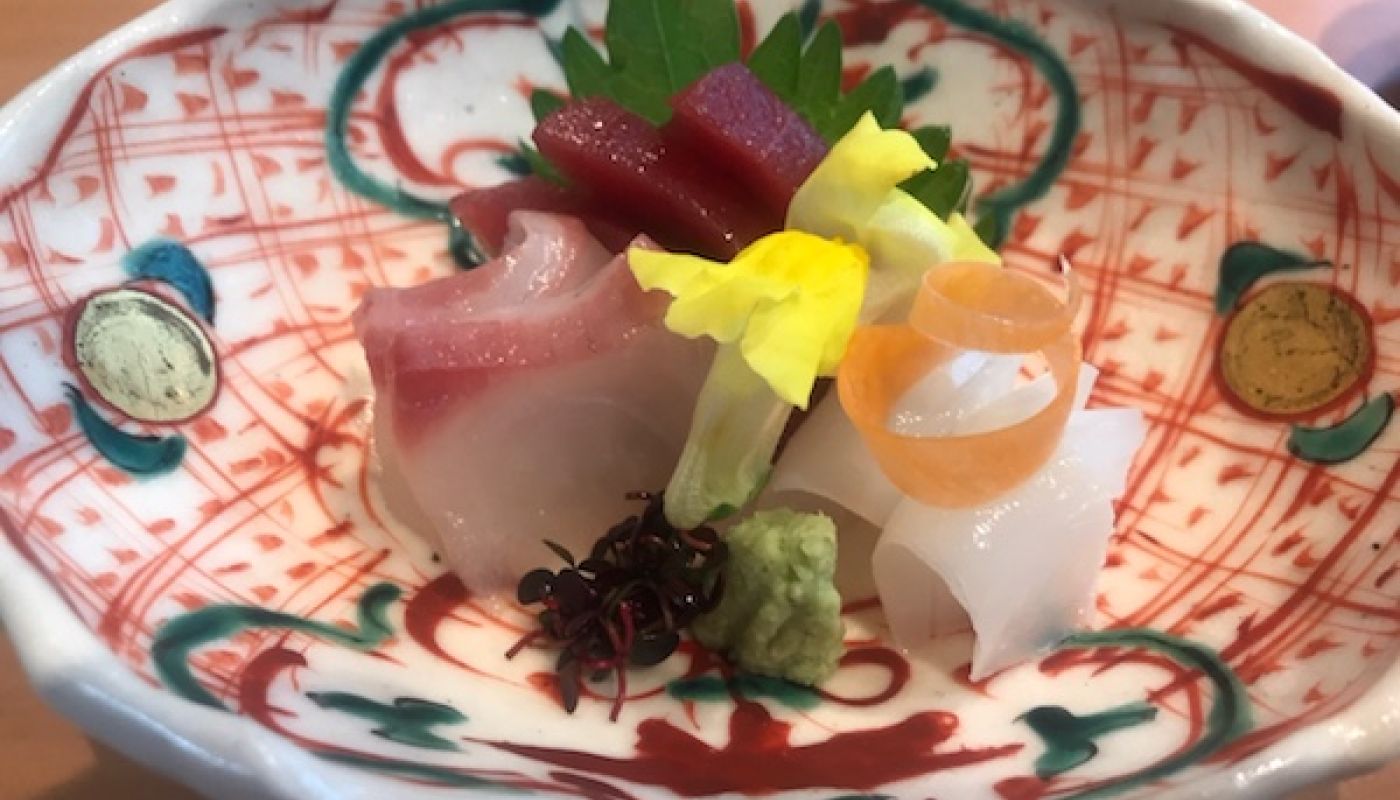
No sooner had we sat down than we were brought the warm towels that are so common in Japan (much more common than napkins) and some delicious green tea served in beautiful, obviously highly individualistic, cups. This was followed by a square of white sesame tofu in a clear liquid that I was forced to drink by putting the dish to my mouth. The bowl of sashimi of tuna and squid shown above right followed, served with a small portion of potent, high-quality wasabi and then a bowl of soup containing the herb junsai. I learnt the name from my Japanese fellow diners but received the explanation, as so often, from the copy of Richard Hosking’s indispensible book A Dictionary of Japanese Food (Tuttle, 2015), which I carry with me whenever I eat out in Japan. He describes junsai as ‘water shield, a little water plant, an expensive delicacy with virtually no flavour appreciated for its gelatinous texture’. As ever, he is completely correct.

Then came the main course, two large bento boxes served one on top of the other, the whole containing a vast number of dishes. This was almost as visually spectacular and colourful as it was confusing to us non-Japanese. But the more discernible of the dishes included some lovely, melting braised beef (the only meat we were to encounter during our week in Japan); a piece of fish with the crispest skin; a dish of the most delightful pickles; a small bowl of red miso soup; a bowl of fried rice enhanced with almost criminally tiny sardines; and a particularly umami-rich dish of konbu (kelp) wrapped around nishime, a simmered food that has lots of umami and is extremely popular at New Year.
We finished with a highly seasonal sorbet made from fukinoto, 'the unopened bud of Japanese butterbur', which I had only encountered served as a tempura, and a refreshing, lighter cup of green tea.

As well as being highly memorable, this meal’s price at 6,500 yen (£47/$60/€53) per person – including service – seemed extremely friendly for first-class food in such beautiful surroundings in a notoriously expensive city.
Motif Four Seasons Hotel, 1-11-1 Pacific Century Place, Marunouchi, Tokyo; tel +81 3 5222 7222
Surien Capitol Hotel Tokyu, 2-10-3, Nagata-cho, Chioda-ku, Tokyo 100-0014; tel +81 3 3503 0109