Something of the Milk Wood dreamtime lingers on in the creeks and coves, the nants and the cilfachs, of this stretch of the south Wales coast. Faint echoes of Mrs Ogmore-Pritchard and Organ Morgan steal in on the ‘fishboat-bobbing’ tide only to be drowned out by the cries of the herring gulls wheeling overhead, while groups of Nogood Boyos still prop up the local bars. In the seaside towns of the Gower Peninsula, these Dylan Thomas characters at least are evergreen.
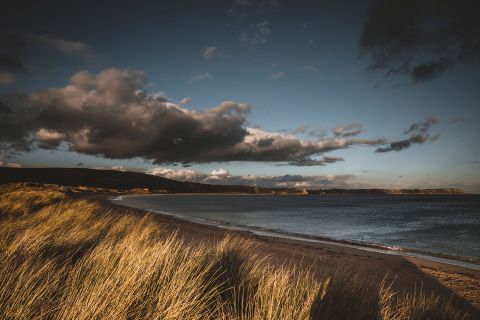
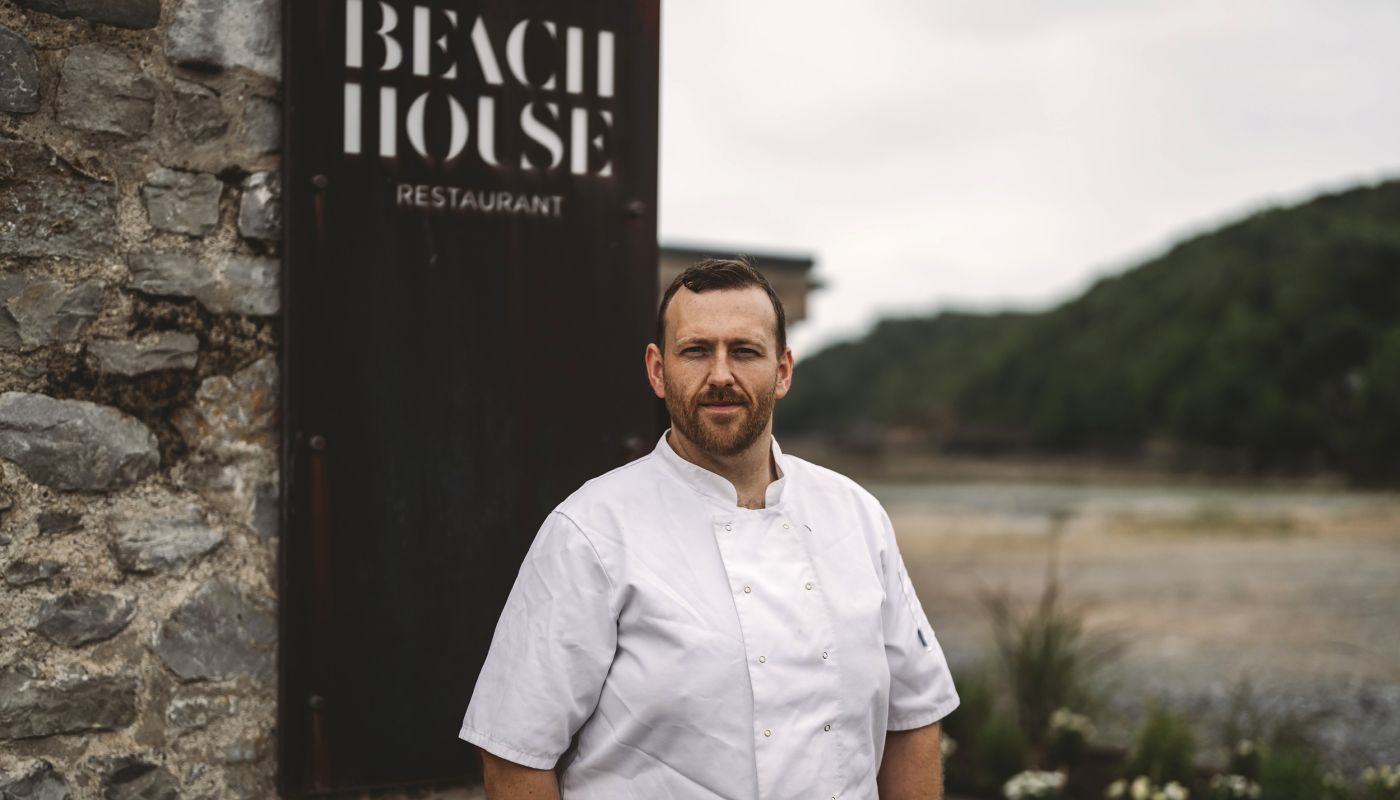
Nestling against the dramatic dunes of Oxwich Bay, the weathered stone and bleached wood of Beach House seems to mark the exact moment when the gold and grey of the shore resolves into the softer green of the surrounding hillsides. Wild strawberries and tufts of sea holly give way to a scrap of garden that shelters leeward. It leads to the main door that likewise turns its back on the weather’s caprices, one minute watercolours in the rain and the next gouache-thick sunlight pouring through holes rent in gun-metal clouds. Picture windows contrast this grandeur with the beautifully pitched urbanity within, marking the fragile border between nature and artifice. It’s an intoxicating dissonance that continues into the food that chef Hywell Griffith and team conjure from the best that local farmers and fisherfolk have to offer.
Opened in 2016 and now garlanded with 3 AA rosettes and a Michelin star, Beach House offers 3-, 6- and 8-course menus. At first glance, all need a little translating – each course being afforded a single-word description, ‘Celeriac’, for example, or ‘Citrus’. The dual-language menu doesn’t really help: betys being no more revealing than beetroot, lar y goedwig than hen of the woods. But further on, all is revealed. Betys, for example, are served with Pant ys Gawn. Which sounds like a remarkably brave idea in these windy environs. As it turned out, Pant ys Gawn is a goat’s cheese from Monmouthshire. A rather good one at that.
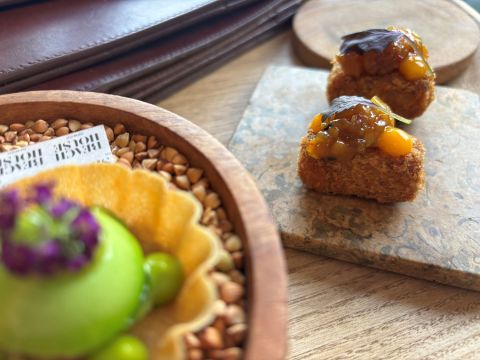
We were still discussing the merits or otherwise of undercarriage aircon (I have Scottish ancestry so claim kilted carte blanche) when the first glimpse of gastromancy appeared bar-side to accompany our strawberry and Earl Grey cocktails. Two tiny amuse-bouches – a smoked-fish tartlet and a pressed-pork croquette topped with pineapple confit (pictured above) – augured well. So did the warm bread buns, light as a gull’s feather with a dab of local laver bread within, that awaited tableside in the airy, mid-century modern of the restaurant proper.
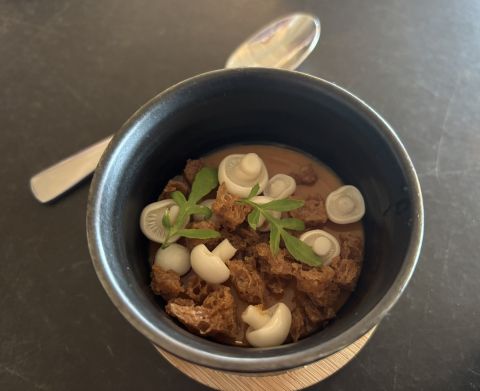
We managed a bread-muffled thanks as our first course arrived soon after: a small bowl of seemingly disparate parts that came together on the spoon with the miraculous alchemy of a Michelin-starred hand. Briny, brown-meat-heavy crab hid beneath a reflective pool of yuzu gel (pictured above). Strewn on top, tiny Shimeji mushrooms, diminutive croutons and shoreline herbs that matched peerless local produce with notes of Japanese restraint (echoes of Griffiths’ Ynyshir past, perhaps?). It was a tall order for the wine pairing, though: Chateau Oumsiyat’s fresh but introvert Soupir rosé 2023. Something well-chilled with a little residual sugar might have fared better, even at this stage in proceedings.
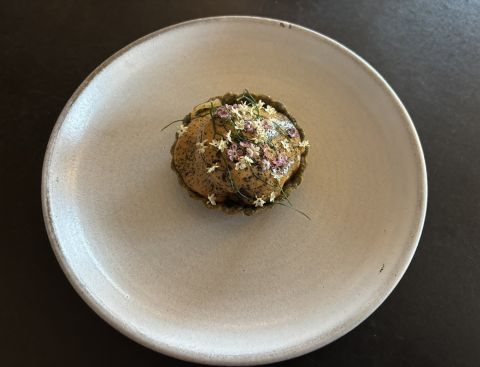
But our smiling sommelier, Matty, came up trumps with the following course, a delicate lobster tartlet of seaweed-laden pastry garnished with edible flowers (above). He poured out orange qvevri wine from Khaketi in Georgia: Vachnadziani’s Rkatsiteli 2019. It was indeed wild on its own, as he had intimated, but it purred like a cat when presented with the buttery lobster. Matty, Maciej in fact, was from Poland. We quizzed him gently on his home country having been intrigued by Jancis’s reports of a nascent winemaking scene a few months back. His eyes misted over when he spoke about Riesling and Grüner Veltliner, and no doubt they will at this very moment be marching north to replace the Bacchus and Solaris PiWis of his homeland’s past. Just like England. No doubt Wales, too.
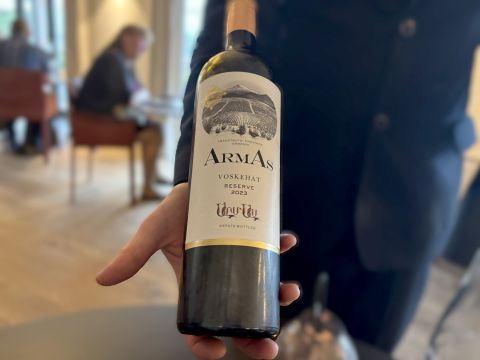
Feeling by now semi-fluent, ‘it’s betys’ I thought to myself as the beautifully cooked medley of beets arrived. Offset by the delicious infamy (at least at our table) of that goat’s cheese and dabs of garden pesto, it was the tiny hazelnut details that pulled together both taste and texture. To go with, a leesy, cedary white from Armenia (ArmAs Reserve Voskehat 2023). It was, I think, the vinous highlight of the evening, dry but with a ghost of fruit-driven ripeness powering significant if well-behaved alcohol. Stone-fruited, melon-scented and with a haunting herbal lilt (thyme flowers, woody honeysuckle?), it turned over the earth of the beets wonderfully.
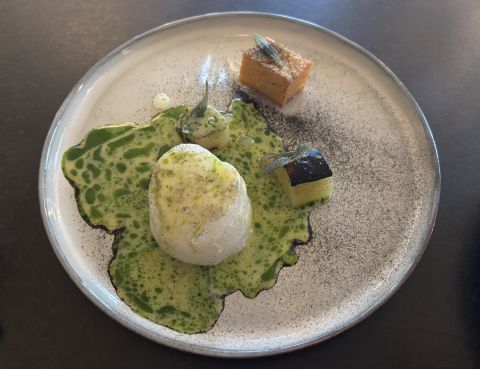
Pearlescent cod (below) appeared next, accompanied by a single confit-potato chip and a patriotic charred leek to gather up the herb-oil-split sauce. I was fascinated by the white chosen as its partner, Hirutza’s Txakoli 2024 from Spain’s Basque country. It resembled another Atlantic coast hugger, Vinho Verde, with its slight spritz and green-citrus bite. But it was leaner, coiled and almost feral. Salty and sweaty, like a Jean Genet dream of Bilbao bad-boy sailors, I rather liked it.
The few shavings of raw asparagus (merllys) that followed barely registered against the risotto chew of ancient grains cut with verjus and haunted by wild garlic. But we didn’t care, as hidden in the dish’s Brythonic depths was a single slab of unforgettable treacle-cured pig. Homemade yeast extract gave the whole even more savoury depth. Our passion for this Welsh Marmite of sorts remained undimmed even by the news that it was made from fermented scraps in a plastic bin out back (I imagined a barrel of jetsam crude in the car park). Chilean Cinsault was destined to buckle under this savoury weight but Pedro Parra’s Imaginador 2019 from Itata was itself meaty-smoky, making for a lively conversation that elevated food and wine.
What is the correct response when a smiling waiter approaches clutching a winter truffle (from Monmouthshire, no less)? ‘No thank you, I prefer to taste my beef’ is perhaps wise or there’s the more practical, ‘how much of a “supplement” are we talking?’. But I just nodded, mesmerised like a tom in catnip. Predictably, it did dominate our next, beef-cheek course (pictured above) with its neat carrot rocher, lar y goedwig (you should know by now) and baroque black-garlic detailing. But supplementary truffle has a grim inevitability to it. At least for me.
A ‘nice piece of meat’ seems now destined to come with fripperies: a kitsch pie, a fiddly-faddly stuffed wing or, if truly unlucky, a modish bon-bon. The gleeful proffering of a wee copper pan alongside met therefore with a rather curmudgeonly nod. I associate the term cottage pie with the dun meals of my school days – Late C20th Brown is the Pantone, I think – but such it was, taxonomically speaking anyway. But delving through the pomme purée we discovered ox-cheek depths and duck-liver richness; this was the sort of thing you gobble in indecent haste leaving only a smidge to dab provocatively behind your ears on the way out. It was especially lovely with the confit brambles of our Colchagua Carmenère (Montes Alpha, 2021), the same notes Sam picked up in the 2019.
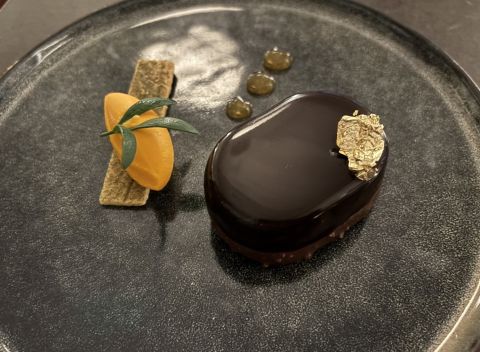
Pre-desserts, or pre-pud puds, feel somehow off the record, a chance for introverted pastry chefs to run amok. Here, a relatively trad meringue, goat’s curd and honeycomb number was shot through with pink peppercorns whose perfumed heat went brilliantly with a chilled Moscato d’Asti (Nivole from Michele Chiarlo). Puds proper came in the shape of warmly spiced bara-brith soufflé with tea ice-cream and a shiny, shiny choc number (below) electrified by pearls of sherry-vinegar gel. One final throw of the vinous dice brought a five-year-old Marsala Dolce Superiore from Curatolo Arini which struggled with the choccy tang and a Chambers Rutherglen Muscat that predictably fared better with the raisin-and-nutmeg charms of the soufflé.
Warm notes of Welsh tea bread and Aussie sticky wafted us to our waiting taxi just as the night clouds were coming in across the bay. ‘Beautifully orchestrated Sturm und Drang’ was the phrase that kept playing in my mind. By now geographically challenged by too much good food and the long-haul wine flight, I could only think of a Fingal’s Cave surge and swell, though Karl Jenkins would have been more appropriate. As it happened, we got neither. It was Neal Diamond who serenaded us home. Not even Tom Jones.
Eight-course tasting menu £135 a head plus £79 per person ‘Curious’ wine flight (there’s a ‘Distinguished’ flight as well, distinguished by price and no doubt wines). Oh, and that £15 truffle supplement …
Beach House Oxwich Beach, Gower, Swansea SA3 1LS; tel: +44 (0)1792 278 277
Photos are the author’s own unless otherwise credited.