
I was once in a small boat with a porcupine named Bertha; Bertha was being removed to a far-away island where she wouldn’t be tempted any longer to eat out the bottom of my friend’s boathouse. Bertha was large and rotund, quite strong and capable of significant destruction, hence ‘Bertha’ – a name forever associated with Big Bertha, the First World War cannon.

This Bertha, however, is nothing like that – though I had my initial doubts when I saw the bottle, with ‘Bertha’ in thick, strong all-caps. I had to remind myself that in Catalan it’s pronounced Bert-a, which helped to remove the association – and also it was on offer at my local store, where I trust the crew’s taste implicitly, so I bought it.
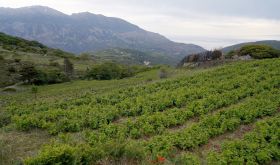
Bertha the Cava turns out to be absolutely delicious, a light, fine organically grown sparkler from a small, family-run estate in Subirats in the Alt Penedès, the heart of Cava land. The estate is relatively new in European terms, founded in 1989 by Josep ‘Pep’ Torres Sibill in Sant Sadurní d’Anoia when he was just 18 years old. At that time, he named the winery after himself, and made just small amounts of two sparkling wines: a Brut Cava and a Brut Nature Cava. By 2014, however, he’d changed the name to Bertha and moved the winery to Subirats, where he built a very modern tasting room and winery right in the middle of the vineyards.

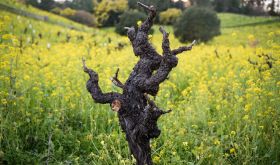
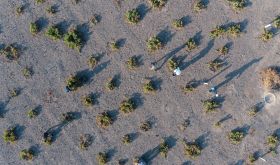
Pep makes many wines now, but all are focused on local varieties, whether it’s a still Xarel·lo (called Mountain, a reference to the nearby Montserrat mountains) or one of the several sparkling Cavas. The Brut Nature Reserva remains the company’s flagship wine, a blend of hand-harvested fruit from their own 17 ha (42 acres) of vines as well as some purchased fruit; the average age of the vineyards is 30 years. It’s made from the classic blend of Xarel·lo, Macabeu and Parellada, all organically farmed and certified since 2018 (by CCPAE, the Consell Català de la Producció Agrària Ecològica, the Catalan Council of Organic Production). The blend is fermented first in stainless-steel tanks at 14 °C (57 °F), then fermented a second time in bottle. No dosage is added so the final wine is dry and it comes in at a light and easy 11.5% alcohol.

The top selling point, however, is the flavour. This is a terrifically delicate Cava, a light, breezy sparkler with herbal notes and a lemony snap. The pinprick-fine bubbles keep it buoyant and gentle the dryness; the wine comes off feeling fresh and lively rather than austere.

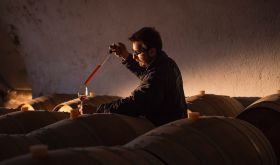
All Cava Reserva wine must by law spend at least 18 months on the lees; every bottle of Bertha’s Cavas, however, carries its disgorgement date. Mine stated 11-25, meaning that it spent 23 months on the lees. That time no doubt helped give the wine its fine texture and perhaps a hint of brioche – as fine as this wine is, it has an underlying strength that allows it to stand up to all sorts of food; in my house, it went from salty snacks to a full-fledged paella without any problem.
As for Bertha the porcupine, she slipped into the water as we neared shore and paddled safely to land, kept buoyant by her hundreds of hollow needles.
Cava Bertha is imported by sparkling-wine specialists Transatlantic Bubbles in the US and is available in the UK through Vinissimus.
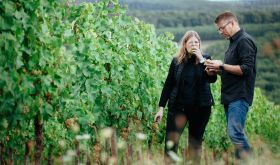
Photo at top of Josep ‘Pep’ Torres Sibill with his wife Gemma Flaqué Aranda and their children Ivette and Bertha. All photos courtesy of the winery.
For more background on Cava, see The Oxford Companion to Wine; for more Spanish sparklers, see our tasting notes database.