
I’m not sure there are many winemakers in the world who would describe themselves first as a flower farmer. But Ginny Povall does. Because, the fact is, she unintentionally bought a flower farm when she wanted a vineyard. And even now, 18 years later, she still grows more hectares of flowers than she does of vines.

How a Massachusetts-born New Yorker and high-flying insurance-industry executive, who’d grown up in a home where there was never any wine, ended up in the most unlikely dual career of protea grower and winegrower in southern Africa, is because of kitesurfing. Or rather, more precisely, not kitesurfing.
Povall was on holiday with her boyfriend. He was a professional sailor who helped rich people win big yacht races, and because of the circles he moved in, Povall ended up sipping fine bordeaux and Barolo instead of her usual bottle of beer. Wine crept into her life, quietly but surely. They’d come to South Africa to kitesurf and windsurf. But the windsurfing scene wasn’t great, and Povall wasn’t in the mood for kitesurfing, so she abandoned him to the waves and headed inland, to explore the winelands instead. It was the beauty that got her, she said. And the positive energy. And vineyards so close to the ocean.
The company she worked for as COO had been bought out, there was a payout, and she’d already been thinking about getting out of New York. Maybe a vineyard. No winemaking though. Just grow the grapes and sell them off. She booked herself in for a couple of weekend courses at UC Davis; read books; checked out vineyard properties for sale in Argentina and in California. But nothing quite clicked. Until South Africa.
She began to go back to South Africa every chance she got, until she finally realised that what she needed to do was spend three months working the harvest. So, in 2008, completely inexperienced, she landed a temp job as harvest-hand at Zorgvliet. (‘I didn’t tell them my age!’) Weekends were spent with land agents, visiting vineyards for sale. Nothing fitted the bill. Eventually, an agent suggested that she might look at something that wasn’t a wine farm and perhaps consider planting a vineyard instead.

When Povall drove up the drive of Protea Heights Farm for the first time in April 2008, saw the beauty of the place, the trees (‘it was like an arboretum’), the fynbos, it was an instant sense of recognition. By July 2008, she was the owner of a 22-ha (54-acre) protea farm and a nine-room guest house. By 2010, she’d planted 5 ha (12 acres) of vines, and, without any wine qualifications whatsoever, was making her own wine. Not quite what she’d had in mind. However, for someone who’d always dreamed of going to art school but was prevented from doing so by sensible parents who told her she would never make a living from it, perhaps being surrounded by beauty was, in a sense, coming home.

Today, Povall farms 8 ha (20 acres) of proteas, runs a guest house and four cottages, and makes a wonderful range of organic and regeneratively farmed wines from her vineyards in the cool Devon Valley of Stellenbosch. She hasn’t used chemicals or tilled for 13 years and is, she says, fixated with building topsoil by making sure that all her soils are constantly covered with wood chip, mulch, native herbs, cover crops and compost. It’s abundantly clear from the footage on her website that she is obsessed with biodiversity and wildlife, and her farm is a rich, thrumming ecosystem. Her Flower Girl range (offbeat wines) and Big Flower range are both wholly from estate-grown fruit.
I could have chosen pretty much any of her wines for my wine of the week (I have a particular soft spot for her Flower Girl Petit Verdot Pet Nat, and the Flower Girl vermouth is divine) but when I had to narrow it down to wines that ticked all the boxes of interesting, elegant, sustainable, outstandingly good value, delicious and available in both the UK and the US, it came down to Flower Girl Albariño and Big Flower Cabernet Franc. They also make a complementary pair, especially at this time of year.
Flower Girl Albariño

In 2018, at her wits end with a tiny parcel (0.3 ha/0.74 acres) of Cabernet vines which simply wouldn’t ripen, Povall top-grafted the vines with Albariño – making her one of just three people growing the variety in South Africa right now. She and her team hand-pick the grapes and the juice undergoes spontaneous fermentation in concrete egg and stainless-steel tank. It spends about three months on its lees without going through malo. I’ve tasted the 2023, 2024 and 2025. They’re all fantastic – Galicia with a South African accent, added ripeness, extra brightness.
Of the 2025 I wrote, ‘Apricot jam and lemon marmalade. Absolutely packed to the rafters with fruit. A happy, glorious wine. A little orchestra and line dance in a glass. Circles and circles. Long, luscious lime. So happy in its own skin.’ It’s just 13%, and honestly, if like many of us in the northern hemisphere you’re longing for the end of winter, for the taste of the promise of sunshine, this wine will go so well with what’s in season right now: try seared or smoked mackerel with a salad of blood orange and celeriac; or a scallop ceviche with blood orange and little crispy fried slices of Jerusalem artichoke sprinkled on top for a spring-is-on-its-way starter. Riverford, the organic veg box company, has a brilliant recipe for a ‘Vitamin C grain bowl’, which you could whip up in 20 minutes, and I can see a glass of Flower Girl Albariño being just the sidekick to prevent wholegrain virtue slipping into wholescale prohibition.
The 2025 vintage is available in Germany, Sweden, the US (FL, NY, WI), where it is imported by Pascal Schildt Selections, and the UK, where it is imported by Dreyfus Ashby and can be found stocked by a number of independent wine merchants. It’s worth noting that The Wine Society is still stocking the 2024, which is in no way going to be past its drink-by date, at a bargain £18. I wouldn’t hesitate to buy an older vintage.
Big Flower Cabernet Franc

The Big Flower Cabernet Franc also tastes, to me, like the promise of late spring, early summer. It has a heady aroma (so perfumed that I wanted to do a little happy dance in the tasting room) and tastes of roses without being soapily floral, and of masses of red cherries without being tutti-frutti fruity. Like the Albariño, it has a brightness and warmth, but of flavour not of alcohol. The tannins are long and feel like they are shining with graphite.
Like the Albariño, it comes from organically farmed vines on the Botanica estate, part of the original plantings in 2009 and 2010. The grapes are destemmed, crushed and spontaneously fermented in open-top tanks, and then it is racked to 300-litre French barrels (second, third and fourth fill) for malo and 11 months of ageing.
In the UK, venison is still in season, and this wine would be fantastic, perhaps even better if you served it with a walnut-oil-rubbed kale and pomegranate salad on the side. Or oven-roast slices of butternut squash and mix with the bitter bite of deep-red and pink-flecked char-grilled and raw radicchio leaves. Toss with a rose-harissa dressing and some dried cherries or cranberries, to ping with and pick up the roses and cherries and spice in the wine; serve with olive-oil-drenched puy lentils, to draw out the baritone of the beautiful earthy timbre of the tannins.
It, too, is imported into the US by Pascal Schildt Selections and into the UK by Dreyfus Ashby. Although it’s not showing up in Wine-Searcher, it is being sold in the UK by Wine Reserve.
My suggestion? Buy both wines, find local producers for seasonal food, and then gather friends around your table for an It’s Almost Spring celebration that also celebrates farmers working hard and making wonderful things to nourish us. These are wines to uplift your soul and bring a bit of light and beauty. God knows we need a break from all the gloom.
Find Flower Girl Albariño
Find Big Flower Cabernet Franc in Europe and the US and in the UK
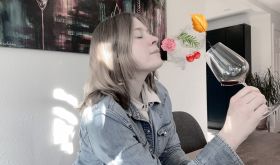
That’s Samantha, by the way, in the very top photo, harvesting Pink Lady proteas, one of the eight varieties grown on Protea Heights Farm in the Devon Valley of Stellenbosch. All the photos, except the one of Povall herself (from Dreyfus Ashby), have been supplied by Ginny Povall.