
There is something, if not quite rotten, then certainly missing from the current state of British food.
I speak despite being an avid admirer of this style of cooking. In the 1980s my restaurant was not only one of the very first to write its menus in English but also alongside head chef Martin Lam, we made a practice of using the very best English ingredients such as Jack Morris’s black pudding from Bury and Bob Baxter’s Morecambe Bay potted shrimps.
These ingredients seemed fitting, and many still do, in a restaurant setting. But where does British food fit in the more casual, takeaway era where food is often eaten on the go?
Of course there is the great British sandwich. We eat 11 billion of them a year, the vast majority of which are made at home and taken to school or work, and form an indispensable part of the British way of life. But who, for example, chooses to eat a sandwich after 3 pm – other than the man in front of me at ‘An American in Paris’ last week? Who chooses to eat a sandwich over an aperitif with a date? The answer is practically nobody.
The absence of British influence in what we eat in the evening is increasingly obvious as the shift in eating patterns is dictated by the move towards food trucks, by the increasing influence of women and the growing propensity towards spicier, stronger flavoured foods.
This perhaps seems a growing concern for me as I write this in our apartment overlooking the new Kings Cross development where I have been responsible for the choice of restaurants. There is Greek food at The Greek Larder; German at the German Gym; a daily queue outside Dishoom for Indian food; a suitably diverse offer at Caravan and The Lighterman; spicier Korean food at Kimchee; and only a handful of British dishes among the world’s wines on offer at Vinoteca. But there is no particularly distinctive British menu – simply because, I would argue, no one has yet come up with the appropriate style of serving such food.
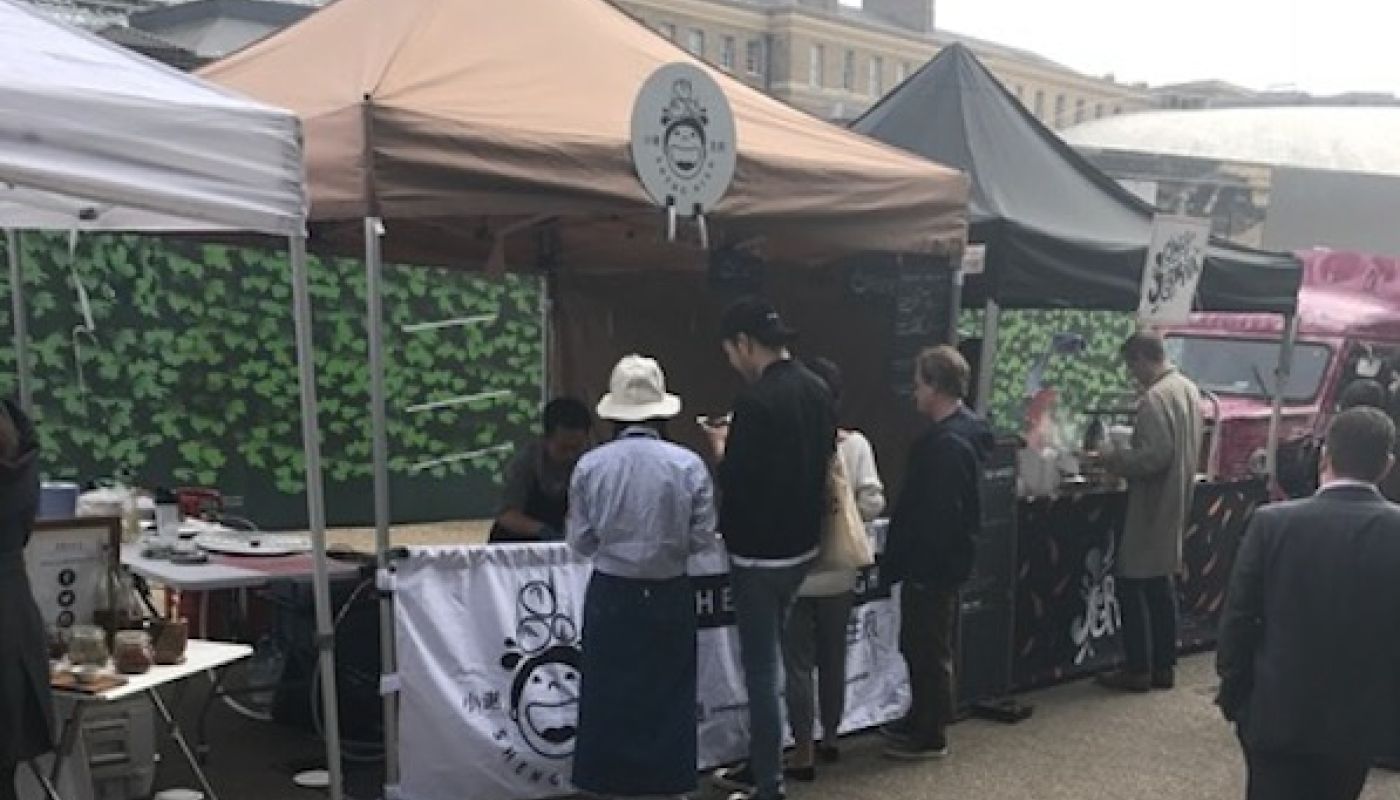
At Kerb, King’s Cross’s lunchtime collection of food trucks and stalls (pictured here), where the emphasis is on food that can at best be served on a plastic plate and eaten with a plastic fork, the choice is just as broad and exotic. There is Thai and more Greek food, as well as burgers, of course. There is pizza, mac and cheese, with perhaps the nearest thing to British food coming from Ghetto Grillz, who deliver a bagel, baked in London’s East End, stuffed full of salt beef, cheese, all topped with a Russian dressing. Delicious this may be but how British is it? Meanwhile, spice is provided by Biang Dang, which serves up Taiwanese lunch boxes, and Sheng High, which specialises in Shengjian baos, so popular in Shanghai, both of which attract long queues of admirers.
The fundamental problem is a basic logistical one: what is the British way of serving quick, easy to eat food and what can be done to find anything more stable than two pieces of thick bread between which we include whatever ingredients may excite us? However, a more fundamental question remains: How did this state of affairs come about?
Is it because Britain has a long tradition of growing wheat, the staple of our bread-eating forebears? Certainly, this seems to be part of the reason, as none of the countries based along the same latitude seems to fare much better. Only Italy with its long tradition of pasta and Spain with its rice offer dishes more akin to the stronger Asian flavours that seem so popular and which today offer a more appetising alternative.
As to spices, perhaps British food evolved too early and too gently? Certainly, the addition of nutmeg and cayenne pepper, the combination that was used pre-refrigeration as a method of preserving fish and meat over the winter, seems quite tame by today’s standards and unlikely to excite many now addicted to Indian or Chinese spices or any other combination of spicing from the East.
Or perhaps the reasons are more attributable to social and economic factors. Lacking until quite recently a winemaking culture of our own there was no need to design dishes that could quite easily be served alongside a glass or a bottle of wine. There has been no tradition of sherry making, the process that gave rise to the equally laudable Spanish tradition of enjoying tapas, or of the synergy of having winemakers so close by that led to the growth of the enotecas of Italy and the Weinstuben of Germany and Austria.
This historic split between eating and drinking, which has had so many other significant repercussions over the years in the UK, may also be mirrored in the split between what the various social classes have eaten. While sandwiches, fish and chips and other relatively bland foods, washed down by tankards of ale, were the staples of the working class, those who had the option of a wider choice of food, such as the emerging middle class in Victorian England, had their introduction to any spicier alternatives blocked by a general ban on anything that smacked of a more adventurous approach to cooking.
These may be contributory historical factors that go some way to explaining why, with the exception of sandwiches and fish and chips, British food does not translate easily into fast food. Name one dish that can be served and eaten easily and inexpensively and comprises predominantly British ingredients and can be served swiftly and/or from a food truck?
These two factors – greater choice at lunchtime than a sandwich and the search for somewhere less formal than a restaurant – were picked up in last week’s (18 March) Economist in the Banyan section written by their Asia correspondent. Here he or she, the column is anonymous, cites the cracking down on street vendors by the current government in Bangkok – a similar process is under way in Ho Chi Minh City and has happened in Singapore that has seen the eviction of 15,000 street vendors despite the fact that the last survey showed that two-thirds of households ate at least one meal a day on the street. The article states that it was the overcrowding of the cities that led to the proliferation of food stalls, a fact that is now being replicated in the West.
I would be very happy to put my money where my mouth is and offer a £1,000 reward to the chef, restaurateur or food lover who can come up with this dish. I would imagine that this sum would pale into insignificance when compared with the financial rewards that will eventually, and undoubtedly, transpire.