The most instructive tasting I experienced during my nearly two weeks in New Zealand last month was not specifically linked to either wine or New Zealand.
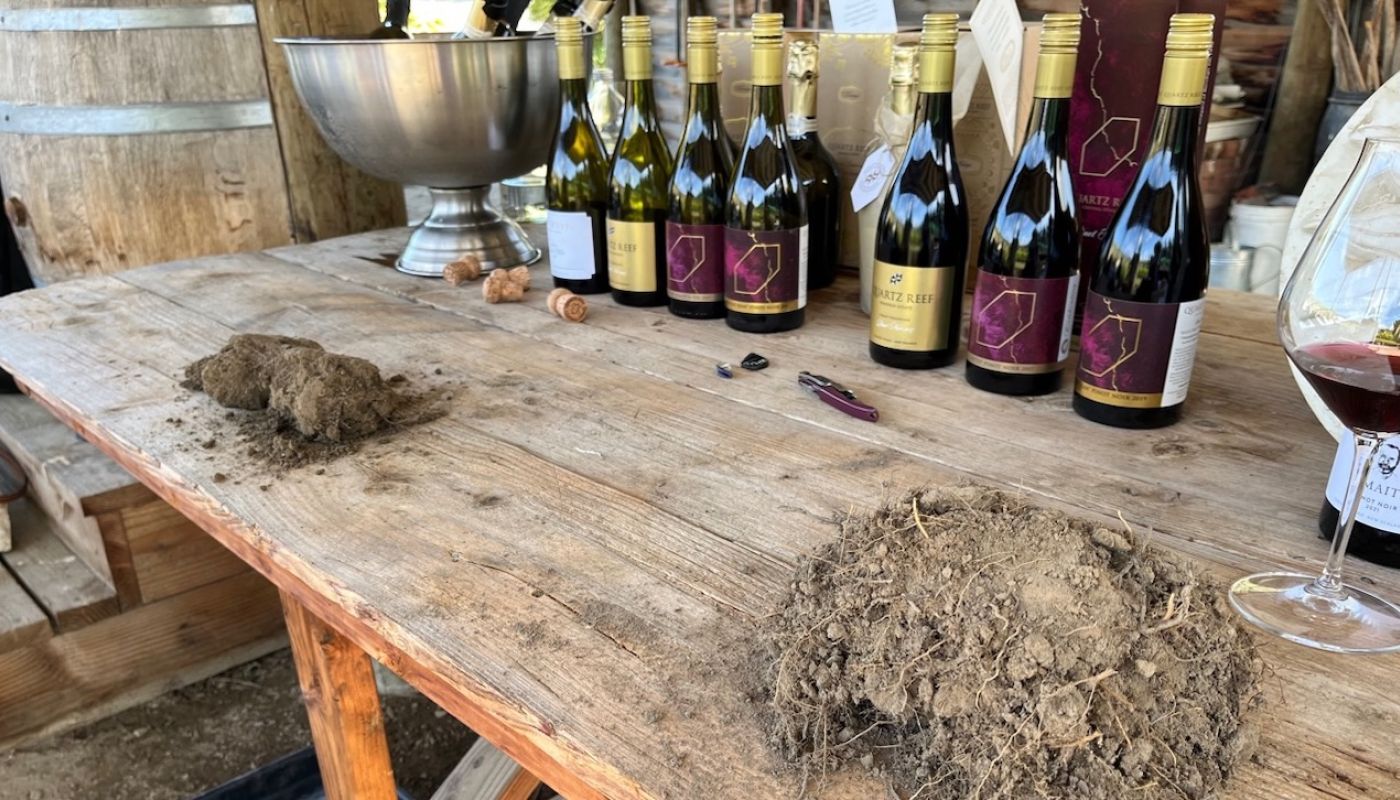
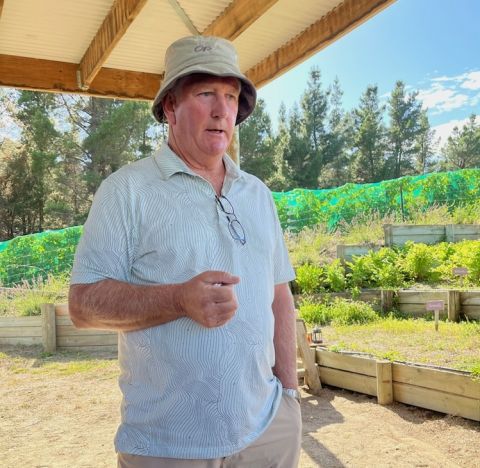
I was given two wine glasses filled with soil by ruddy-faced viticulturist Grant Rolston (pictured below), an emigré from a long line of Irish farmers. The contents of the left-hand one (one the left above) looked and, with a bit of encouragement, smelt like dust. But out of the right-hand glass leapt a complex array of aromas that seemed as full of life as the earth inside the glass appeared to be, full of fragments of vine roots and tiny insects.
The soil in the left-hand glass had apparently been taken from an unidentified vineyard farmed conventionally, therefore treated with chemical fertilisers and fungicides, that had been planted at the same time as the vineyard that supplied the soil in the right-hand glass. This came from Rudi Bauer’s Quartz Reef wine operation in Central Otago in the south of the South Island, where I was tasting.
Bauer is a particularly avid follower of the precepts of biodynamics in his vineyard, which means being guided by the phases of the moon, burying homeopathic doses of special ‘dynamised’ (stirred) preparations in cow horns at propitious times and generally seeming pretty deranged. But all over the world producers of some of the most admired wines follow biodynamic principles more or less, with a demonstrably beneficial effect on vine health and wine quality.
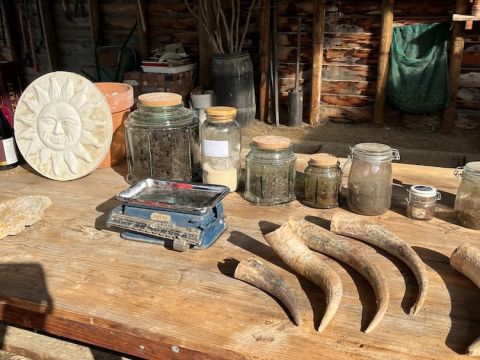
The soil demonstration took place in Bauer’s open-sided centre of biodynamic operations, more accurately described as a wooden shack. It was flanked by beds of valerian, chamomile and yarrow. Butterflies flitted everywhere. An old meat safe used for drying these ingredients in various biodynamic preparations hung from the ceiling. The earth floor was home to a healthy colony of sandflies, as my legs were to discover later.

Biodynamics is a step beyond organic viticulture, whose adherents forswear agrochemicals – but both organic and biodynamic vignerons are allowed to spray the traditional Bordeaux copper-sulphate mixture to ward off the mildews that seem to be targeting grapevines with increasing frequency. A climate-change effect perhaps.
Copper can be toxic, however, and there is concern about the build-up of copper in vineyard soils. Soil is becoming the new focus of vine-grower attention. Like farmers of all sorts, vignerons are in general becoming increasingly aware of the importance of what goes on below rather than above ground.
Regenerative is the new buzzword in wine-growing circles – not least because decades of agrochemicals have so degraded vineyard soils. One of its laudable aims is to regenerate the soil by increasing the life within it now that we understand more fully the importance of underground networks of microbes and mycorrhizal fungi in promoting healthy growth. The more earthworms the better!
Another of its requirements is to abandon tillage, which turns over the soil, breaking up these networks and reducing the soil’s water-holding capacity. One of its most visible consequences is the planting between vine rows of a healthy mix of different cover crops that sequester carbon in the soil, and can be designed to attract predators that will keep vine pests at bay without recourse to pesticides. Bare earth is no longer a badge of honour in a vineyard – rather the reverse.
Viticulture has been a woeful monoculture for decades, but another new buzzword is biodiversity. Even the Bordelais, who have now widely abandoned their previous rejection of organic viticulture, boast of how many trees and hedges they have planted in their vineyards. In New Zealand, nurseries are short of native tree saplings, so great is demand.
Regenerative viticulture is steadily gaining ground. Every year we have a writing competition for visitors to JancisRobinson.com and the theme last year was regeneration. We had entries from all over the world citing at least 24 wine producers committed not just to sustainability but to regeneration to a greater or lesser degree. The wines I recommend here are made by those profiled in the writing competition, mainly produced from regeneratively grown vines, although some of the producers cited, while on the path to regeneration in their vineyards, have not yet arrived.
The Torres family of Spain and Chile are wine producers who have long been more aware of the effects of climate change on viticulture than most. Miguel Torres Maczassek was present at the launch of the not-for-profit Regenerative Viticulture Foundation in London last year, along with Mimi Casteel of Hopewell Wines in Oregon, one of the most persuasive advocates of regenerative viticulture.
Torres told of how, when he started to sow cover crops in his vineyards in 2020, his neighbours shook their heads and were convinced that these ‘weeds’ were signs that Familia Torres was going down the tubes. Most of the Torres wines that will result from this new philosophy are as yet unreleased but I include the first to emerge on to the market in my recommendations. As he explained in an email, ‘the wine does not cite regenerative viticulture on the label because there was no proper certification at that time’.
Torres is president of Spain’s RVA (Regenerative Viticulture Alliance), which has been developing an international protocol with associated certification. The idea is that under the auspices of Ecocert, the well-established international organic certifying body, individual soils will be audited every three years. He added, ‘There is also a new app that helps vine-growers to use technology to better understand and monitor regenerative practices in their soils. This app is linked to the certification. We made it all very simple and with no bureaucracy so any vine-grower can join.’
The American ROC certification (Regenerative Organic Certification™), launched in 2020, is more demanding because it’s even more wide-ranging, and requires a commitment to organic farming. It also requires integrating animal welfare and livestock operations, where appropriate (it can be applied to a wide variety of products – not just wine), as well as the social aspects of sustainability (looking after the workforce and so on). These aspects are encompassed by the ROC certification, whose motto is ‘farm like the world depends on it’. So far the only wine operations to be fully ROC-certified are Domaine Bousquet in Argentina, Troon in Oregon, and Bonterra, Neal, Sominer, Tablas Creek and Truett-Hurst in California.
The nexus between wine production and fauna is an interesting one. Working horses have become increasingly common in vineyards as they generally entail much less harmful compaction of the soil than all but the most recently designed tractors. Sheep are also increasingly put to work in vineyards to keep cover crops trimmed (if cover crops grow too abundantly, they start to compete with vines for nutrients and may even risk imposing themselves between vine leaves and the sunshine needed for photosynthesis and grape ripening). Geese have also been known to do this job, and there is one farm, Antiquum in southern Oregon, that grazes not just sheep and geese but also pigs, chickens and turkeys in its vineyards.

But animals and, especially, birds are more often seen as pests by vine-growers. Vines are commonly and cumbersomely netted as grapes approach ripeness in much of New Zealand and parts of Australia and the UK, so attractive are they to the local bird population. This is rare in France, a fact not unconnected to the popularity of la chasse with the French.
And in many parts of the world, vineyards, especially tender young vines that grow conveniently close to the ground, have to be fenced to keep out animal predators: wild boar (in Tuscany especially), more exotic wildlife in parts of Africa, and rabbits (in Central Otago), for instance. During my recent visit to Quartz Reef, Bauer was quick to point out that the most effective defence against leaf-munching rabbits is one they would hardly welcome: urban development.
Recommended regenerative wines
Sparkling
Wyfold, Rosé Brut 2018 England 12%
£33 Laithwaite's
Harrow & Hope, Blanc de Blancs 2018 England 12%
£40 Laithwaite's, Averys
Whites
Reyneke, Organic Chenin Blanc 2020 Western Cape 13.5%
£8.99 Waitrose
Henschke, Peggy’s Hill Riesling 2022 Eden Valley 12.5%
£19.30 Vinum, £20.46 Shelved Wine, £22 Oz Wine
Filipa Pato & William Wouter, Nossa Calcário Bical 2020 Bairrada, Portugal 13%
£32 Festa Wine
Clos de la Meslerie, Sec 2017 Vouvray 13.5%
£34 Buon Vino
Domäne Wachau, Achleiten Riesling Smaragd 2021 Wachau 13.5%
£250 for 12 bottles in bond Farr Vintners
Reds
Torres, Clos Ancestral 2021 Penedès, Spain 14%
£14.88 Nickolls & Perks, £22 The Wine Tasting Shop, Balham
Thymiopoulos, Jeunes Vignes Xinomavro 2020 Naoussa, Greece 13.5%
£16.25 Hennings, £17.10 Theatre of Wine
Te Mata, Bullnose Syrah 2018 Hawke’s Bay, New Zealand 13.5%
£35.68 Lay & Wheeler, £39.05 Vinum
Ch Haut-Bages Libéral 2019 Pauillac 14.5%
Four Walls Wine £41.70
Tablas Creek, Esprit de Tablas 2017 Adelaida District of Paso Robles, California 14.5%
£49.95 AG Wines, £51 Vinum
Darling, Mariah Vineyard Pinot Noir 2021 Mendocino Ridge, California 12.3%
£54.95 Lea & Sandeman
Tasting notes, scores and suggested drinking windows are in our tasting notes database. Some international stockists can be found on Wine-Searcher.com.