
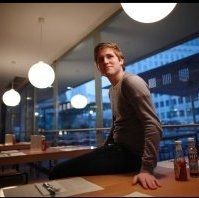
Ed Burgess, 18, having worked as a waiter for the past nine months, has just flown off to spend six months travelling around South America before university. This trip has been funded by the £3,500 he has earned, a combination of the £6 an hour wages he received working as a waiter during this period plus any tips he could generate.
Before he left, I met him for lunch in the new branch of Canteen in London to hear what life had been like on the lowest rung of the restaurant ladder.
Although he was to talk for the next 90 minutes at a speed that I could barely keep up with, Burgess said very little immediately after we had shaken hands and sat down. Instead, he just looked around the busy room.
'This looks like a really nice place', he then commented, 'everyone seems to be in a good mood. I would like to work here. Since I started as a waiter, I’ve begun to notice things I never saw before: whether people are smiling or the purposefulness of their walk. The whole experience has made me much more observant.'
There have, however, been scars both physical and mental. Before we ordered, Burgess rolled up a trouser leg to reveal some deep cuts. These were the result of his being told to take several black rubbish bags out from behind the bar to the pavement without having been warned that they contained broken bottles.
The strongest commercial memory came from his first part-time job as a waiter in a restaurant that closed its doors after only seven months. It was an experience that seems to have left him with a healthy appreciation of the precarious nature of the business but also, once he had started working somewhere much more popular, of just how customers are attracted to busy restaurants. 'It’s amazing once business builds up, how more and more customers just flock in', he observed.
Burgess secured his second job by calling in at restaurants and hotels around a major London railway station and seeing whether there were any vacancies. Once hired, he was immediately introduced to London’s cosmopolitan make-up as the restaurant comprised a mainly English kitchen brigade but waiters and managers from eastern Europe, Italy, Spain, Brazil, Hungary and even a 7’1” Rwandan Rastafarian whom he described as ‘very graceful except for having to crouch continually to miss the ceiling’. On certain shifts, he said, going from the restaurant into the kitchen had been like walking from Poland into England.
Working in the busy restaurant of a hotel open for breakfast (the worst shift, as customers were invariably grumpy and rarely tipped), lunch and dinner, Burgess had also been able to discern strong differences among the nationalities he served. Those from northern Europe never tip; those from the US always do so and generously, although not quite as generously as the Russians, who are invariably the most demanding because of their habit of ordering any dish they like at any sequence in the meal. As soon as he heard an American voice at the entrance, he added, he would always try to seat them, knowing that they would repay good service.
The management’s not uncommon practice of not passing on the service charge to the waiting staff led the waiting staff to adopt two different approaches when it came to presenting the bill. If they thought the customer would not tip generously, they automatically added the 12.5% service charge. If they thought they would be generous, they left the service charge off and shared out whatever was left.
Burgess obviously enjoyed looking after customers conscientiously. He compared it favourably with chatting up a girl, with the excitement of securing a good tip as something ‘that made his day’. The experience has also left an indelible mark on him, as he added that whenever he is a customer now he always leaves a tip even if a service charge has been included.
More indelible marks have also been left via his dealings with the kitchen. Although he said that the food was always beautifully presented and generated few complaints, he did opine that ‘all chefs are nuts’ and that at times the kitchen brigade seemed ‘like a dysfunctional family’.
These characteristics were accentuated when the restaurant was busy. If a sequence of orders came in too quickly from the restaurant, then a moment would come when, in Burgess’s words, ‘the chef would just flip’ and the atmosphere in the kitchen became very unpleasant. He quickly realised that not taking an order for a few minutes to avoid such a pile-up of orders could lead to a smoother service.
He admitted that becoming even a reasonably good waiter took longer than he had expected. He knew he would not have trouble with the physical demands of the job but it took him some time in the absence of any training to develop the particular computer brain, as he described it, which could cope with doing three different things at once and then being told to do something else all under pressure. 'It’s definitely not the cleverest who make the best waiting staff', he said with genuine respect.
He will not miss the worse aspects of the job: waking at 5 am to serve breakfast; having his rota changed at the last minute, which interfered with his social life; and being under constant surveillance by the hotel’s CCTV cameras.
But life as a waiter has definitely not dented his appetite. He polished off vegetarian sausages and a chicken and mushroom pie with gusto before demolishing a chocolate sundae.
And he has acquired two new characteristics his parents would be proud of. As soon as he has finished eating he always aligns his cutlery vertically to signal that his plate can now be cleared and, as we walked past a table that six customers had just left with all the resulting detritus, he said 'I desperately want to go over there and clean all that up even though it’s nothing to do with me.'
Canteen, www.canteen.co.uk
Charlie Bibby of the FT took the photograph