From AU$ 48.99, £33.25, £170 for six bottles in bond, HK$1,620 for six bottles, SG$298.72 for six bottles in bond, HK$324, €241.80 for six bottles, NZ$69.99, 449 Swedish kronor, $56.19, 2,565 New Taiwanese dollars
Henschke Hill of Grace and Penfolds Grange are Australia’s most famous, and most expensive wines, the most recent vintage of each priced at around £500 ($620) a bottle. The styles of the two wines are completely different, even though they are both based on antique Shiraz vines and are made within about 10 miles of each other in Barossa in South Australia. I don’t think the difference lies in the fact that Hill of Grace is a single-vineyard wine and Grange is always a blend. Nor essentially in the difference between a family-run enterprise and a subsidiary of one of Australia’s giant wine companies. It has more to do with the house style. You might summarise it as expression (Henschke) v concentration (Penfolds). Or, to explain it to those familiar with the wines of Bordeaux’s right bank, Moueix v Pavie. Although I should add that, when presenting the most recent Penfolds Collection, winemaker Peter Gago did make it clear that he is now heading more for a vintage expression than slavishly following the Grange recipe, and I noted that 2015 Grange tasted ‘more like Ye Olde Australia’.
It's the taste of reds that recall the great Australian wines of the mid twentieth century that I hanker after, wines that, with their warm (but not exaggerated), lightly medicinal, earthy aromas and round embrace of gentle, ripe fruit have very little to do with the blockbuster style of Australian Shiraz that was popular for a short while in the US in the late 1990s. I was lucky enough to be introduced to these classics by people such as the late Len Evans when I first went to Australia in the 1980s, and he put on a memorable tasting of these classics for British wine writers in London in 1993 when irritated by the fact that Australian wines were being dismissed as sprinters rather than long-distance runners.
I recently had the pleasure of tasting Henschke’s top four reds from a vintage the family describe as ‘exceptional’, 2015, and they all recalled this glorious, quintessentially Australian style. Hill of Grace 2015, Mount Edelstone Shiraz 2015 and Cyril Henschke Cabernet Sauvignon 2015 (the links are to my tasting notes) all clearly have their distinct attributes, but they are all pretty pricey – about £100 a bottle for the second two – and are designed for a lifespan of about 30 years.
Henschke, Keyneton Euphonium 2015 Barossa may not be inexpensive as a wine of the week (we owe you a really cheap one), but I do think that at just over £30 a bottle, it’s fabulous value. It is absolutely in the subtle South Australian style I describe above, and you don’t have to age it for 30 years; the Henschkes on their admirably informative website suggest a mere 20 years. It is presumably much less expensive than the three stablemates cited above because it’s not a single-vineyard wine and is therefore made in sufficient quantity to be available around the globe. It’s available from a wide range of retailers in Australia, the UK and the US as well as in the Netherlands, Sweden, Hong Kong, Singapore and Taiwan (though sometimes by the six-pack rather than by the individual bottle).
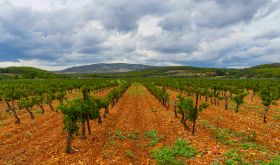
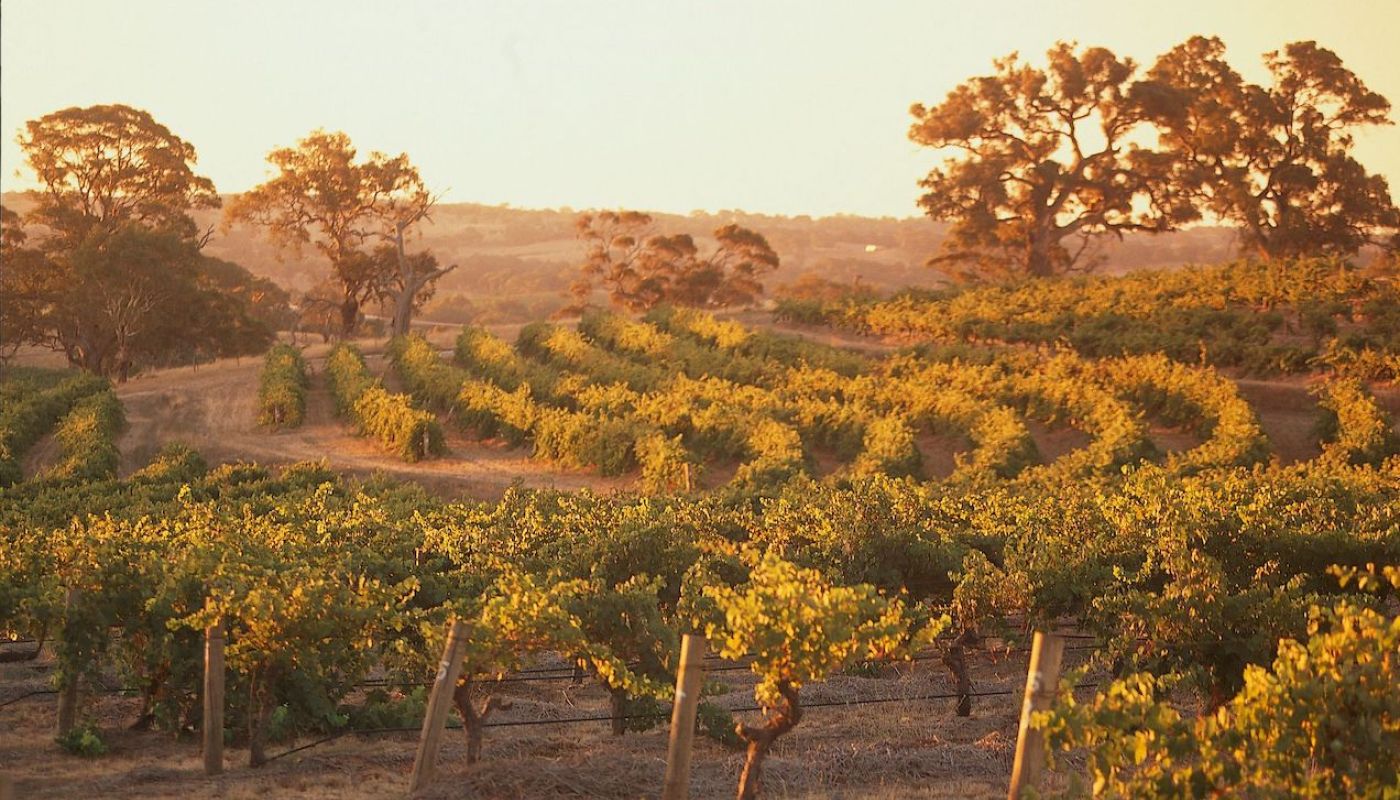
The relatively bargain price may also be that blends of Shiraz and Cabernet have not been as highly valued in Australia as are single varietals, despite their representing a classic Australian wine style – See Australia's defining blend. The Keyneton Euphonium 2015 is made up of 66% Shiraz, 19% Cabernet Sauvignon, 10% Merlot and 5% Cabernet Franc matured for 18 months in French oak hogsheads, of which 20% were new. The Shiraz was sourced from vines up to 50 years old in both Eden and Barossa Valleys – which is why it’s given the portmanteau appellation Barossa, which encompasses both valleys. Some of vines were planted by Cyril Henschke at his Eden Valley property in the 1960s and the picture above shows 50-year-old Shiraz vines in one of their countoured vineyards there.
The Henschkes were and are based in the Barossa Hills village of Keyneton, founded by livestock farmer Joseph Keynes in 1842. The village became a bit of a meeting place for the early Germanic settlers, who famously arrived in this part of the world from Silesia, and still today dominate vine growers in and around the Barossa Valley.
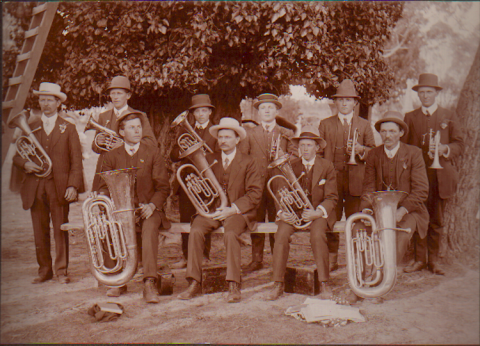
The Henschke family brass band – pictured here in the 1920s, I hope in winter when it wasn't too hot for those suits and hats – was founded in 1888 by Paul Gotthard Henschke. It was later led by third-generation Paul Alfred Henschke. It featured wind instruments such as a B-flat euphonium, cornet and E-flat clarinet. The Henschkes are particularly proud of the century-old brass euphonium since it was made by the famous Zimmermann factory in Leipzig. The instruments were imported by musical entrepreneur Carl Engel of Adelaide in the late nineteenth century and have now been restored by the Henschkes.
I asked Justine, Prue and Stephen Henschke’s daughter' about the current generations' musical talents and was told:
'Dad can play the old Henschke organ, the piano and the guitar. Johann learnt to play the piano and then the saxophone. Andreas learnt to play the piano and then the French horn. I also learnt to play the piano, used to sing in a jazz/blues band and am currently trying to learn to play the guitar.
'Therefore, Andreas and Johann are both best placed to get a note out of the old euphonium!
'Mum has a deep appreciation for classical music and has joined a choir with some friends in the Barossa; outside of COVID-19, they get together as a group and sing traditional German songs.'
My tasting note on Euphonium 2015:
Transparent dark ruby. Delightfully mellow, sun-baked and ripe on the nose but with freshness on the finish. Pure South Australia on the palate: warm and leathery but with a gentle texture. Nuanced rather than showy. I'm not sure why the Henschkes recommend decanting this wine as it seems to be pretty mellow already. Long, subtle and satisfying.
This particular wine has a long history with several different chapters. Here’s the story according to Justine:
'Cyril Henschke developed the Mount Edelstone single-vineyard Shiraz in 1952 and the Hill of Grace single-vineyard Shiraz in 1958. He had a number of his relatives growing Shiraz in Eden Valley and Springton, and wanted to make an easy-drinking Shiraz dry red wine to complement his single-vineyard Shiraz wines. In 1958, the Henschke Dry Red was born. It had a simple white label with black lettering.
'In 1967, Cyril decided he wanted the wine to look more upmarket and named it Henschke Hermitage. But he was one of the first winemakers to become concerned about using European names and in 1972 changed the name to Henschke Keyneton Estate, in tribute to the Keynes family who settled at what became known as the village of Keyneton in 1842. This wine was labelled with Cyril’s distinctive black and silver label.
'In 1980 Stephen and Prue, who had recently returned from their studies in Europe, had the opportunity to look at blending the Eden Valley Shiraz with other varieties to create a wine which was more savoury and food-friendly. This resulted in a final blend of Shiraz, Cabernet Sauvignon and Malbec, tying in with the developing popularity of Shiraz/Cabernet Sauvignon blends which were becoming the cornerstone of Barossa reds. These blends have affectionately been called Super Barossans. In 1999, Stephen and Prue replaced the finicky variety Malbec with Merlot, which was more reliable and provided lovely texture and softness in the blend. From 2003 onwards, Stephen and Prue increased the complexity of the blend by including Cabernet Franc, to add nuances of red currants, violets and herbaceous notes.
'Increased focus on history and heritage of the family and the village caused Stephen and Prue to consider changing the name to Keyneton Euphonium in 2001. This enabled the family to pay tribute to Stephen’s great-grandfather Paul Gotthard Henschke, who formed the first brass band in the district. From 2001 to 2006, both names were on the label: Keyneton Estate Euphonium and from 2007 it was known as Henschke Keyneton Euphonium.'
So this is the chronology of how this delicious wine was named and composed:
1958–1967 Dry Red (Shiraz)
1967–1971 Hermitage (Shiraz)
1972–1979 Keyneton Estate (Shiraz)
1980–1998 Keyneton Estate (Shiraz/Cabernet/Malbec)
1999–2000 Keyneton Estate (Shiraz/Cabernet/Merlot)
2001–2002 Keyneton Estate Euphonium (Shiraz/Cabernet/Merlot)
2003–2006 Keyneton Estate Euphonium (Shiraz/Cabernet/Merlot/Cab Franc)
2007 onwards Keyneton Euphonium (Shiraz/Cabernet/Merlot/Cab Franc)
I should add incidentally that, if you give Penfolds Grange enough time in bottle – and I’m talking decades here – it approaches the style I’m writing about here (see Putting Grange back on the map from 2008). It’s just that when young it is so very different. These Henschke wines are much more approachable in youth. See also Every vintage of Henschke Hill of Grace and Hill of Grace and its little brother – verticals back to the 1970s.