The waitress at Spruce in San Francisco was only halfway through her two-minute description of the charcuterie plate I had ordered while my wife and I caught up with an American friend after several years’ absence, when my heart began to sink. Why, I wondered, could she not simply deliver the food and let us get on with our conversation?
The rest of the meal was punctuated by similar unnecessary intrusions to such an extent that, as we walked out on to the windy pavement, our guest felt he had to apologise. ‘Waiting staff in the US have always believed that they have to say too much, to put on too much of an act, because they know only too well that their tips depend on their performance', he said, ‘but I do think that this habit has got worse since the recession. They’re trying harder to compensate for the fact that their customers may leave less than they used to.’
This practice may now be at its worst in the US but it has sadly spread far and wide. The most ridiculous, invasive, over the top – and therefore unforgettable for all the wrong reasons – service we ever suffered was at an overly ambitious restaurant in a small village in the Lake District, north-west England.
Yet among those in the business I have spoken to on both sides of the Atlantic there is unanimity about what exactly a waiter should say when delivering a plate of food: it should be as little as possible. In this context, unobtrusiveness is a positive attribute.
Drew Nieporent, who began as a busboy and now manages the Myriad Restaurant Group, even responded tersely to my question. ‘I tell my staff to say very little. It’s far more important to "read" the customer for cues, ie how much or how little they want of your time. Brevity, without pretence, is best.’
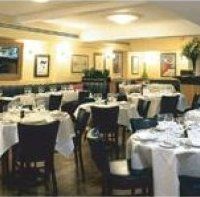
This approach was echoed by the equally experienced Gavin Rankin at Bellamy’s in Mayfair, London (pictured, sans waiters and customers). ‘A waiter’s job is to answer questions not to pose them', he said. ‘They should never say ‘Bon appétit’ or ‘Enjoy’. And they should never ask if everything is alright as we are going to find out soon enough anyway if it isn’t.’
Chris Corbin, of St Alban and The Wolseley in London and now The Monkey Bar in New York, elaborated on the service principles that he seeks to inculcate into his waiting staff. The initial greeting must always be prefixed by Good Morning or Good Evening; that when presenting the main course, the descriptions should be restricted to an abbreviation of the main course, ‘the fillet steak’ for example; and together these two phrases leave room for the waiter to return to the table for the vital ‘check back’. This, he believes, only requires the phrase ‘is there anything else I can get you at this time?’ a sensitive approach which minimises the need for too many further interruptions.
But if these are the simple principles laid down by these successful restaurateurs, why do so many waiting staff still choose to adopt a more long-winded, intrusive approach?
There are, I believe, several reasons.
The first is to appreciate quite how upfront and personal waiting staff have to be. No other profession brings complete strangers into such close physical proximity on such a regular basis, whether this involves their customary practice of putting down a plate of food not that far from a stranger’s face or reaching across the table to serve a customer who may be seated in an otherwise inaccessible corner. That is one reason why monitoring the waiting team’s personal hygiene is one of the most important but, not surprisingly, least talked about aspects of any General Manager’s roles.
And this close connectivity happens very frequently during a meal. A quick calculation reveals that during a not overly complicated three-course meal, any waiter could come into close contact with a customer on 15 separate occasions from the initial greeting to the processing of the bill and the goodbye.
Secondly, as chefs have expanded their culinary horizons, menus have definitely become more intricate and this has opened up the potential for waiters to be more long-winded.
There is more to talk about on the plate; more details to be passed on of just who grew what and where; more opportunities for the waiter to interpose their personality between the customer and the kitchen.
This process has been compounded by the presence in numerous restaurants of a tasting menu alongside the à la carte. The former is obviously where the kitchen is trying to show off what it is capable of and the chef wants to communicate via the waiter the origins of every single ingredient and the pleasure each will generate. But these menus do increase the number of times a waiter comes to the table and also tend to increase the number of times they feel they have to say something just as the customer is about to eat.
Louis Smeby, a highly experienced waiter at The Modern in New York, elucidated these differences. ‘When I am delivering a dish off our à la carte menu I usually mention the three main ingredients about 95% of the time. The only reasons I may not are because of a strong language barrier or because I can see from the spreadsheets spread across the table that this is a business lunch and just finding space for the plates is a challenge. Multi-course tasting menus are different, however. Customers have come to be dazzled and they present the waiting staff with the opportunity to present a more personalised service.’ But unlike many of his compatriots, Smeby believes the expression ‘Enjoy’ should be reserved for those sharing a Coca Cola.
In less professional hands, however, the practice of saying too much has spilled over into too many waiters’ seemingly automatic and, therefore, insincere vocabulary.
In two particular instances customers may also be responsible. The first comes via numerous restaurateurs at the moment who comment that, particularly at lunchtime but also often in the evening, customers are now so pressed for time that it is increasingly difficult for waiters to ‘read’ them for the important cues as to how they want to be treated.
The second may be a consequence of this haste. In the middle of a conversation, too many customers forget to say even the occasional thank you when a dish is served, which denies the waiter the opportunity to respond with the eminently appropriate, ‘My pleasure’. In waiting, as in architecture and cooking, less is definitely more.