
It’s a miracle that Indian wine exists at all. For a start, the tropical climate is, shall we say, unhelpful. Extreme heat and months of monsoon rains mean that, although all the vineyards are in the northern hemisphere, they are forced, by multiple prunings, into a southern hemisphere annual cycle with a first rough pruning just before the monsoons arrive in May, then a second, more precise one after the summer monsoons so that the growing season is effectively from October to March.
With a full range of wine styles, from fizz to a concoction known as Indian port, about which Peter Csizmadia-Honigh writes in his definitive The Wines of India, ‘I highly recommend that wine drinkers avoid it’, and a ready source of local labour, harvest lasts forever. Last year the leading wine producer Sula, for instance, picked between 15 December for base wine for the increasingly popular sparkling wine category right through until 10 April when their last red wine grapes had to be pulled off the vine before the summer heat shrivelled them into unfermentable raisins.
Asian wine specialist Denis Gastin can think of only one part of Thailand that faces anything like the same wine-growing challenges as India, but by no means all of the Indian wine industry’s challenges are natural. Total prohibition of alcohol is still part of the constitution (although increasing restrictions on the spirits adored by so many Indian men may benefit wine sales a little). Even the word ‘wine’ is negatively charged. So many of the holes in the wall selling hooch have been known as wine shops that the recently reconstituted national organisation governing wine production is known with fine euphemism as the Indian Grape Processing Board.

The tangle of vague, illogical and contradictory taxes and bureaucracy would cripple most nascent industries. Every state has its own complicated system, and levies its own taxes on wines imported from other states – so that, for example, Grover of the Nandi Hills near Bangalore in Karnataka, the producer with the longest history, has merged with Zampa in Maharashtra, the state to the immediate north, so that it can offer wines at better prices to the lucrative Mumbai market, also in Maharashtra. This means that wines carrying the same label will be different in different states – but since only a small minority of Indians have even tasted wine, that may not be the disadvantage that it might be in a nation of wine nerds.
It is presumably the enticing prospect of the burgeoning Indian middle class, with an estimated 35 million potential drinkers coming of age each year according to Fratelli, an Italo-Indian joint venture near Pune, that has lured about 50 wineries, most of them tiny, into existence. Although India has long been a major grower of table grapes, the total area of wine-grape vineyards is put at about 2,500 hectares (6,200 acres), not that much more than its English counterpart – whose challenges are so very different.
So unfamiliar are most Indians and Indian authorities with wine that state officials require not only each separate wine label to be registered, at considerable cost, with each individual state, the states also demand expensive re-registration of the brands every time the vintage changes.
Another major problem is that by far the majority of grapes are grown by smallholder farmers who know infinitely more about pomegranates than wine, and are naturally inclined to maximise quantity rather than quality. Founder of the biggest wine producer Sula, Rajeev Samant (below), inspired by Napa Valley during his time in California, is cool about owning only about 5% of the vineyards that supply the grapes for his 9.6 million bottles a year. ‘We want to make fruit-forward wines rather than complex ones. 99.99% of Indian homes have no corkscrew or cellar, so making ageworthy wine is a conceit', he said in his newly constructed La Source de Sula, an ambitious boutique hotel modelled on a Tuscan villa at his base a dusty three-hour drive north east of Mumbai.

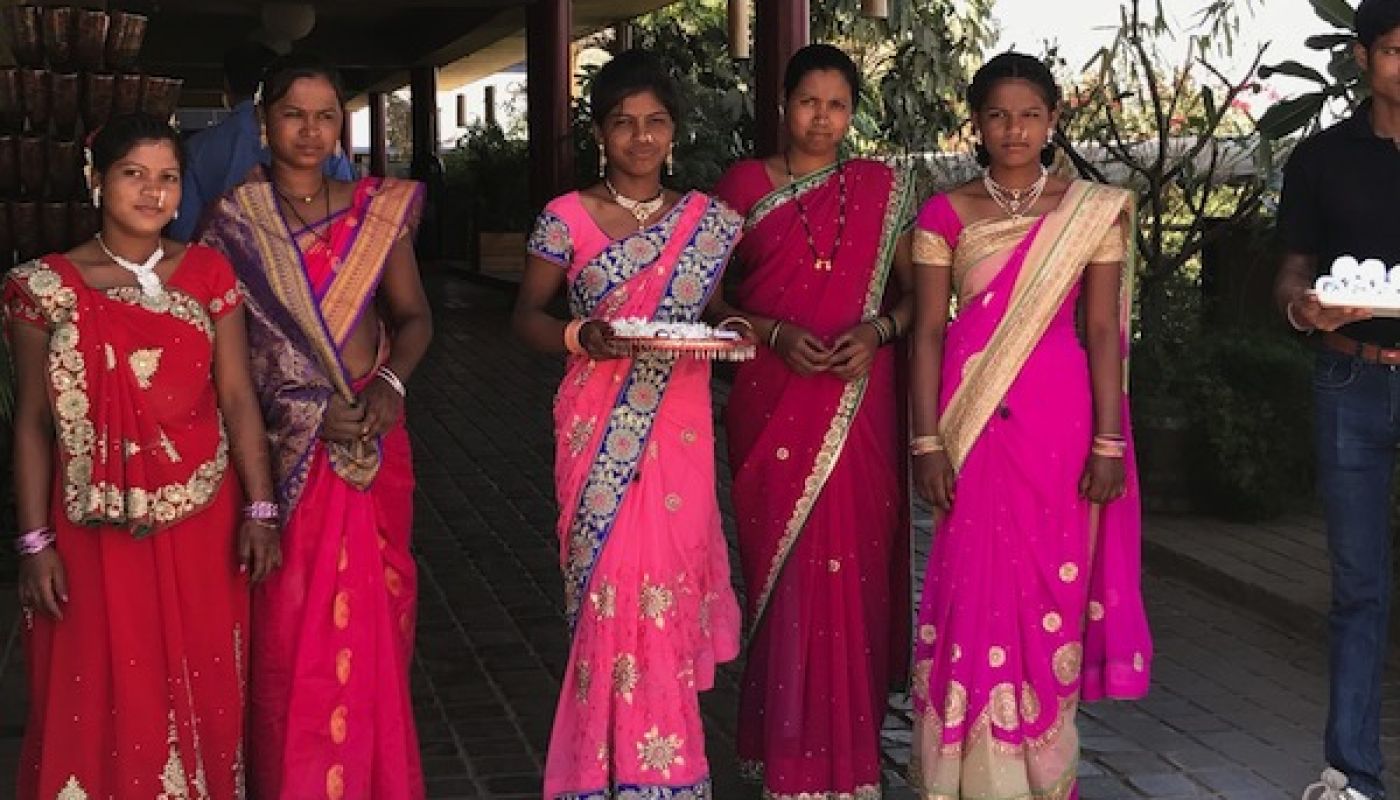
He must be doing something right because Sula, close to the holy city of Nashik and offering what he calls ‘wine and shrine’ tourism, notches up 240,000 visitors a year according to Samant, who claimed that the terrace below overlooking his parched vines last month, his new reservoir and, in the distance, the local dam, is the single place on earth where the greatest number of people have had their first-ever taste of wine. (My picture at the top of this article is of Sula's traditional welcome committee for foreign visitors.) He has introduced Sulafest, a music festival complete with its own Hollywood-style giant white letters in the distance, has an amphitheatre, two restaurants, gift shop, flea market and has plans for a petting zoo. I do hope the animals will be tropical natives.

Nashik in Maharashtra, the most wine-friendly state, is where the great majority of all Indian wine is produced, even though the climate is more punishing than in less extreme Karnataka to the south. Total annual rainfall is about 3,000 mm/118 in. (The norm for good-quality wine production is closer to 500 mm.) But none of it falls during the growing season so all vines need continuous irrigation until they are picked.
The Grover Zampa winery is also in Nashik but south of the city and (what the Grover family are hoping is) a crucial 45 minutes’ drive closer to Mumbai. Like the Gurnani family who own York winery down the road from Sula, the Grovers see tourism as an essential part of selling wine in India and have just signed a deal that will allow them to build a hotel and visitor centre on the hillside below behind their winery, with views over their nearest dam. Note the interesting skyline in this part of the world.

In the nearest village, Sanjegaon, I marvelled at two young women carrying giant steel canisters of water on their heads, an old man in a flowing white tunic swinging a flask of water on his handlebars, a naked three-year-old pouring a jug of water over himself by the roadside, and a girl of about seven squatting over a bowlful of washing. Like Grover Zampa’s vines, they are lucky enough to have ready access to water, but it’s so dry here that clothes are hurled over washing lines all bunched up; no need to stretch them out to get them dry.

In the major cities, on the other hand, young women can now be seen drinking wine in the smartest locales, even if the habit of combining wine with food is still in its infancy. But wine is such a novelty for most Indian palates that I find it quite amazing that the wines I list below are even drinkable.
FOR WINE LOVERS IN INDIA
Indians apparently prefer red but I was more impressed by the whites.
RECOMMENDED
Whites
Grover Zampa, Zampa Soirée Brut 2014 Nashik Valley
Grover Zampa, Vijay Amritraj Reserve White 2015 Nandi Hills
Reds
Fratelli, Sette (any vintage except 2010) Pune
Grover Zampa, Insignia 2015 Nandi Hills
DRINKABLE
Whites
Fratelli, Sangiovese Bianco 2016 Maharashtra
Fratelli, MS Chardonnay/Sauvignon Blanc 2016 Maharashtra
Fratelli, Vitae Barrel Fermented Chardonnay 2015 Maharashtra
Grover Zampa, La Reserve Blanc 2015 Nandi Hills
Soma Chenin Blanc 2014 Nashik Valley
Sula Reserve Chenin Blanc 2016 Nashik Valley
Sula Riesling 2016 Nashik Valley
Sula Riesling 2014 Nashik Valley
Reds
Fratelli, MS Red 2015 Maharashtra
Grover Zampa, Zampa Chene Grand Reserve 2014 Nandi Hills
Grover Zampa, Insignia 2014 Nandi Hills
The map above, from The Wines of India, is reproduced courtesy of Cosmographics Ltd. and The Press Publishing Ltd.













