From €18, £22
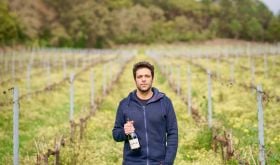
On what would have been Beaujolais Nouveau day the Noble Rot crew, famous for both magazine and wine bar, held a Beaujolais lunch attended by three estimable Beaujolais producers, Jean-Louis Dutraive of Domaine de la Grand’Cour, Julien Sunier and Andrew Nielsen.
I enjoyed many a wine but one that really stood out was Andrew Nielsen’s 2015 Fleurie-Poncié. Australian-born Nielsen and his wife Emma, who divide their time between England and Burgundy, have been building up an increasing reputation as a small-scale négociant, Le Grappin, in Burgundy. They have worked hard, not just at making pure, refined wines (Purple Pagers can see our enthusiastic notes on 17 Le Grappin wines from the 2012 vintage onwards) but at selling them too.
They have put in many a freezing cold day and evening at markets and events such as Ruth Spivey’s Wine Car Boot introducing wine lovers personally to their wares and they make an annual offer direct to consumers that, coincidentally, has just gone live here.
They are famous for their innovative way of packaging their wines and they have been creative in addressing the waste involved in much wine distribution. As Andrew explains, 'starting with our first vintage, we don’t finish our wines with capsules, a waste of resources if I ever saw one, and we collect our wine cartons from our retail partners where possible to re-use in France (last year we re-used 200 cases and some are now seeing their third vintage). As we started to make wines that were ready to drink straight away, we hated the waste from bottle, shipping, label, etc and, with our 2012 rosé, became the first in the UK to put quality wines in kegs for restaurants and bars to serve by the glass and carafe, and then created the #Bagnum “magnum in a bag” for retail customers in 2013, for our vin de soif cuvées. Even these wines are single-vineyard vinifications (except for 2016 Beaujolais-Villages Rouge, where, due to our normal parcel being wiped out by hail, we had to scramble for some parcels; all still very close to each other at least, around the village of Lantignié). We want to keep the Le Grappin philosophy from our “smallest” wines through to our premiers crus.'
Below is an example of the self-deflating #Bagnum bag that holds 1.5 litres of wine – whose contents tend to be wildly superior to the market average.

Of course recent small harvests and rising grape prices in the Côte d’Or have been making life increasingly difficult for the likes of the Nielsens and their friend and fellow Aussie Mark Haisma. Incomers without an extended Burgundian family and pedigree tend to go to the back of the queue when growers decide to sell their grapes.
As a result, like many on the Côte d’Or (even the extremely well-established Lafarges of Volnay), the Nielsens have increasingly been looking south, both in the Mâconnais and in Beaujolais, where grapes are so much cheaper and more available. Indeed nowadays their cellars in Beaune, used by Fanny Sabre until she moved to Pommard, contain more wine from the Mâconnais and Beaujolais than from the Côte d'Or.
Nielsen is extremely inquisitive and obviously likes to do something new with each vintage. The 2015 vintage was particularly hot and dry in Beaujolais and some vines really suffered from stress. Here he is describing Le Grappin 2015 Fleurie-Poncié:
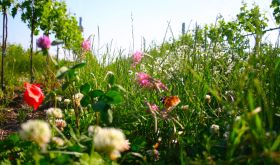
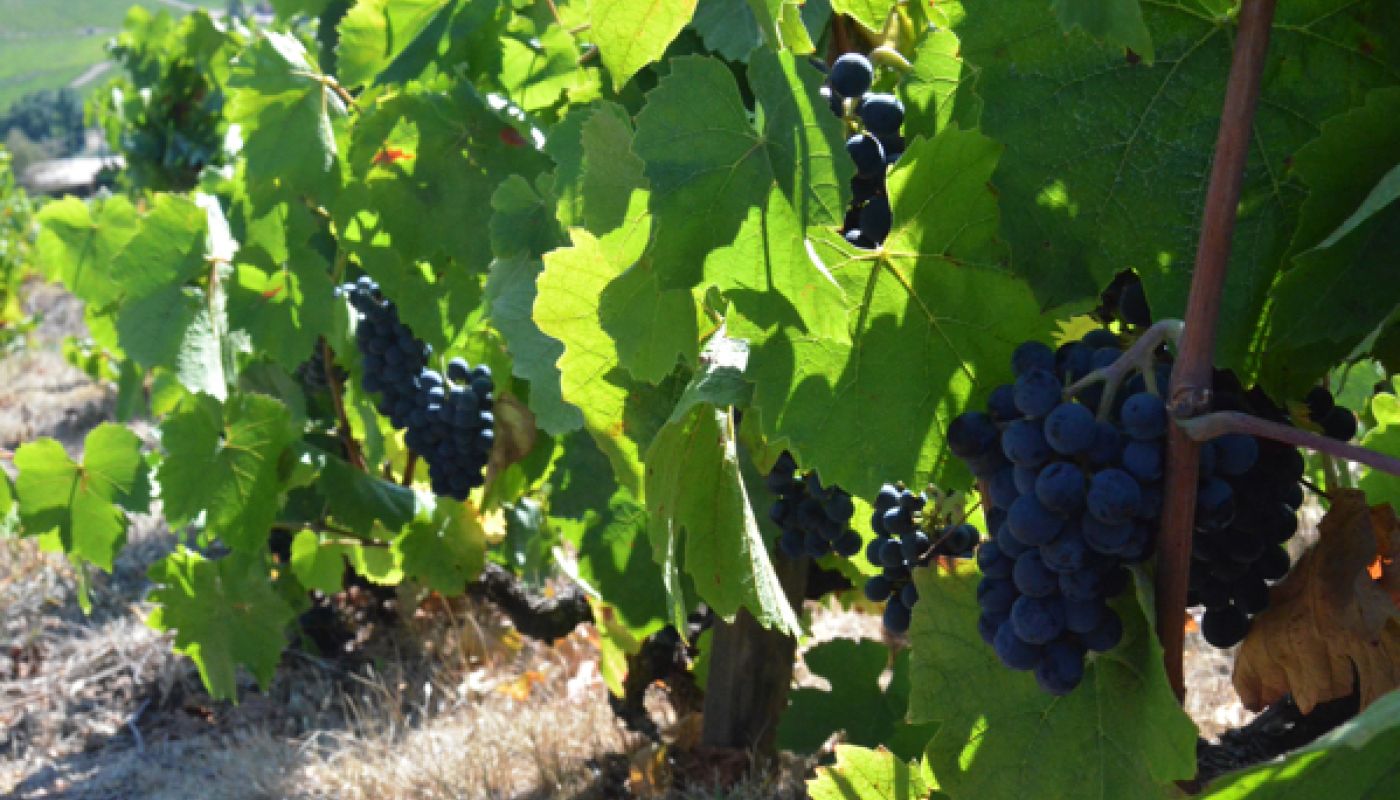
‘Our Fleurie-Poncié 2015 is from along the top, or the ridge, of Haut-Poncié and abuts Moulin-à-Vent, the soil being pink granite with lots of quartz and mica interspersed. Vines are goblet trained and up to 80 years old. In 2015 there were only three sprays in total. Crazy year and crazy grower. You can get some sense of just how small the clusters were in 2015, more Pinot than Gamay, and how dry the year was from the weeds in this picture [above right]. No weed control was necessary, nor was hedging!
‘I had an idea running around in my head of doing a “Jules Chauvet from first principles” vinification [Chauvet being the father of winemaking without added sulphur] and the fruit in 2015 from this site was so immaculate that I thought this was my best opportunity to give it a go. I really respected that Jules Chauvet approached everything from a scientific point of view and was pioneering no-SO2 vinification, not from a “this is more natural” mindset but his belief that the enzymes that create the perfume he wanted in his wines were blocked by the use of SO2. He was definitely not a “chuck the grapes in a tank and let nature do its thing” type even though he seems to have been deified by many in the natural-wine movement. From Phillippe Pacalet I managed to beg a copy of his Études scientifiques, a collection of Jules Chauvet’s scientific writings that Phillippe put together to guide us. The idea was to approach the vinification using only techniques that Jules would have had available to him and see if we could make a wine that captured the spirit of what I felt these wines must have been like.

‘Fruit was hand harvested directly into small picking cases, refrigerated overnight to 8 ºC [46 ºF] and then placed in a concrete tank under cover of CO2 for its “fermentation aromatique”. Jules from his writings was quite strongly against any intervention so there was no remontage or pigeage. He did allow use of CO2 gas or using no-SO2 wine to pour over the chapeau [cap] if mould or bacterial growth was forming, but we didn’t need to do that in 2015.
‘Several times a day we would take a lighter to the top of the tank and try and spark it. If it threatened to spark we would inject CO2 via a cane throughout the tank to protect the fruit and encourage the intraberry enzymatic conversion. Every day we counted the yeast under a microscope using a hemocytometer and when the yeast count in the juice reached 4 million/ml, the juice density was below 1.015 (so you knew the yeast was alcohol-tolerant) and most of the pulp was red from the enzymatic conversion, we pressed off (on day 21 of cuvaison). The pressings had over 150 g/l of sugar so the majority of alcohol was converted in tank. When the wine had about 2-3 g/l of sugar left, it went into old burgundy barrels (more than four years old) for seven months, with two SO2 additions. One was made in the spring when the cellar started warming and another on the morning of bottling. The wine is unfined, unfiltered, and stoppered by DIAM as we normally do. The alcohol is 13.4%.’
They like to add SO2 as late as possible after painfully fastidious sorting of the fruit. (In 2014, for example, a 1-tonne hail-damaged parcel took 16 hours to sort, with eight people working on the sorting table.) In this case they added 35 mg/l in April and another 5 mg/l the morning of bottling in June. Free SO2 at bottling was 12 ppm and just 8 ppm after two weeks.
The wine is feather-light, delightfully smooth-textured, super-refreshing and totally charming. It’s far from the cheapest Beaujolais around but, as you can see, is the antithesis of an industrial product. Poncié, by the way, is one of no fewer than 13 lieux-dits which may be suffixed to the name Fleurie.
I’m afraid the wine is available retail only in France and the UK (from Prohibition Wines, La Fromagerie, Yardarm and General Store in London; from Whalley Wine Shop in the north of England; Cork & Cask in Scotland; and Wright’s Food Emporium in Wales). The wine is available is very small quantities in Ontario, Canada through The Living Vine, in Finland through Vindirekt, and in Australia through Apostrophe Wine. It can also be bought direct from Le Grappin here.