See dozens of tasting notes of madeiras of all but the lowest quality in The Great Island Tasting and More madeiras.
Bert Jeuris, a 34-year-old importer of burgundy and fine Portuguese table wines into Belgium, had never tasted madeira until two years ago. The result of a seminal glass of D'Oliveiras Boal 1968 is that he, with a few co-investors, now owns 10,000 bottles of fine old madeira, and another 4,000 bottles of the more commercial sort. With input from his television director partner Ludovic Beun, he is now aggressively marketing this as The Madeira Collection, complete with distinctly 21st-century graphics, video footage, website (www.themadeiracollection.be), and an extraordinary celebratory tasting of historic treasures on the Atlantic island itself last week.
Just over a dozen of us were lucky enough to taste 43 of the finest madeiras produced by three of the island's best producers – Barbeito, Blandy's and D'Oliveiras – including no fewer than seven wines made in the 19th century and one bottle of wine made from grapes harvested in 1795. All of these wines were fighting fit, and had been opened a full week before the tasting just to ensure this was the case. Madeira, as you will gather, is virtually indestructible. An opened bottle can be eked out over months.
Although it is a wine fortified by the addition of grape spirit and so is usually around 19% alcohol, it never tastes heavy – thanks to the high acidity of everything, even the bananas, grown on this volcanic island between the Canaries and the Azores. It can vary from bone dry and pale to richly spicy and dark brown, but is always super-tangy, food-friendly and refreshing. We got up from our historic tasting feeling perky enough to assay a three-course dinner on the moonlit terrace of Reid's Palace hotel's Villa Cipriani with (yet more) wine.
All of these 43 wines were based on one of the light-skinned grapes Sercial, Verdelho, Boal (to make Bual), Malvasia (to make Malmsey), Terrantez or Moscatel traditionally grown on the island until mildews and the phylloxera louse arrived there in the late nineteenth century and decimated vine plantings. Most growers replanted with the much more robust Tinta Negra Mole vine whose grapes have dark skins and produce rather less refined fox-red wines. This vine variety, thought to be identical to the Molar of the minuscule Colares wine region on the Portuguese coast, is responsible for a good 85% of all wine produced on the island, although there is now official financial encouragement for the 1,500 growers to switch back to the classic white grapes. The island's top winemakers are learning to love Tinta Negra Mole, however, and have been producing increasingly ambitious versions such as Barbeito's Colheita 2001.
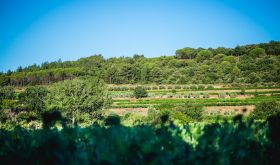
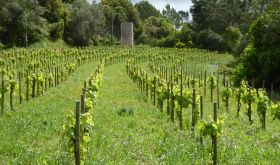
That the total area planted with vinifera (European) vines on this fertile island is just 400 hectares (much less than the total planted in England, for example) shows that vineyards here are typically no more than a small terrace or garden plot on the island's steep slopes. The Madeira Wine Company, whose (virtually interchangeable) brands include Blandy's, Cossart Gordon and Leacock, buys from 800 of them, for example, their purchases varying from 30 tonnes of grapes down to just 50 kg.
Arguably more than in any other wine, it is the ageing rather than the grapes that determines madeira's quality – perhaps not so surprising for a wine that can easily last a century or two. Before Prohibition and the Russian revolution robbed the madeira shippers of two of their best markets, there were dozens of producers on the island, each with several warehouses, or lodges, designed to expose the wines deliberately to the heat and oxidation that can preserve them for so miraculously long. Today there are just six producers of sufficient size to export in any quantity, and the single biggest export market is France, which is really only interested in young madeira for cooking rather than drinking. (This lowly sort, 'modified' with added pepper and salt, is the only type of madeira that may be exported in bulk rather than bottle nowadays.)
The dominant premium producer, Madeira Wine Co, run by the powerful Blandy family, who have been on the island for nearly 200 years, had to join forces with the Symington port group in 1989. Barbeito, whose delicately vivid wine style suggests this producer could be regarded as the Lafite of Madeira, sold a 50% stake to their Japanese importers Kinoshita International in 1991. Two years later the French rum distributor group La Martiniquaise was sold a majority stake in Justino's, which produces some fine wine, wine for the Broadbent madeira label, and substantial quantities of young madeira and the 'cooking madeira' of which the French are so fond. Pereira d'Oliveira, whose labels carry the name D'Oliveiras, is still family owned and has good stocks of rich, old wines, and H M Borges is another, even smaller, family company worthy of attention. Henriques & Henriques is owned and run by two of the directors who worked with the late John Cossart when he owned this well-respected company.
One of the many quirks of madeira is that how long it is kept in cask matters every bit as much as the year of its birth. Francisco Albuquerque, award-winning winemaker at the Madeira Wine Co (pictured above), says firmly of his firm's various releases of 1958 Bual that the lot bottled in 1996 is the best, even though there have been three more bottlings, under various names, since then, 'each of them is quite a different wine. The bottling date is crucial. A wine can change enormously with, say, seven more years in cask'. He showed us two different samples of their 1920 Bual. The one bottled as recently as 2006 was delicious – well rounded, spicy, gentle and complex – whereas the one drawn straight from cask seemed almost painfully concentrated, more treacle than fruit.
So how do they decide how much of these ancient stocks of wine to bottle at a time? Apparently Albuquerque tastes every cask once a year and writes a report on each with a recommendation as to whether to bottle, blend, transfer to a demi-john to stop the ageing process, or keep for even longer. But the final decision is always a commercial one – and demand for madeira over the last few decades has been far lower than I for one think it deserves to be. The shippers all agree that they have had only a handful of customers for their finest wines: The Rare Wine Company of California, Patrick Grubb Selections of the UK and Madas NV of Belgium, run as a hobby by the stock exchange accountant who recently decided to sell his collection to Bert Jeuris.
Currently, as you can see from the background to all the wines we tasted in The Great Island Tasting, these bottlings are usually of only a few hundred or at most just over a thousand bottles each, to conserve stocks of the really old  wines. I always wonder what would happen if there were to be a sudden wave of international enthusiasm for this intensely rewarding, versatile wine? A day or two after our historic tasting, I asked Ricardo Diogo Freitas (pictured here), who now runs his grandfather's firm Barbeito – with such enthusiasm that he has managed to persuade his brothers to finance a brand new, ultra-modern lodge high above Câmara de Lobos, famous for being the birthplace of Cristiano Ronaldo and, possibly, for being the principal source of madeira grapes. He explained, 'Old wines are much more from a sharing point of view than pure business. The tasting was a good example of that. Many, many times, I have to refuse sales of old wines. I sell them in limited quantities (based in allocations every year) and only to the customers/importers that, I am sure, take good care of them. It may seem a utopia but it's my way of living with the material treasures I still have from my grandfather and my mother.'
This makes me feel all the guiltier about some of the heart-rending notes in our tasting booklet such as 'From a small demi john of my mother's collection' and 'only one bottle known'.
At the end of this historic exercise, Michael Blandy observed firmly to Jeuris, 'so, now you've got to sell a great deal of madeira'. The good news is that even some of the five year old wines can be delicious.
See dozens of tasting notes of madeiras of all but the lowest quality in The Great Island Tasting and More madeiras.