Almost exactly two years ago at the beginning of 2020 we published my New Year’s resolutions. When I wrote them I had never heard of either Wuhan or COVID. Life looked pretty good, and I was looking forward to exercising my freedom to travel to wine regions in search of material.
So how do these resolutions look now?
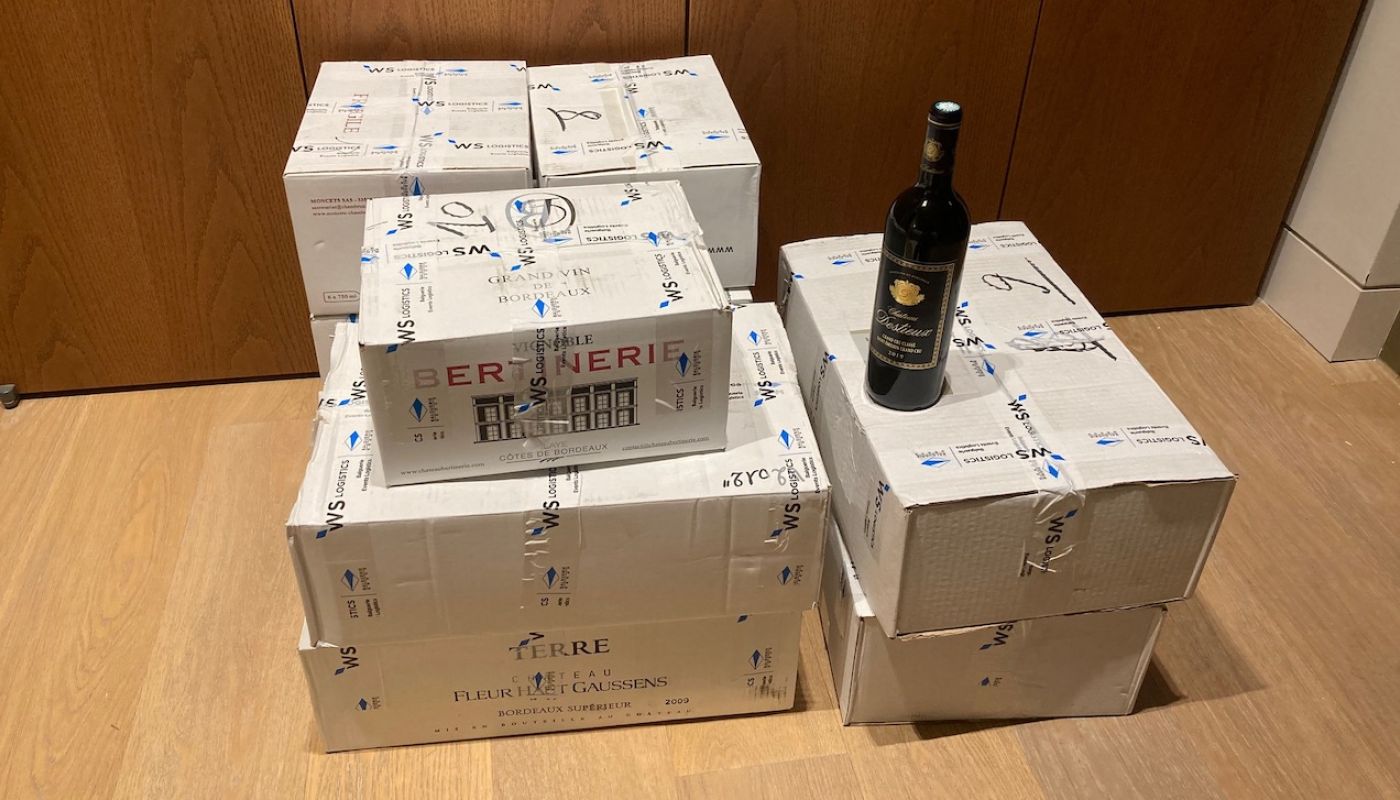
Drink more wine was the first one. I reckon that in strict volume terms I have certainly kept that resolution. There are few wine enthusiasts who responded to being restricted to their own homes for months at a time, and probably spending less time at the wheel of a car, by going on the wagon. But the spirit of my original resolution was to deplete our personal wine collection more rapidly, and in that I have failed miserably. The upshot of working from home for a wine writer is that instead of going to the wine to taste it, either to a wine region or to one of the many professional wine tastings ‘normally’ held in London, where I live, the wine has come to me – literally by the pallet-load. (The picture above shows about 60% of a pallet of Grand Cercle de Bordeaux 2019s that arrived the other day.) It takes more resolve than this northerner has to ignore dozens of opened bottles completely in favour of a much more expensive unopened one in my own cellar. Of course I have given most of the tasting samples away, but there have usually been favourites that I wanted to take to the dinner table – however few people were able to gather round it.
My second resolution was Try more natural wines, with an open mind. Unfortunately, only a small (but growing) proportion of the bottles that arrive on my doorstep qualify as orange (skin-fermented white wines made, like red wines, in contact with the grape skins) and an even smaller proportion are out-and-out natural (zero additives and minimal sulphites). My resolution ended, ‘I am too often guilty of shying away from the off-piste section of a restaurant wine list. I hereby resolve to be more adventurous.’ Cue hollow laughter. Restaurant-going has been all-too-severely curtailed. We have done our best but I have had all too few opportunities to be adventurous. But, having failed in 2020 and 2021, I’d like to repeat this as a resolution for 2022.
Try to stamp out the term ‘natural wine’, I wrote in early 2020. I added casually, ‘I rather like the term I came across recently in Australia: lo-fi winemaking.’ Australia? The country seems unimaginably, impossibly distant today. And yet there we were, taking the karri forest and surf of Margaret River for granted really quite recently. My point was that the term ‘natural wine’ implies, very misleadingly, that any other wine is unnatural.
Mind you, a few months after I wrote that, an even scarier and more misleading term was launched, by actor Cameron Diaz and entrepreneur Katherine Power: clean wine. Apart from grapes, Diaz and Power promise that their wine contains ‘only’ sulphites, added yeast and yeast nutrients and is clarified with bentonite, a common clay used for fining. You wouldn’t find a hard-line naturalista using added yeast and yeast nutrients, yet that word ‘clean’ is so emotive. Yikes, have I been drinking dirty wine all these years?
A less emotive, more descriptive term is ‘minimal intervention’ wine, but it hardly trips off the tongue. Anyway, I certainly want winemakers to continue the trend long evident of using fewer and fewer additives in the winery. The long-awaited application of ingredient listing for wine, expected soon in the EU, should only hasten this phenomenon. Farewell Mega Purple colouring (a sweet concentrate based on a red-fleshed grapes)?
Be more aware of true sustainability was resolution number three and I can only repeat what I wrote:
‘Sustainability is surely today’s buzzword. In wine we tend to focus on transitions to organic and biodynamic viticulture but we need to be much, much more holistic. Not just awareness of energy use in vineyard and cellar, capturing the carbon dioxide given off by all fermentations, recycling and minimising water use. Waterfootprint.com claims that 120 litres of water are used in total to produce and deliver a glass a wine into your hand. This may well be an exaggeration, but water shortages in many key wine-producing regions must be a concern. And, like all agricultural workers, vineyard labour is often itinerant and almost always poorly paid, a fact that we wine lovers tend to skim over. We have to wonder how long ‘hand-picked’ will be regarded as a positive attribute.’
I’m delighted to see ever greater commitment to true sustainability throughout the world of wine. A growing band of wine producers are signing up to International Wineries for Climate Action, designed specifically to decarbonise the global wine industry. JancisRobinson.com is just one of 52 founder members from all over the world of Sustainable Wine Roundtable run by Sustainable Wine, whose aim is to ‘make sustainability mainstream in the wine industry’. The (admittedly slightly nebulous) concept of sustainability was the theme of our writing competition last year (old vines this year) and we were sent nearly 100 profiles of wine producers who were deemed by their authors to be going the extra mile towards saving the planet. There is without question a head of steam within the wine world to be more aware of the ecological and societal cost of wine production.
The very process of fermentation gives off carbon dioxide, almost all of which disappears into the atmosphere, and some particularly emission-conscious producers are putting in place systems to capture it. But this is by no means wine’s biggest contribution to global warming…
Rap knuckles over heavy bottles was my next resolution, fully carried out. Audits of carbon emissions associated with the entire life cycle of wine show that the biggest culprits are the production and transport of glass bottles. Yet consumers still – quite erroneously – associate heavy bottles with wine quality.
Since last February on JancisRobinson.com we have been weighing wine bottles and publishing their weights (full – much more practical than having to pour out the liquid, which weighs more or less 750 g anyway) whenever possible. This has often been possible thanks to the paucity of in-person tastings and an increase in tasting from full bottles delivered to my door, much to the delight of neighbours thirsty for leftovers.
All this means we can call out those using unnecessarily heavy bottles, and it’s clear that many wine producers who regard themselves as good guys by practising organic viticulture, for example, just haven’t thought about the impact of their heavy bottles on carbon emissions. A common defence from those who realise the disadvantages of heavy bottles is that they use them only for their top wines and use lighter bottles for the majority of their production. But this practice bolsters the consumer perception that heavy glass equals a superior wine, thus perpetuating its use.
Roll on really efficient recycling. Some countries are so much better at doing this, and educating their citizens about how to help, than the US and the UK with its reliance on a network of very disparate local authorities. And what about refillable bottles in wine-saturated areas such as Napa Valley and the Médoc? Conscious Container of San Francisco is actively promoting this.
I also swore to Explore eastern Europe, which has been a bit difficult to do in-person, though in 2021 I managed to taste wines from Romania, Ukraine, Cyprus, Moldova and Georgia (horribly heavy bottles from these last two) – some of them rather good (see More wines from east of Vienna). I do feel I need to research Czech and Slovakian wines further.
Other resolutions in brief were Ask even more questions, Write slightly more enthusiastic tasting notes, Smile more often and finally to ensure that I experienced Less work, more perk. The last two are connected.