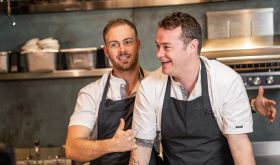
No chef in the UK is better placed to dream of opening his own restaurant than 23-year-old Brett Graham. Three weeks ago he walked off with the Young Chef of the Year award, testimony to his innate skills honed by two and a half tough years in the prestigious kitchens of The Square, Mayfair.
Yet Graham is the first to admit that this is likely to remain a pipedream. 'I am on £30,000 a year and unable to save a penny in this expensive city,' he laughed. 'If eventually I do find a backer my fear is that I would not be allowed to cook what I want, that I would be dictated to. It will probably be much easier back home in Australia.'
Graham is not alone in these aspirations. Fourteen of the 16 finalists in the Young Chef/Young Waiter competition said that their professional goal was to own their own restaurant. Yet the harsh reality is that, despite their obvious talents, most will be disappointed and those who do succeed may do so only after a quasi-Mephistophelean arrangement with an as yet unknown third party.
The major reason for this seemingly gloomy prediction lies in the nature of restaurants themselves. As individual performers chefs are not unique. They display various natural talents, allied to a necessary strong physique; they have to learn quickly, broaden their skills through hard work and travel, and like many other professions, particularly in the sports and arts worlds to which the top chefs are often compared, they are at their very best between 25-40.
Then, after what may be 15-20 gruelling years at the stove, the creative spark may begin to dwindle. For the lucky few the opportunity may arise to swap roles, to put the word executive before the word chef and their name on more than one hoarding, book or TV series and to achieve financial security. But for most, with limited savings, there is simply not at present the possibility to convert their dreams into reality.
Yet if there is one significant way in which the chef's profession is different from that of the equally highly regarded sports personality, singer or performer it is this: that a chef can dream of ultimately owning the means of creating his or her own reputation. The great chefs of the world – Wolfgang Puck, Alain Ducasse, Charlie Trotter, Ferran Adria – can walk into a restaurant and say 'This is mine' in a way that no sports personality or pop star ever can. David Beckham may be far more widely known and recognised, a much bigger brand, but he ultimately has no control over Manchester United, nor Robbie Williams over EMI, however much each individually is paid by these companies. How can a greater number of increasingly talented chefs ever achieve their highest ambition and still maintain their independence?
A new way of encompassing the risk financing involved in setting up individual chefs in their own restaurants is long overdue. The lending banks have never really showed any interest in this sector and instead the backing has come from one of the following: a small group of wealthy, hedonistic individuals; one particularly generous backer often with tax avoidance as a priority; an international, impersonal hotel group; or a group of businessmen who have seen restaurants primarily as retail outlets which can sooner rather than later be floated on the stock market.
All these options are flawed. The first preserves the image of the chef not as a professional equal but a rather superior domestic. The second, which Graham fears is his most likely route to professional independence should he stay in the UK, puts his future in the hands of one, possibly whimsical, individual, an arrangement which often leads to a lowering of standards to meet unrealistic financial goals. The third forsakes hospitality for corporate profit whilst the past year has proven the unsustainability of the last model as a flood of new, middle-market openings with indistinguishable offers has led to closures and drooping share prices.
Yet over the past decade chefs have transformed their own profession so much that at the outset the career prospects have never looked as good for anyone keen to cook, learn and work hard. There may still be the occasional case of bullying or maltreatment but it is far, far rarer today than it was even 30 years ago before chefs became glamorous. And while role models, both chefs and restaurateurs, have done a great deal to eradicate such bad behaviour (David Moore, proprietor of Pied à Terre in Fitzrovia promptly sacked his talented head chef at the first instance of such misbehaviour), the reason is not just the emergence of a group of more socially responsible individuals but sheer business common sense.
But whilst the profession has finally got its act together there has not been a simultaneous improvement on the financial side and I still fear for those talented, young chefs who have worked so hard to reach the final of their chosen profession. Unless extreme good fortune shines on them – either by impressing a wealthy client or marrying well – then their dreams will not be realised and an essential ingredient for the increasingly important service economy of the 21st century will not realise its potential.
But with the current state of the stock market, a sluggish property sector and emerging markets failing to emerge, perhaps London's financial expertise should now be turned to pastures new. There is today scope, I believe, for a risk fund that specialises in backing emerging chefs, in creating for the very first time anywhere in the world, the process whereby chefs can walk a fairly straightforward, uncomplicated path from dreamers to independent exponents of their chosen profession.
The funds required would be relatively small, a fraction of what went into dotcom businesses, but the returns, combining the financial and the pleasure factors, could be huge – for investors and consumers alike.
Plans are well under way for Lunch with the FT 2003 which will run from Monday 20 January – Friday 7 February 2003. Readers keen to nominate restaurants or restaurateurs keen to participate please contact Ronald Ndoro at [email protected].