
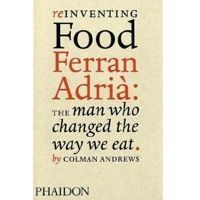
I picked up Reinventing Food. Ferran Adriá: The man who changed the way we eat by Colman Andrews with equal amounts of excitement and envy as I have long been an admirer of both individuals.
Ferran Adrià is the extraordinary Catalan chef who, with his partner, the restaurateur Juli Soler, has made El Bulli restaurant world famous but who earlier this year announced that it would close forever at the end of July 2011.
Andrews is a highly respected American food writer whose book, Catalan cuisine, first published in 1999, was a prescient and original insight into why the food of this hitherto-neglected north-east region of Spain is so exciting.
I finished this new biography disappointed for several reasons but most significantly for the fact that it simply does not, or even cannot, live up to its slightly ridiculous subtitle.
There is no question that Adrià has had a major impact on how so many young, talented chefs around the world now interpret their role in the kitchen. But this influence is on how these individuals cook not on how the world at large eats. Whatever the shape of the food on the plate or spoon, or whether we are asked to close our eyes before something is put into our mouths (as the staff at El Bulli sometimes suggest), we still eat in the same way. Adrià has not changed this.
Andrews' insistence that everything has to be seen through his eyes is questionable. We begin with his interpretation of the dishes he is served during dinner at El Bulli and end with Acknowledgements in which he rather patronisingly thanks 'my main character, Ferran Adrià', as though he has created him.
The history of El Bulli – initially a mini-golf course that became a restaurant, owned from 1961 for 30 years by a German couple – and the personal development of Adrià are told in over-long, linear fashion. They jointly evolved to produce the most exciting restaurant in the world but there is never any real sense of drama in Andrews' storytelling.
This is partly, I believe, because while Andrews justifiably describes the role of the Taller, or laboratory, in Barcelona which Adrià has set up with his brother Albert and which creates the new dishes for next summer, Andrews never sits down with Adria and Soler to interview them together for the book. Yet this personal interaction is not just the key to El Bulli's success. It has also underpinned Adrià's growing confidence as a chef and as a global spokesman for his style of cooking and for Spain as a whole.
Soler joined El Bulli in 1981, three years before Adrià, when the restaurant served predominantly classic French food and was rarely full, and he has been in charge of the dining room ever since. They jointly took it over in 1990 and by the mid 1990s Adria was cooking in his completely different and distinct style, an approach to food which I still recall as shocking in the impact it had on all my senses when I first ate there in 1996. Adria could not have gone down this path without Soler but why the latter backed him with such obvious conviction is a question Andrews never asks either of them.
Both have been jointly involved in the decision to close, to convert a still relatively simple building overlooking the Mediterranean into some form of culinary foundation. Soler told me once, somewhat wearily, that he had not gone into the restaurant business to turn away so many prospective customers as now try to make a booking at El Bulli. When I had a quiet drink with Adrià in the Hotel Ritz in Madrid the night before he announced the restaurant's closure, he looked exhausted – and he still had 160 nights at the stoves to look forward to.
Adrià and Soler have jointly made El Bulli into a remarkable institution, an emblem in the restaurant world for innovation, change and dynamism. This book, regrettably, tells only part of that story.
Reinventing food
• 2 min read
This article was also published in the Financial Times.


选择方案
会员
$135
/year
适合葡萄酒爱好者
- 存取 296,559 条葡萄酒点评 & 16,125 篇文章
- 存取《牛津葡萄酒指南》及《世界葡萄酒地图集》
- Access askJancis, our AI wine assistant


核心会员
$249
/year
适合收藏家
Everything in “Member”, plus:
- Early access to the latest wine reviews, 48 hours in advance
- Early access to the latest articles, 48 hours in advance
专业版
$299
/year
供个人葡萄酒专业人士使用
- 存取 296,559 条葡萄酒点评 & 16,125 篇文章
- 存取《牛津葡萄酒指南》及《世界葡萄酒地图集》
- Access askJancis, our AI wine assistant
- 提前 48 小时获取最新葡萄酒点评与文章
- 可将最多 25 条葡萄酒点评与评分 用于市场宣传(商业用途)
商务版
$399
/year
供葡萄酒行业企业使用
Everything in “Professional”, plus:
- 可将最多 250 条葡萄酒点评与评分 用于市场宣传(商业用途)
- Access to submit wines for review
- Offer memberships to your employees and manage them from a single place
- API access available for an additional fee
More Nick on restaurants

Nick on restaurants
An international institution in the southern Irish countryside. In 2011 I travelled to Ballymaloe House, a 40-minute drive from Cork...

Nick on restaurants
伦敦东区餐厅界令人兴奋的新成员。上图,萨莉·阿贝 (Sally Abé)。 萨莉·阿贝 (Sally Abé) 的新餐厅蒂尔 (Teal)...
Nick on restaurants
丹吉尔的鱼之味餐厅 (Le Saveur de Poisson) 绝对值得(稍有挑战性的)一游。 在当今世界的各种餐厅中...
Nick on restaurants
开设第二家餐厅并不容易,无论第一家有多成功。尼克 (Nick) 从伦敦西区冒险进入伦敦码头区。上图为联合主厨杰克·克罗夫特 (Jack...
More from JancisRobinson.com
Tasting articles
证明南非仍然是最值得探索的葡萄酒国家之一。上图为天气报告 (Weather Report) 的克里斯·基特 (Chris Keets)(左...

Tasting articles
历史悠久的葡萄园、高海拔、火山土壤和有机种植的结合使这个鲜为人知的 AVA 脱颖而出。上图为 拉塞特酒庄 (Lasseter Winery)...
Tasting articles
来自热浪年份的诱人清新且易饮的葡萄酒。索蒂马诺 (Sottimano) 从科塔 (Cottà) 特级园(如上图所示...
Tasting articles
来自 2022 年份及更早年份的葡萄酒证明了巴巴莱斯科的陈年潜力。 巴巴莱斯科 2022 年份的晚期发布打破了两个误解—...
Free for all
路边餐馆的乐趣,作者:查理·吉奥根 (Charlie Geoghegan)。照片由杰森·洛 (Jason Lowe) 拍摄。...
Free for all
首个跨大西洋合资企业作品一号 (Opus One) 涉及20世纪葡萄酒界的标志性人物。本文的一个版本发表于《金融时报》(Financial...
Tasting articles
25种在炎热中保持清爽的方式。 上周欧洲经历了有记录以来最严重的6月热浪;本周,美国东海岸各城市将打破高温记录。在这种炎热中喝什么?水...
Wines of the week
一款由前化学家以精确态度和葡萄藤语者灵魂酿造的绿酒 (Vinho Verde) 白葡萄酒。售价 23 美元起,22 英镑起。上图为拉莫斯...