
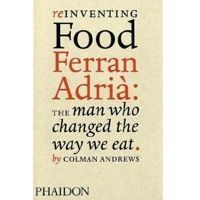
I picked up Reinventing Food. Ferran Adriá: The man who changed the way we eat by Colman Andrews with equal amounts of excitement and envy as I have long been an admirer of both individuals.
Ferran Adrià is the extraordinary Catalan chef who, with his partner, the restaurateur Juli Soler, has made El Bulli restaurant world famous but who earlier this year announced that it would close forever at the end of July 2011.
Andrews is a highly respected American food writer whose book, Catalan cuisine, first published in 1999, was a prescient and original insight into why the food of this hitherto-neglected north-east region of Spain is so exciting.
I finished this new biography disappointed for several reasons but most significantly for the fact that it simply does not, or even cannot, live up to its slightly ridiculous subtitle.
There is no question that Adrià has had a major impact on how so many young, talented chefs around the world now interpret their role in the kitchen. But this influence is on how these individuals cook not on how the world at large eats. Whatever the shape of the food on the plate or spoon, or whether we are asked to close our eyes before something is put into our mouths (as the staff at El Bulli sometimes suggest), we still eat in the same way. Adrià has not changed this.
Andrews' insistence that everything has to be seen through his eyes is questionable. We begin with his interpretation of the dishes he is served during dinner at El Bulli and end with Acknowledgements in which he rather patronisingly thanks 'my main character, Ferran Adrià', as though he has created him.
The history of El Bulli – initially a mini-golf course that became a restaurant, owned from 1961 for 30 years by a German couple – and the personal development of Adrià are told in over-long, linear fashion. They jointly evolved to produce the most exciting restaurant in the world but there is never any real sense of drama in Andrews' storytelling.
This is partly, I believe, because while Andrews justifiably describes the role of the Taller, or laboratory, in Barcelona which Adrià has set up with his brother Albert and which creates the new dishes for next summer, Andrews never sits down with Adria and Soler to interview them together for the book. Yet this personal interaction is not just the key to El Bulli's success. It has also underpinned Adrià's growing confidence as a chef and as a global spokesman for his style of cooking and for Spain as a whole.
Soler joined El Bulli in 1981, three years before Adrià, when the restaurant served predominantly classic French food and was rarely full, and he has been in charge of the dining room ever since. They jointly took it over in 1990 and by the mid 1990s Adria was cooking in his completely different and distinct style, an approach to food which I still recall as shocking in the impact it had on all my senses when I first ate there in 1996. Adria could not have gone down this path without Soler but why the latter backed him with such obvious conviction is a question Andrews never asks either of them.
Both have been jointly involved in the decision to close, to convert a still relatively simple building overlooking the Mediterranean into some form of culinary foundation. Soler told me once, somewhat wearily, that he had not gone into the restaurant business to turn away so many prospective customers as now try to make a booking at El Bulli. When I had a quiet drink with Adrià in the Hotel Ritz in Madrid the night before he announced the restaurant's closure, he looked exhausted – and he still had 160 nights at the stoves to look forward to.
Adrià and Soler have jointly made El Bulli into a remarkable institution, an emblem in the restaurant world for innovation, change and dynamism. This book, regrettably, tells only part of that story.
Reinventing food
• 2 分で読めます
This article was also published in the Financial Times.


購読プラン
スタンダード会員
$135
/年間
ワイン愛好家向け
- 297,198件のワインレビュー および 16,153本の記事 読み放題
- The Oxford Companion to Wine および 世界のワイン図鑑 (The World Atlas of Wine)
- askJancisへのアクセス(AIワインアシスタント)


プロフェッショナル
$299
/年間
ワイン業界関係者(個人)向け
- 297,198件のワインレビュー および 16,153本の記事 読み放題
- The Oxford Companion to Wine および 世界のワイン図鑑 (The World Atlas of Wine)
- askJancisへのアクセス(AIワインアシスタント)
- 最新のワイン・レビュー と記事に先行アクセス(一般公開の48時間前より)
- 最大25件のワインレビューおよびスコアを商業利用可能(マーケティング用)
ビジネスプラン
$399
/年間
法人購読
「プロフェッショナル」プランの内容に加えて
- 最大250件のワインレビューおよびスコアを商業利用可能(マーケティング用)
- レビュー依頼用のワインを提出可能
- 従業員向けにメンバーシップを提供し、一元的に管理可能
- APIアクセス(※別途料金)
More ニックのレストラン巡り

ニックのレストラン巡り
アイルランド南部の田園地帯にある国際的な名所。 2011年、私はアイルランドのコークから車で40分のバリーマロウ・ハウス...

ニックのレストラン巡り
イースト・ロンドンのレストラン・シーンに加わったエキサイティングな新店。写真上はサリー・アベ。 サリー・アベ (Sally Abé)...
ニックのレストラン巡り
タンジールのル・サヴール・ド・ポワソンは、(やや困難な)道のりを経てでも行く価値がある。 今日の世界にある数多くのレストランの中で...
ニックのレストラン巡り
最初のレストランがどれほど成功していても、2店舗目を開くのは簡単ではない。ニックがウエスト・エンドからロンドンのドックランズへと足を向ける...
More from JancisRobinson.com

テイスティング記事
このアクセスしやすいヴィンテージに関するウォルターのレポートの後編。今回は、カスティリオーネ・ファッレット、モンフォルテ・ダルバ...

テイスティング記事
困難なヴィンテージに関する最終報告。驚くほどフレッシュでアクセスしやすいワインに仕上がっている。本日は、複数の村のワインと、ケラスコ...

現地詳報
メキシコのワイン産業は気候変動への対処法について教訓を与えてくれる、とメキシコを拠点とするジャーナリスト兼ソムリエのカルロス・ボルボア...

Vinomakase
リチャードの新連載「Vinomakase」では、専門家たちがワインと日本料理をどのようにマッチングさせているかを探る。第1回は...


Bite-sized
セント・オールバンズの大聖堂地区にある15世紀のパブで、最新の料理を堪能できる。 フロント・バーは今も安心できるほどパブらしさを保っている...

今週のワイン
フランス中部の赤ワインに見る、渇きを癒すフレッシュさ。 £15.50、$26.95から 。...

書籍レビュー
クラシック・ワイン・ライブラリーへの3つの新刊と、ポルトガル・ワインに関する自費出版ガイド。 以下のレビューのうち3冊は、アカデミー・デュ...