Firstly, the bad news. There is no doubt that menu prices in restaurants across the world are likely to rise quite significantly and most probably in the not too distant future. Even those restaurateurs and chefs with long, harmonious working relationships with farmers and growers will be unable to escape the steep rises in a number of basic foodstuffs.
Wheat and maize prices have risen by over 50% as farmers switch to growing these crops for ethanol, a move that has already had an effect on the price of bread in the UK, that of tortillas in Mexico and pasta in Italy. As the staple price of animal feed increases, so too will the cost of lamb, chicken and beef, while our continued failure to look after the bounty of the sea is only likely to lead to higher prices for the best wild fish. The recent dry spell has bought some comfort to British farmers but there is sadly no escape for vegetarians as vegetable prices have increased significantly over the summer. One restaurateur quipped that he never thought he would ever have to pay so much for a cauliflower as he is currently doing.
But the scale of the price rise depends on a number of factors, not just how restaurateurs respond to this challenge but also on how willing customers are to appreciate and accept some fundamentals of the restaurant business. And, most importantly, it depends on just how quickly restaurateurs are prepared to jettison some of their current practices which in my mind have become costly irrelevances and often detract from the overall enjoyment of the meal.
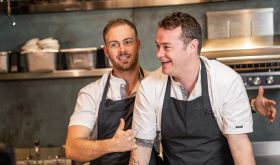
The most encouraging news for those who eat out is that over the past couple of years a growing number of restaurateurs have emerged with laudably high standards and a commitment to volume over high margins even if, infuriatingly for many, some choose to do this via a non-booking policy. Amongst this group are Arbutus and its sibling restaurant Wild Honey; Canteen; Great Queen Street; Tapas Brindisa; Magdalen; and Barrafina in Soho, the lively sibling to Fino.
More will follow in their wake but their opening prices and their long term success will depend on two very different factors. The first is the reduction and, I hope, eventual disappearance of the premiums restaurateurs are being asked to pay for sites over and above increasingly high rentals. These premiums, which can be as high as £250,000, are the consequence of greed on one side and excessive optimism on the other and can only be recouped through higher prices overall. Anthony Demetre and Will Smith reluctantly paid a premium of £200,000, a third of the overall cost of opening Arbutus, for what was deemed to be ‘goodwill’ on a failed restaurant from which Smith reckons he has seen no more than ten former customers.
Many restaurants have now introduced timed bookings to the indignation of numerous customers but this is the only significant and practical alternative solution to raising prices. Most professionals base their fees on a time basis and the time any table is occupied is a crucial factor in a restaurant’s profitability. When Demetre and Smith took over Wild Honey in Mayfair they calculated that they needed to serve 150 customers a day to generate a sensible return. Lunch will never account for more than 50 to 60 covers maximum, so the balance has to come between 7pm and 10pm every night. And this practice is no longer restricted to London and New York – we recently managed to get a table at the intimate Baratin in Paris’s 20th arrondissement for 8pm but only if we were out by 10pm.
But before a whole host of other restaurateurs nonchalantly raise their prices in the expectation that the strong demand for their tables will simply continue, I hope that they would look more closely at what they are offering and abandon several practices which have been introduced to impress rather than deliver value.
Firstly, I would propose the elimination of the charger plate, the ridiculous and invariably expensive empty plate that is at every place setting before the customer sits down and which is then whisked away once the table is occupied (there are also smaller ones set in front of those who do not order a particular course while others do).
I once asked a three star Michelin chef to try to justify these but his explanation – that they are there so that the customer has something to look at rather than an empty table setting – has never convinced me. Expensive, fragile and presumably constantly in need of washing, they should be abandoned.
I assure you that I am not a killjoy, but I also think that the array of amuse-bouches, breads and petits fours that an ambitious restaurant now makes an integral part of the meal has got completely out of hand.
The most constant complaint I hear from chefs is that they cannot find enough talented and committed young chefs for their kitchens, yet too many of them still put far too much emphasis on these often intricate and invariably time consuming titbits. Is there anything that much better than a bowl of the best olives to nibble on while studying the menu? Is the drawn out recital of the six different, painstakingly made, breads adding anything to the table’s ultimate enjoyment? And what has got into the heads of far too many chefs who obviously believe that after a three course meal we still need a choice of five different petits fours (that is the most I have been served at one time)? I have even had post prandial sweetmeats served in two flights, fruit based followed by chocolate. A delicious, single petit four would be quite enough.
Finally, with wages now accounting for 30% of a restaurant’s running costs, it is time to reassess the waiter’s role. I know that I am not alone in thinking that there really is no good reason why a good waiter has to spend so much of his time fussing with the napkins, either draping them over someone’s lap or refolding them every time a customer gets up from the table. And in terms of extra efficiency, as well as getting rid of an extremely annoying practice, it is definitely time to call a halt to the waiter’s recitation of every single ingredient in a dish. A quick calculation for a 50 seater restaurant where each description takes 45 seconds shows that almost two hours are spent on something that does not add any extra benefit or pleasure for the customer – and often interrupts an interesting conversation.
All this could ultimately lead to some good news. With higher costs and a slightly less rosy economic outlook, restaurateurs will have to work harder to make their menus and wine lists more appealing and their service more attentive to maintain their essential profitability.