I love Riesling in all its many forms.
But after three days of long, blind tastings of this great wine in its many styles from around the world, complete with Riesling-accompanied meals, I might have to say enough is enough.
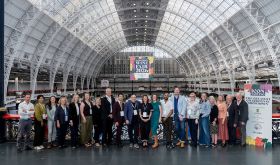
The second Riesling Rendezvous was held last week in Seattle, co-sponsored by Chateau Ste Michelle and Weingut Dr Loosen, Ste Michelle’s Riesling partner in Eroica and the Single Berry Select, a TBA-style wine, both produced in Washington state.
Ste Michelle CEO Ted Baseler kicked off the event, saying that in the old days of Riesling, only 15 people knew about this great grape and the rest of the world didn’t; now the numbers are reversed. In the last three years, Riesling consumption in the US rose 54%, making Riesling the fastest growing white wine in the US.
Erni Loosen asked, “Why are we all here?” He offered three reasons:
1. How do we continue to rebuild the reputation of Riesling?
2. It is great to get producers of Riesling together.
3. We can create forums to educate the trade, consumers and the media.
British wine writer Tom Stevenson moderated the first panel, focused on dry Rieslings. The panelists included Ingo Grady of Mission Hill in the Okanagan Valley, Stephen Henschke of the eponymous winery in the Barossa, Fred Loimer from the Kamptal, Carl F Prinz zu Löwenstein from Franken and Rheingau, Harry Peterson-Nedry of Chehalem in Oregon, Johannes Rienhardt of Anthony Road in the Finger Lakes of New York and Pierre Trimbach of his family’s estate in Alsace.
When asked what he looked for when making Riesling, Pierre Trimbach said “Three things: 1. Balance. 2. Balance. 3. Balance.” This was repeated by the others.
Seventeen wines were tasted blind, with the 2002 Cuvée Frederic Émile from Trimbach my high scorer, with the Loimer Seeberg 2005 and the Chateau Grand Travers Old Mission Peninsula 2007 from Michigan not far behind.
After lunch (more Riesling) Stephen Brook had the unenviable task of moderating the off-dry panel. (Isn’t it always a challenge to focus immediately after lunch?) Well, Stephen did the best job of moderating of the whole conference, in spite of the after lunch position. His panel consisted of Caroline Diel from Schlossgut Diel in the Nahe, Andrew Hood from Frogmore Creek in Tasmania, Erni Loosen of you know where, Bob Madill from Sheldrake Point in the Finger Lakes, Egon Müller of the eponymous Saar estate, Adam Satchwell from Shady Lane Cellars in Michigan, and Wendy Stuckey, now at Ste Michelle.
The standout wine in this 14-wine blind tasting had to be the Egon Müller, Wiltinger Braune Kupp Spätlese 1996. Not too far behind were the Dr Loosen Urzinger Wurtzgarten Spätlese 2006 and the Sheldrake Point Finger Lakes 2004.
But this session also sparked heated discussion about the labelling of different sweetness levels of Riesling. A consumer does not know what to expect in a bottle of Riesling. A simple scale of categories on the back label is deceptive: a wine with 10 g/l residual sugar can taste very sweet; if it has balanced acid the wine is obviously less sweet in perception. So how do you mark that on the bottle?
Jim Trezise of both the New York wine grape foundation and the International Riesling Foundation (the IRF, which was formed just after the 2007 Riesling Rendezvous last year) announced that writer Dan Berger, a member of the board of the IRF, has just developed a Riesling Taste Scale with illustrative chart. It will be a horizontal graphic that goes from dry to sweet; winemakers are supposed to indicate where the wine fits, and place this graphic on the bottle.
Also presented was new research by Full Glass Research about Riesling consumers. The study found that:
1. Riesling drinkers were casual and not “sophisticated”. [that’ll be me, then – JR]
2. Riesling food friendliness was largely not acknowledged.
3. Usage perceptions were not deep, but skewed toward millennials
4. There was a need for education and a dryness/sweetness scale.
5. There was confusion about dry, off-dry, medium dry and semi-sweet.
6. The range of dry to sweet is widely known but the perception of Riesling is sweet.
The largest segment (47%) of the respondents drink Riesling less often than monthly, presenting a good opportunity to “pick off the low hanging fruit”.
The next day began with a panel on the ageability of Riesling. Stuart Pigott moderated a panel that included Jochen Becker-Köhn from Weingut Robert Weil in the Rheingau, Joel Butler MW from Chateau Ste Michelle, Egon Müller, Louisa Rose of Yalumba in South Australia, Christine Saahs of Nikolaihof in the Wachau and Pierre Trimbach.
These wines were not tasted blind, oddly. Of the 13 wines tasted my standouts were the 1995 Cuvée Frederic Émile of Trimbach, Dr Loosen, Wehlener Sonnenuhr Spätlese 1983, Egon Müller, Scharzhofberger Riesling Auslese 1988 and Orlando’s Steingarten Riesling 1998 from the higher reaches of Barossa.
My penultimate seminar of the programme was called Decoding Riesling in the US Market and was very well moderated by wine writer Paul Lukacs. On his panel were Sean Bavaresco from Pacific Rim Riesling, Jochen Becker-Köhn, John Gillespie of Wine Opinions, Marian Jansen of Flemings restaurants, and wine writer Richard Leahy of Virginia.
Lukacs started the program by saying, “This session is on the challenges to selling Riesling; all other sessions have celebrated Riesling.”
He continued, “There is a disconnect between the critics/experts and wine drinkers. We have always promoted Riesling and the wine-buying public has ignored us. Now, younger drinkers have an interest in Riesling. But the perception of Riesling faces lots of hurdles and challenges.”
John Gillespie then went through the research again, and showed how consumers viewed Riesling. He said the terms off-dry and late harvest are not understood. And 45% of the respondents think Riesling is sweet.
Richard Leahy used all his time (and some more) to promote a Riesling sweetness scale of his own. He divided categories in unnecessary ranges, calling dry up to 15 degrees of sugar, which in my book is pretty sweet without balancing acidity, which had no role in his chart.
The last seminar of the program was with pioneering importer Terry Theise. He had a fabulous panel with him to talk about Old World terroir. The wines indeed were fabulous, but this was the Terry Theise show, and quite a showman he is.
The wines (and winemakers) present were Hirsch from the Kamptal, Nikolaihof from the Wachau, Leitz from the Rheingau, and Dönnhoff from the Nahe in Germany. Four wines from each winemaker were poured – different vintages and different vineyards – a real terroir tour of each region.
Theise is a poised and confident speaker, with many interesting stories to tell. What was needed, though, was less Theise and more conversation from and with the winemakers. Had the discussion been opened to the audience, a more interactive and educational session could have been achieved.
But on the whole, this was one wonderful conference, showing some of the best that this variety has to offer, from some of the world’s best producers of the grape. I sure hope they do this every year.



Guest contributor