15 July 2019 Jonathan Reeve of Liv-ex (formerly of Wine-Searcher.com) samples the dry life – and is looking pretty chipper on it.
In mid April, I launched myself into a madcap experiment to discover what life would be like without alcohol. Below are a few observations and recommendations which have so far emerged.
So, what happens when you unplug alcohol from the life of someone who works, lives and breathes wine? Many people take an occasional month off these days, but I was going far beyond that. My experiment was going to last a full 229 days, from Good Friday until 4 December this year, my 40th birthday. And wine really is not a small part of my life. My last five employers had ‘wine’ in their title, I study wine, write about wine, talk about wine, photograph wine, I even travel wine – every holiday I’ve taken since 2006 has been to a wine region. Unplugging alcohol from my life would be like anyone else simultaneously giving up sugar, their car and Netflix.
I’m using the practical definition of alcohol-free used by most countries: under 0.5% alcohol by volume. (UK food law defines alcohol-free as <0.05%, but that would rule out even orange juice and bread, many examples of which contain around 0.1%.) And a quick disclaimer: I paused the experiment for five days during a recent wine tour of northern Italy. My friends had flown all the way from New Zealand for the trip, which was arranged long before the experiment started.
More than two months in, and all is very well. I’ve been to the pub with friends and genuinely enjoyed orange and tonic and alcohol-free beer. I thoroughly enjoyed The Cognac Show, but didn’t swallow a drop. I even enjoyed a boozy weekend celebrating my brother-in-law’s birthday, without actually consuming any booze.
One fascinating development was the disappearance of my desire to eat red meat. I usually eat beef at least once a week, almost always with wine (pairing the two cȏtes – de boeuf and du Rhȏne – is a particular favourite), but during the first month of the experiment I ate no beef at all. Even now, the only beef I’ve eaten was during three days in Valtellina, where the local bresaola (air-dried beef) was irresistibly omnipresent. I therefore assume that my love of beef is associative; pairing juicy red wine with rare red meat must appeal strongly to my hedonist inner animal.
I’ve tested and tasted a wide range of alcohol-free products, and discussed the topic with people in various parts of the drinks trade. I’ve also kept track of changes in myself – my feelings, tastes and habits. A quick summary of these follows.
From zero to hero
An immediate and lasting revelation of the experiment is how much easier it now is to go alcohol-free, even compared with five years ago. The alcohol-free tide is rising, and on it floats an ever-growing raft of interesting non-alcoholic beverages, like a modern-day Noah’s Ark. There are now many decent alcohol-free alternatives which look and taste just like the original they are imitating. (Sadly, wine is lagging behind cider, beer and spirits equivalents in this respect, but more on that later.) Many even feel like alcohol, in every way except the obvious. Once you start looking, you’ll see them everywhere: in supermarkets, wine shops, bars, pubs, restaurants. This is probably truer in London than anywhere else in the UK, but I’ve had no problem finding such alternatives in Cornwall, rural Wiltshire and alpine Italy.
In week one, I noticed how solid Waitrose’s selection was (the upmarket retailer reported a 31% increase in low-alcohol wine sales in 2018), and I was struck by the range available from Dry Drinker, a market leader whose founder Stuart Elkington observes that recently, ‘the market has seen double-digit growth in this category, and this is projected to continue'. Seedlip founder Ben Branson echoes this sentiment: ‘When Seedlip launched 3.5 years ago, 99.9% of bars, restaurants, hotels and retailers were not considering those not drinking, there were only a handful of sub-standard options. Fast forward to today and there is a category; supermarket shelves dedicated to it, bar menus dedicated to it, 100+ products to choose from.’
There are now so many alcohol-free equivalents that it’s actually possible to get geeky about them. In the first week of the experiment, I had an engaging discussion with a Liv-ex colleague, creating a shortlist of the best booze-free beers. His impending London Marathon meant that he had been abstaining for a while, and had clearly done some research.
Perception is everything
If it looks like wine, is packaged and priced like wine, it pretty much is wine. Or at least that’s what my socially programmed brain seems to think. Even though these products contain no alcohol, I still consume them only at times and occasions where I would otherwise consume their full-alcohol counterparts. For example, it feels very odd to drink alcohol-free wine at breakfast, and the bottle of booze-free beer I brought to my desk at lunchtime yesterday just felt weird.
How I drink it also seems to matter. Just now I stopped writing, unscrewed a bottle of Leitz, Eins, Zwei, Zero Riesling, and took a swig. I would think nothing of doing that with water, but with something so very clearly a wine-ish (wine bottle shape, screwcap and capsule, branded labels in all the right places and dimensions) it feels really odd – particularly at 9 am. Johannes Leitz told me that this wine was born after a Norwegian restaurateur requested an alternative for drivers. Although I haven’t yet found an alcohol-free wine which truly feels like a wine when you drink it, Leitz’s excellent packaging certainly looks and feels the part from the outside, which definitely removes societal barriers. If alcohol really is the ‘social drug’, then the perception and feeling of taking part in the group activity of drinking is key.
The market leaders seem to be those who have worked out that their alcohol-free products must on no account look or feel second class.
Yin, yang and the future
I believe that there is room for, and a need for, both alcoholic and decent non-alcoholic versions of the drinks we know and love. There’s no way I’m giving up alcoholic beverages permanently – there’s a reason that over 6,000 years our fascination with wine and beer has consistently increased. Real wine and real beer are beautiful, enjoyable things. But it is good to know that a group of friends can now go to a bar and share a near-identical experience (in every regard but the intoxication), even though one half are drinking non-alcoholic versions of the same drink.
I envisage a not-too-distant future when alcoholic beverages complement their non-alcoholic equivalents, rather than opposing or competing with them. And why? Human nature and economics. Tobacco, marijuana, fat, salt, sugar, wheat, dairy products, processed pork … everything that humans love to consume but which is ultimately ‘bad’ becomes either socially outlawed or heavily taxed, or both. Alcohol is already heavily taxed, but we still drink so much of it that its dangers are a permanent media fixation. Just imagine the next step up from these high taxes. And if you don’t believe it will happen, go and ask one of the five remaining tobacco addicts still rich enough to buy cigarettes.
Lagging behind, but looking up
Sadly, wine is lagging behind in the alcohol-free stakes. Non-alcoholic beers, aperitifs and spirits are doing really well, but I haven’t yet found a no- or low-alcohol wine which genuinely tastes like a wine. Sparkling wines are the most convincing imitations, and they’re about halfway there. I definitely enjoyed Leitz’s Eins, Zwei, Zero, but it can’t be described as being truly wine-like (even though Leitz has managed to retain varietal Riesling character). The upshot is that de-alcoholised wines are currently their own category of beverage, and really nothing to do with wine at this point.
Happily, though, the wine world is clearly beginning to pay attention. On my recent flight to Italy, I happened to sit next to a WSET student. The topic of his Diploma case study? Non-alcoholic wine. The topic also arose, without any prompting from me, during conversation with Foradori winemaker Emilio Zierock, who has spent time contemplating the opportunity and need for alcohol-free products. At San Leonardo, my conversation with Marchese Anselmo also touched on the topic. And the energy that crackles around Johannes Leitz when he talks about alcohol-free wine is inspiring. People are clearly very interested in this topic right now. Alcohol-free wine has a great distance to cover, but keen minds are already invested in the journey.
My recommendations
Wines
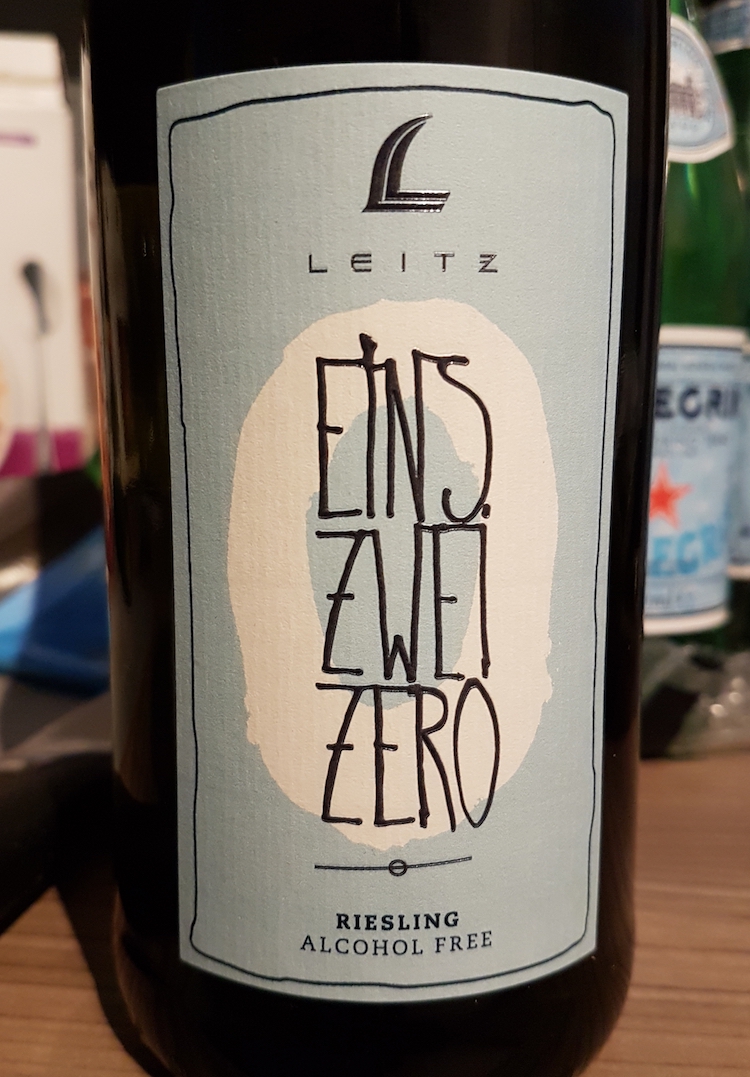
Leitz, Eins, Zwei Zero Riesling
0% alcohol. Crisply refreshing, clearly Riesling, and very grapey. Faint notes of lime juice and white peach. Slight spritz (confirmed by the faint but distinct hiss on re-opening the bottle two days later). As with all de-alcoholised wines I’ve tried, there is a textural hole where the alcohol weight should be, but there is enough flavour generally to compensate for this.
£6.99 Waitrose

Richard Juhlin, Blanc de Blancs Sparkling
A traditional-looking label, champagne-style cork, muzzle and the all-important ‘pop’ on opening, this drink carrying the name of Sweden’s most famous champagne writer suggests itself for alcohol-free celebrations. The wine has a lemony pale straw colour and sufficiently persistent fizz to look the part. Although it’s a little light on flavour, there are clear signs of lemon and green apple and a faint tinge of straw, which contribute to the overall refreshment. Acidity is moderate, as is palate weight.
£15.99 Drydrinker.com
Adnams, 0.5 Cabernet/Tempranillo
Very much super-jammy berries-and-plums, with a trace of spice (clove, cinnamon, nutmeg). Better balanced than most low-/no-alcohol wines, this wine has quite a full mouthfeel and there’s even a touch of tannin. Still that doughnut effect though, missing texture and flavour in the middle of the mouthful. Unfortunately this product seems to be available only in the UK. I’d be interested to know how easy it is to find alcohol-free wines in other countries.
£4.49 Adnams
Beers

Maisel’s, Weisse Hefe-Weissbier
Beautiful stuff. All the tell-tale banana-ester notes of a classic Weiss, and a very authentic mouthfeel – full, refreshing and clean. The finish is noteworthy, because there actually is one; many no-/low-alcohol products have no finish whatsoever (it disappears along with the palate weight, during the de-alcoholisation process).
£1.50 for 500 ml Find this beer
Adnams, Ghost Ship Pale Ale
The low-alcohol version of the respected brewery’s eponymous ale. A mouthful of authentic hoppy (Citra) notes, and a respectable texture. Maintains its head very well, and the aroma is very appealing, as per the original. Now a regular fixture in the fridge at Liv-ex HQ. Direct from Adnams and also from Waitrose (as is Brew Dog’s Nanny State, which is also worth trying).
£1.30 for 500 ml Adnams, Waitrose
Clausthaler, Unfiltered Lager
Very clean, refreshing, impressively authentic. I really enjoyed this with a well spiced Keralan curry last week. None of the glycerol-esque cloying feeling which dogs other such beers. This beer is made using a brewing technique which creates almost no alcohol in the first place. This avoids the need to remove the alcohol (which strips flavour and texture).
£1.25 for 330ml Drydrinker.com, Waitrose
Spirits and aperitifs
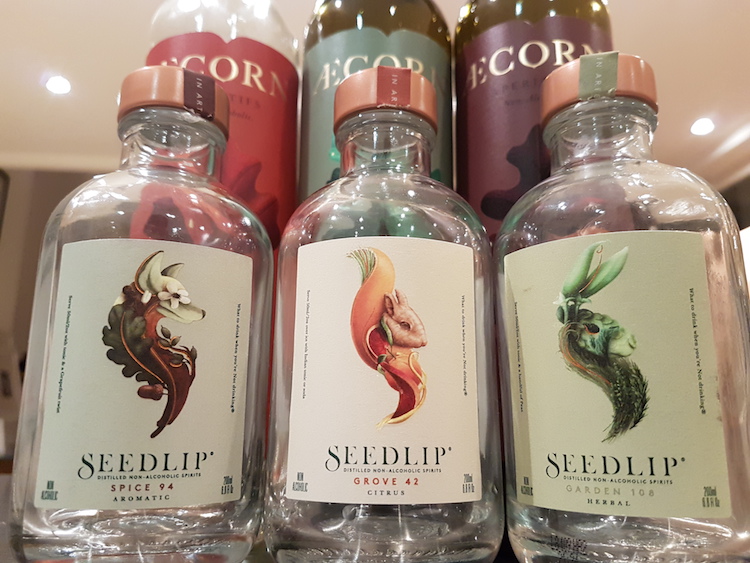
The Seedlip ‘spirits’ and Æcorn vermouth-like aperitifs, the latter so new that they are hardly available anywhere yet (and not even listed on Wine-Searcher) are impressive replacements for cocktail ingredients, particularly in combination. The former are distilled, the latter based on verjus. My tasting notes below:
- Seedlip Garden 108 Fresh-cut grass, cucumber, mint, rosemary, bay leaf, faint piney whiff.
- Seedlip Grove 42 Blood orange, ginger, sweet and earthy (like fresh-cut baby carrots).
- Seedlip Spice 94 Very much clove and nutmeg. For my tastes, best as a background ingredient, over an orange base.
- Æcorn Aromatic Smoky, dry cherry cola, and a solid dose of the spice cupboard at Christmas.
- Æcorn Dry Tarragon, sage, chamomile, Darjeeling, faint tinge of cinnamon, pleasingly bitter and dry.
- Æcorn Bitter Bitter almond on the nose, orange peel on the palate and a persistent grapefruity-dry finish. My overall favourite from this range.
Æcorn have their own clever cocktail suggestions but it’s fun to mess around with your own ideas. My favourite two combinations:
- Æcorn Dry, Fever Tree tonic, Seedlip Garden 108 and lemon juice. Very G&T-like.
- Æcorn Bitter with orange juice and a dash of Seedlip Spice 94. Rather Negroni-esque.
Find Seedlip products Æcorn Aperitifs are available at Selfridges as well as via www.aecornaperitifs.com