30 June 2018 A version of this article is published by the Financial Times. See also Tuscany April 2018.
What are the signs of self-belief? I’d say taking your own rice, olive oil, saffron, fish, charcuterie and parmesan to the perfectly good restaurant you are entertaining in might be taken as one sign.
I was thrilled to be taken to lunch at Il Leccio in Sant’Angelo in Colle in southern Tuscany a few weeks ago by Gianfranco Soldera, at 81 Montalcino’s most celebrated wine producer. Of course I expected him to take a bottle of his world-famous Sangiovese, a Brunello di Montalcino Riserva until he had a spat with the local producers’ organisation. He now nonchalantly labels it simply Tuscan red.
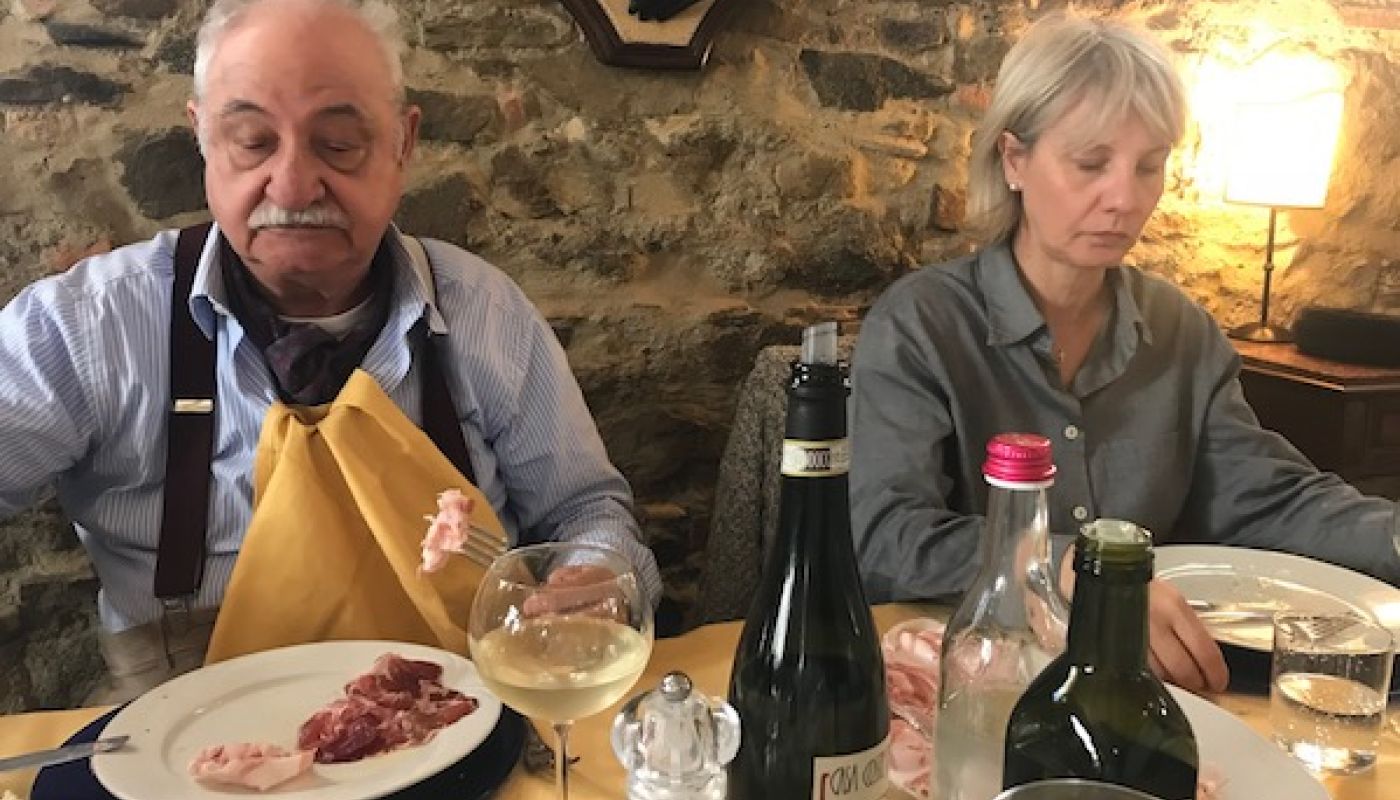
I wasn’t that surprised when we started the meal with a bottle he’d obviously supplied of his favourite fizz. Casa Coste Piane’s frizzante is Italian, of course. ‘The French are very good at selling but they don’t have good soils; they’d be better off growing potatoes', according to Soldera.
But as the meal progressed in this highly regarded restaurant (at the next table were two local wine producers entertaining an American wine writer), I realised to my amazement that the whole kit and caboodle had been shipped in by Soldera. The carnaroli risotto rice from the De Tacchi family in a village that has been growing rice since the time of the Venetian Republic. The saffron from Abruzzo. The parmesan from a favoured producer near Parma. The three-year-old pancetta and four-year-old coppa from 250-kg pigs ‘raised traditionally’. The Solderas’ own oil from their 120 olive trees. And the salt-baked grouper that was brought to the table on a platter by our long-suffering waitress and that Gianfranco had been tracking since it was line-caught by a long-standing contact in Senegal, flown to Paris and shipped to Montalcino via Milan.
Here is a man who knows what he wants and will go to any lengths to get it. I had admired his extraordinarily transparent yet long-lived wines for many years but had not visited his Case Basse estate for decades, during which much has happened – not least the loss of six vintages of wine in 2012 when a disgruntled ex-employee opened the taps on the traditional giant casks in which Soldera ages his wine longer than almost any of his neighbours. The culprit is now in prison.

Today, the property is surrounded by heavy metal fences. There is CCTV everywhere with bilingual notices telling us we are being watched. A complex battery of ironmongery has to be tackled to get into or out of the property. Perhaps this is not surprising. Soldera’s wines, the ones of which he lost the equivalent of tens of thousands of bottles, sell for hundreds of pounds a bottle. But Soldera at least will have been insured up to the hilt.

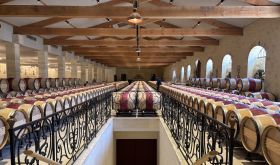
He was originally an insurance broker and left insurance for full-time work in his vineyard and spotless cellar (above: no concrete; no spitting allowed) as recently as 2003, 30 years after he arrived from Milan to find the perfect spot on which to plant Sangiovese vines. He claims his gentle, south-facing slope outside Tavernelle, regularly cooled by breezes he describes as importantissimo, above the fog line but low enough at 320 m (1,050 ft) elevation to ensure the grapes always ripen fully, is the best in Montalcino. But then he would, wouldn’t he?

He cannot be faulted for his continuing efforts to grow grapes with ever more precision each year. His modest office bulges with paperwork, each folder representing a research initiative. When he rebuilt the cellars in 2001, he ensured that above them was accommodation for a fleet of scientific researchers. The precious vines, 45 years old now and set for another 30, benefit from underground water sensors and overground cameras to monitor every tiny development.
As soon as I arrived he launched into the precise relationship between the flowering of the local broom and the likely start of the harvest (early in 2017, late this year). ‘Plants can feel things much better than we can. Man is stupid. He thinks vines will do what he wants them to do. Vines do what vines want to do.’ For English he depends on his patient daughter Monica, pictured above right and below (his son Mauro works in Milan; wife Graziella, seen in the background below, is as besotted by her extensive garden as he is by his vines), but there is never any doubt about what he is trying to say.

A day or two later, at another wine estate in the region, an enthusiastic young woman making her way in the wine world volunteered that he is an excellent teacher, sharing his knowledge with young people in the region. I know myself how active he is on behalf of children's charities. The tiny quantity of 2010 produced has all been put into magnums. Two of them raised £80,000 for Room to Read at our last London wine gala.
In his office he explains, and proudly illustrates with pictures, how last year he got his Bangladeshi vineyard crew to remove leaves in June to give the grapes maximum exposure to the sun because he felt in his bones that in 2017 the greatest threat was likely to be rain and rot. Wasn’t he worried about sunburn, I asked. He smiled and shrugged. They just throw away any sunburnt grapes at the sorting table, he said airily. Soldera is famous for insisting on perfection, and has been known to produce only a tenth of his potential 60,000-bottle production in poor years.

Soldera may take it to extremes but being fanatical about quality (and, like Soldera, preoccupied by the effects of climate change) is not so unusual in wine producers today. What is unusual is the breadth of his vision. He is convinced that Europe and then the US (where he currently sells a fifth of his wine) are in for a tough time so he wants to increase the proportion of wine he sells in Asia from 35 to 60 per cent. He’s wary of brand protection in China (though is planning a trip there), approves of Japan and is hopeful of India. When I mention the taxes that currently cripple the Indian wine industry, he is convinced ‘that’s no problem for my wines – just the mass-market ones’.
He doesn’t use a computer himself but he’s certain future sales will all be online and wine shops will be a thing of the past. ‘We have to anticipate the trends', he says, quite urgently. He hand-picks those he sells to, favouring small companies that will sell direct to people who drink rather than trade in his wines – which is just what those producing the top wines of Bordeaux and Burgundy are currently trying to do.
I wonder whether French wine producers ever visit him. ‘I don’t receive them', he tells me dismissively, ‘because for 30 years they’ve produced poison. In the swamps of Bordeaux and Bolgheri [Italy’s prime Cabernet territory on the Tuscan coast] it’s not possible to make great wine. Vines need roots to go down 8–10 metres to source their water.’
There is something, he says, about the Apennines that apparently ensures the superiority of Italian groundwater over French. I don't get this, just as I don’t understand the science behind his insistence on storing wine bottles upright.
But the sheer audacious and confident quality of every one his wines I have tasted convinces me that he, at least, knows what he’s doing.
MONTALCINO VINTAGES
The least expensive way of experiencing these very different growing seasons (Montalcino is relatively high) is via a Rosso di Montalcino, the baby brother of Brunello di Montalcino. Not that Soldera would dream of producing such a thing.
2017 – Very hot, difficult and early year with Soldera starting to pick as early as 27 August.
2016 – Very warm start to the season and then a difficult early summer affected quantity but the vintage was rescued by fine weather leading up to a late harvest.
2015 – Wonderfully easy year for growers producing classic wines. A cask sample of Soldera’s was magnificent.
2014 – A cool, stormy summer has yielded lighter-than-usual wines. Selection will have been essential.
2013 – Extremely promising with a combination of concentration and freshness. The current vintage of Soldera’s wine, available from Justerini & Brooks, World Wine Consultants and Fine + Rare Wines in the UK.
You can find tasting notes on Soldera wines and a host of Brunellos by searching in our tasting notes database. Stockists from Wine-Searcher.com.