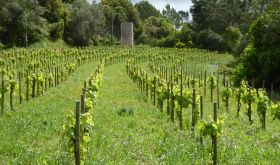
Even Rafael del Rey, the general director of the official Observatorio Español del Mercado del Vino, described it as 'most surprising' that for the first time ever, Spain has produced more wine than any other country in the world, more even than the two wine giants France and Italy.
Most years Italy and France have jockeyed for position as the world's leading wine producer in terms of volume, but the 2013 growing season was pretty miserable for vignerons in both countries, particularly France, where bad weather when the vines flowered really hit the number of embryonic grape bunches formed. Yields are well down so that Italy and France produced an estimated 47 and 42 million hectolitres of wine respectively. (The Organisation Internationale de la Vigne et du Vin, OIV, will be publishing its final figures in May.)
Spain, on the other hand, so the official account goes, seems to have had just the right combination of sunshine and rain to have produced a record harvest of 50 million hl of wine, so much more than in the 1990s when average production was closer to 35 million. This increase is all the more extraordinary when you consider that the total area of vineyard in Spain shrank 20 per cent, from 1.2 to 0.95 million hectares in the 10 years to 2012. What is going on?
For decades Spain has been the country with the most land under vine but, with the rain in Spain being notoriously elusive, the vines have traditionally been planted as widely dispersed low bushes, desperately using every drop of water in the subsoil to ripen the few bunches they were able to sustain. So Spain, for as long as I have been writing about wine, has always been definitively in third place as a wine producer, making concentrated wines from generally low-yielding vines planted on more land than any other country.
But the European Union, in an attempt to drain the infamous European wine lake once and for all, drew up a plan in 2007 which included incentives to encourage farmers to pull out hundreds of thousands of hectares. The figure originally proposed by the Danish agricultural commissioner was a total of 400,000 ha but it was eventually whittled down by the wine-producing countries to a target of 175,000 ha.
The result was that between 2008 when the reforms began to be implemented and 2011, Italy's total vineyard shrank from 825,000 to 786,000 ha while France's total vignoble fell from 857,000 to 807,000 ha – reductions of five and six per cent respectively. So it was to be expected that, whatever the weather, France and Italy would be producing a little less wine than before.
But the big change in Spain has been that the dramatic reduction in vineyard surface area has been more than compensated for by the introduction of vineyard irrigation. This was essentially illegal until the late 1990s, since which time it took a bit of time for irrigation systems to be installed. But today an estimated 34 per cent of all Spanish vineyard land is irrigated, which must swell the grape volumes considerably.
Manchuela wine producer and Spanish wine writer with a healthy degree of scepticism, thanks perhaps to his day job as a journalist on El Mundo, Victor de la Serna observes, 'it's mostly in the southern, drier half of Spain – basically Castilla-La Mancha and Extremadura – that vineyard yields have increased spectacularly, leading to record crops. The increase in yields has not affected quality in a measurable way when drip irrigation is used simply to offset the worst effects of drought-provoked stress on the grape-ripening process, and yields have remained in a, say, 25-50 hl/ha range. But water, potassium nitrate and sundry other chemical fertilisers are often being used in lethal combinations to propel yields to the 100-150 hl/ha level and beyond. This results in, basically, characterless plonk – not to mention that the grapes often are Tempranillo, which to begin with tend to produce flabby wines when grown in hot places. So mass-produced wine from the southern half of Spain tends to be even less interesting today than it was before the ballyhooed, EU-subsidised "vineyard restructuring" schemes.'
The vast plains of Castilla-La Mancha south of Madrid, Don Quixote country, have indeed seen the most marked changes in landscape. They still produce a good half of all Spanish wine, but from a total vineyard area that has fallen from 700,000 to 465,000 ha of vines since 2005. A 2012 EU audit of the €1.4 billion scheme to restructure Europe's vinescape was particularly critical of how it was applied to this vast region, noting that yields in restructured vineyards had risen 60 per cent on average – not the point at all.
This is not to decry Spanish wine en masse. Spain, particularly northern Spain, produces some of the finest wine value on the planet. Lesser known denominations such as Alicante, Arlanza, Calatayud, Campo de Borja, Cigales, Costers del Segre, Empordà, Méntrida, Montsant, Ribeira Sacra and Valdeorras are producing some stunning wines at extremely attractive prices. And quality in the classic regions of Penedès, Ribera del Duero and Rioja in particular is arguably at an all-time high.
But we are likely to be seeing even more of these wines than ever over the next few months and years because, try as they might, Spanish wine producers just cannot persuade young Spaniards to drink wine. Total national consumption of wine has been falling dramatically. As recently as 2006, Spain drank most of the wine it produced itself, but according to Rafael del Rey, 'in the past two years, Spain has been exporting more than double the amount of wine it consumes'.
It is notable that China's imports of Spanish wine, presumably much of it the most basic, have nearly tripled in the last three years so that Spain has overtaken Italy and Chile to be third biggest supplier to that massive market after France and Australia.
Nick Room has been buying Spanish wine for the UK supermarket Waitrose for 19 years and reports that Spanish wine exporters are more accommodating than they have ever been, willing to formulate blends precisely for the needs of individual buyers and markets. 'The Spanish recession also means that far more of the top wines are now available on international markets', he observes. Good news, surely, for wine lovers outside Spain.
SOME SPANISH DELIGHTS
This is a very mixed assortment of Spanish wines most recently tasted and appreciated. See also those of Priorat, A Catalan collection and Canary Islands, about which I have also written in recent weeks, and myriad sherry bargains. Principal UK prices and stockists are given. For international stockists see wine-searcher.com.
WHITES
Rafael Palacios, Bolo Godello 2012 Valdeorras £9.95 Wine Society, Noel Young
Valdesil, Montenovo Godello 2012 Valdeorras £11.99 Majestic
REDS
Manzanos, El Patito Feo Graciano/Garnacha 2012 Navarra £8.99 Majestic (£6.74 if two bottles are bought)
Telmo Rodrigez, Al Muvedre 2012 Alicante £8.99 Noel Young, £10.80 Michael Jobling
Ontañón Reserva 2004 Rioja £12.99 Rannoch Scott, Fintry Wines, All About Wine and others
Jiménez Landi, Sotorrondero 2011 Méntrida £13.29 + tax winedirect.co.uk
La Rioja Alta, Viña Ardanza 2004 Rioja about £20 Four Walls, Wine Society, Berry Bros
PSI 2010 Ribera del Duero £24.95 Corney & Barrow, £26.67 Roberson
Arinzano 2004 Pago de Arinzano £48 Berry Bros
The photo above of Alcázar de San Juan is taken from the La Mancha Wines website.