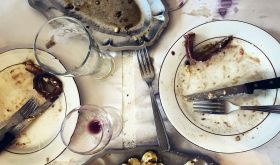
At this time of year even the most professionally designed and well-organised restaurant kitchen begins to take on the cluttered air that characterises any domestic kitchen over the festive season. Quite simply, there are nowhere near enough flat surfaces to cope with the joints of meat, the number of plates or the bowls of food or sauces that are being prepared. Life for even the most meticulous chef now gets messy.
The root cause of this is of course the numbers round the table. A dining room table that accommodates no more than six or eight during the rest of the year may be extended by the addition of a sideboard or a trestle table to squeeze in 16 plus, and the same challenge faces every professional chef over the coming three weeks. The kitchen, however, has not expanded.
Although there are still certain restaurants that will not accept bookings for more than six because they feel that to do so would impinge on the quality of the food or the service they offer, many will simply look to set the limit at the number of chairs they have at their disposal well aware that this is not only a commercial opportunity not to be missed but also a time of year when it is difficult to turn away bookings from their current customers and those whom they hope will return regularly in the future.
One reason why professional chefs manage to serve complex menus to a significant volume of customers is that every kitchen possesses a specific area, often demarcated by a piece of equipment for which this role was never intended, that allows them to despatch every order as it is cooked. It could therefore be considered the most important area in the kitchen although it is invariably one of the least expensive – certainly by comparison with today’s costly Bonnet or Rorgue ovens. It is called the pass.
The pass fulfils two major functions: to act as the place where the finished dishes are passed over from the chefs to the waiting staff and to act as the final quality control area before any food leaves the kitchen. Whichever chef is in charge of that particular session will always stand right by the pass with not just a beady eye on what is being handed to him but also a cloth and a small amount of water mixed with vinegar with which to wipe the rim of any less than perfect plate.
The pass can take many physical forms. In small brasseries it may just be a hatch with a ledge on which the chefs place the finished dishes for the waiters to whisk away. It can, once the restaurant gets busy, be quickly improvised – in one kitchen the chefs used to put a large board across a sink to provide an adequate surface for all the chefs to work at. In the majority of kitchens, however, the building block for the pass is usually a heated plate cupboard underneath a stainless steel surface, which ensures that the chefs have ready access to hot plates on which to complete their dishes before passing them over.
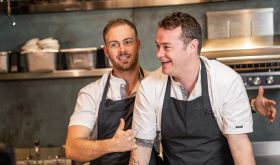
To appreciate quite how vital the pass is in any busy restaurant I spent one hot lunchtime standing just behind Herbert Berger, the chef/director of 1 Lombard Street opposite the Bank of England, and his Head Chef Tim Richardson as they despatched the 700 plates of food to serve the 160 customers sitting in their brasserie and the 43 customers in their Michelin starred restaurant upstairs. This was just a warm up to the pre-Christmas period, Berger explained, when the brasserie would seat 250 as they managed to turn tables into the late afternoon and their 30 seater private room would be full as well.
I chose Berger because, as a classically trained chef of considerable experience (he started in the kitchens when he was 15 in 1968), he has garnered a justifiable reputation for encouraging and teaching young chefs, vital in an industry in which, he told me, there are currently 40,000 vacancies. But there was one ulterior motive. The pass had been described to me as ‘the Vienna of the restaurant world’ where the East of the kitchen meets the West of the waiting staff and so can be the scene of some confrontation. Aggression may be useful for the television cameras but is not representative of best practice – when one young chef began to swear he was promptly silenced by a harsh glare.
This restaurant’s pass is about twelve metres wide and a metre and half deep and consists of two runs of stainless steel tops which abut each other separated by three levels of gantry shelving. The far side belongs to the 15 chefs who prepare all the hot first courses and main courses on a run of stoves along the far wall. Under their work surface is a run of fridges which hold the prepared ingredients interspersed with hot cupboards for their plates. Hanging down from the lowest level of shelving are the crucial heat lamps which continue to keep the food hot and which generate not only a large amount of the kitchen’s heat but also consume a growing proportion of the kitchen’s energy costs.
While the far side of the pass is all hustle and bustle once the orders start reeling out of the five electronic printers round the kitchen, the near side is occupied somewhat more tranquilly by Berger, Richardson and Arnaud Viaté, the pastry chef, who works here until his own section gets busy. They take the two copies of each order from the printers, hand one to the chefs so that they know what to cook and keep the others on a rail in sequence so that they can monitor any table’s progress. It is thus possible to get an impression of how Berger has constructed this pass to enable his kitchen to function ergonomically.
It comprises five shelves. The first, at shin height, is for the trays on which the runners take the food up the two flights of 10 stairs each to the restaurant and to which they must return every empty tray. The second, and by far the hottest under the heat lamps, is where every single dish is passed over to be collated with the rest of any order, inspected, wiped and then placed on a tray so that after a shout of ‘Service’ it can be run upstairs by one of five enthusiastic and obviously strong runners. The three levels of open shelving above the pass contain plates, pastry cases and scores of small jugs and copper pans for the sauces.
The pass also harbours one secret ingredient. Next to the dish of water and vinegar for wiping the plates is a similar sized dish containing clarified butter, which also stays warm under the heat lamps. In it is a small pastry brush with which Berger gently wipes the top of every main course whether it is the more expensive sea bass with fennel, the blackleg chicken with morels or the sausages served with mash. “It makes the main ingredient look even more appetising and the first mouthful even more delicious,” Berger explained with a smile. And with that another table’s food was despatched from the pass to the restaurant.
1 Lombard Street, Lombard Street, London EC3, 020-7929 6611, www.1lombardstreet.com